Why the Setting Question Actually Matters
American adults are, on average, not meeting the CDC's physical activity guidelines — roughly 150 minutes of moderate-intensity aerobic activity per week. For many people, the biggest obstacle isn't motivation or knowledge; it's friction. The choice between exercising at home and going to a gym shapes how much friction stands between you and a workout.
This isn't a trivial decision. Commute time, membership cost, equipment availability, and the social dynamics of a shared space all influence whether a routine sticks. If you're weighing your options — or reconsidering one that isn't working — understanding each environment's genuine strengths and limitations is a practical starting point. Consistency tends to matter more than intensity in the long run, so the setting that keeps you moving most reliably has real value.
The Case for Working Out at Home
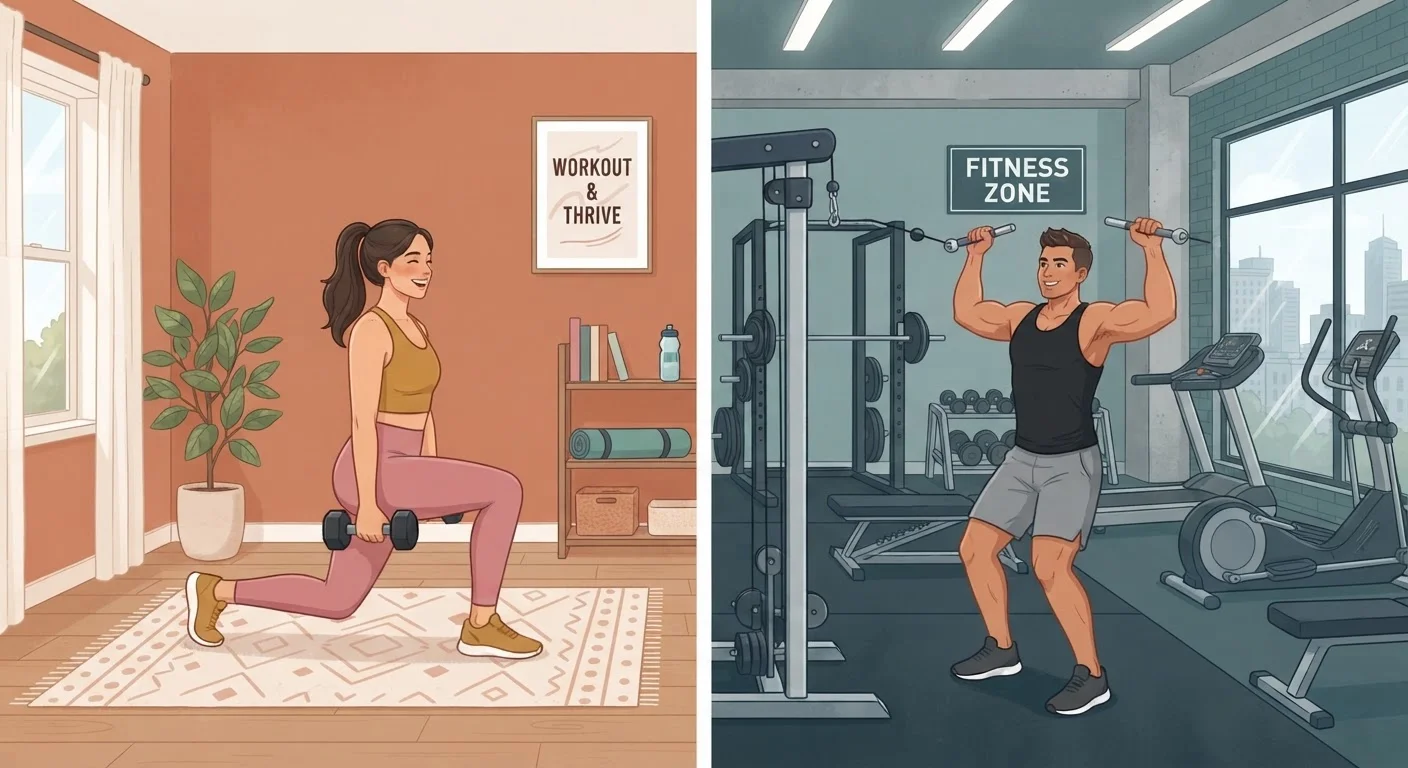
Home training has never been more viable. Streaming workout programs, free video platforms, and a wide range of affordable equipment have made it possible to build genuine fitness without leaving the house.
No commute — workout whenever it fits your day
Eliminating travel time removes one of the most common reasons people skip sessions. Being able to exercise in a ten-minute window at home is more useful than a theoretical hour-long gym session that doesn't happen.
Lower ongoing cost for most setups
A modest home kit — resistance bands, a mat, a few dumbbells — requires a one-time investment with no recurring fees. Over a year or more, this typically costs less than a gym membership.
Complete privacy and personal comfort
Working out without an audience reduces self-consciousness that can deter beginners or those returning after a long break. You control the music, temperature, and pace without compromise.
Bodyweight training is scientifically effective
Research supports bodyweight exercises — push-ups, squats, lunges, planks — as effective tools for building muscular strength and endurance, particularly at beginner and intermediate levels.
Flexible for all fitness levels
Home workouts scale readily from gentle mobility work to high-intensity circuits. Streaming platforms and free video resources offer guided options for virtually every goal and fitness level.
The most cited advantage is convenience. With no commute, no parking, and no wait for equipment, the barrier to starting is dramatically lower. For people with demanding schedules, this alone can be decisive. As explored in our guide to building a weekly exercise routine around a busy schedule, reducing logistical steps is one of the most effective ways to protect workout consistency.
Bodyweight training in particular is well-supported by research. Science shows that bodyweight movements can effectively build strength and muscle, especially for beginners and intermediate exercisers, without any equipment at all.
The Case for Going to a Gym
Gyms offer something hard to replicate at home: a dedicated environment built entirely around exercise. That design matters more than it might seem.
Limited equipment restricts advanced training goals
Progressive strength training at advanced levels requires heavier loads and specialized equipment — barbells, cable machines, squat racks — that are impractical and expensive to replicate at home.
Harder to separate work and rest mentally
For some people, the home environment carries mental associations with rest, family, or work that make it genuinely difficult to shift into a focused exercise mindset.
No access to professional instruction on-site
Learning proper form for complex movements — deadlifts, Olympic lifts, certain machine exercises — is significantly safer with in-person coaching, which isn't available in a home setting.
Social motivation is absent
Many people train harder and more consistently when exercising alongside others. The social environment of a gym is difficult to replicate at home, even with virtual classes.
The range of equipment at a commercial gym — cable machines, barbells, squat racks, rowing machines, pools — supports training variety and progressive overload in ways that are difficult and expensive to match at home. Progressive overload, the gradual increase in training demand over time, is a foundational principle for building strength and cardiovascular fitness. For those pursuing specific performance goals, gym access can be genuinely difficult to substitute.
Access to qualified professionals is another meaningful benefit. Personal trainers, group fitness instructors, and sometimes physical therapists operate in or alongside gym facilities, providing guidance that reduces injury risk and improves technique — particularly valuable for beginners or those returning after injury.
~23%
U.S. adults meeting aerobic activity guidelines
According to CDC National Health Interview Survey data, fewer than one in four American adults meet both aerobic and muscle-strengthening activity guidelines.
150 min/week
CDC recommended moderate-intensity aerobic activity
The CDC and U.S. Department of Health and Human Services recommend at least 150 minutes of moderate-intensity aerobic activity per week for adults, achievable in either setting.
The social dimension also plays a role. Research on exercise behavior suggests that social support and group environments can positively influence adherence. For many people, being around others who are working out creates a motivating context that's hard to manufacture at home.
What the Evidence Doesn't Say
Exercise Science Measures Outcomes, Not Locations
Most peer-reviewed research on exercise compares training variables — volume, intensity, frequency, and type — rather than comparing gym versus home environments as categories. Studies on bodyweight versus weighted resistance training, for example, generally show that progressive challenge matters more than the specific tools used. This means that well-structured programs in either environment can produce meaningful fitness benefits. The absence of a gym doesn't mean the absence of results.
It's worth noting that most exercise science research measures outcomes — strength, cardiovascular fitness, body composition — not environments. A well-designed home program and a well-designed gym program using comparable intensity and volume tend to produce comparable results for the general population. The setting itself is rarely the variable that determines effectiveness.
What the research does consistently identify as a predictor of outcomes is adherence — whether a person actually follows through on their plan over weeks and months. This is why choosing an environment that fits your real life, rather than an idealized version of it, carries genuine health significance. If you're starting from scratch, our guide to building a weekly exercise routine from scratch offers a practical framework for either setting.
Thinking Through Your Own Trade-Offs
Rather than searching for a universal answer, consider these practical questions:
- Budget: Gym memberships in the U.S. typically range from under $20 to over $100 per month. Home equipment varies from nothing (bodyweight) to thousands of dollars for a full setup. Neither is inherently the more economical choice without knowing your usage.
- Schedule: How much time can you realistically dedicate to travel? A 15-minute commute each way adds 30 minutes to every session — that matters if you're already time-pressed.
- Goals: Specific goals like powerlifting, competitive swimming, or advanced strength training often require gym infrastructure. General fitness, cardiovascular health, and functional strength are achievable in both settings.
- Motivation style: Some people work harder with others around; others find the privacy of home more conducive to consistent effort. Neither tendency is a character flaw — it's a factor to plan around.
A hybrid approach — maintaining a basic home setup for shorter or lower-intensity sessions while using a gym for longer or more equipment-dependent training — is a practical middle path that many people find sustainable.
This article is for general informational purposes only and does not constitute medical or professional fitness advice. Consult a qualified healthcare provider or certified fitness professional before beginning or significantly changing an exercise program, especially if you have existing health conditions or injuries.