
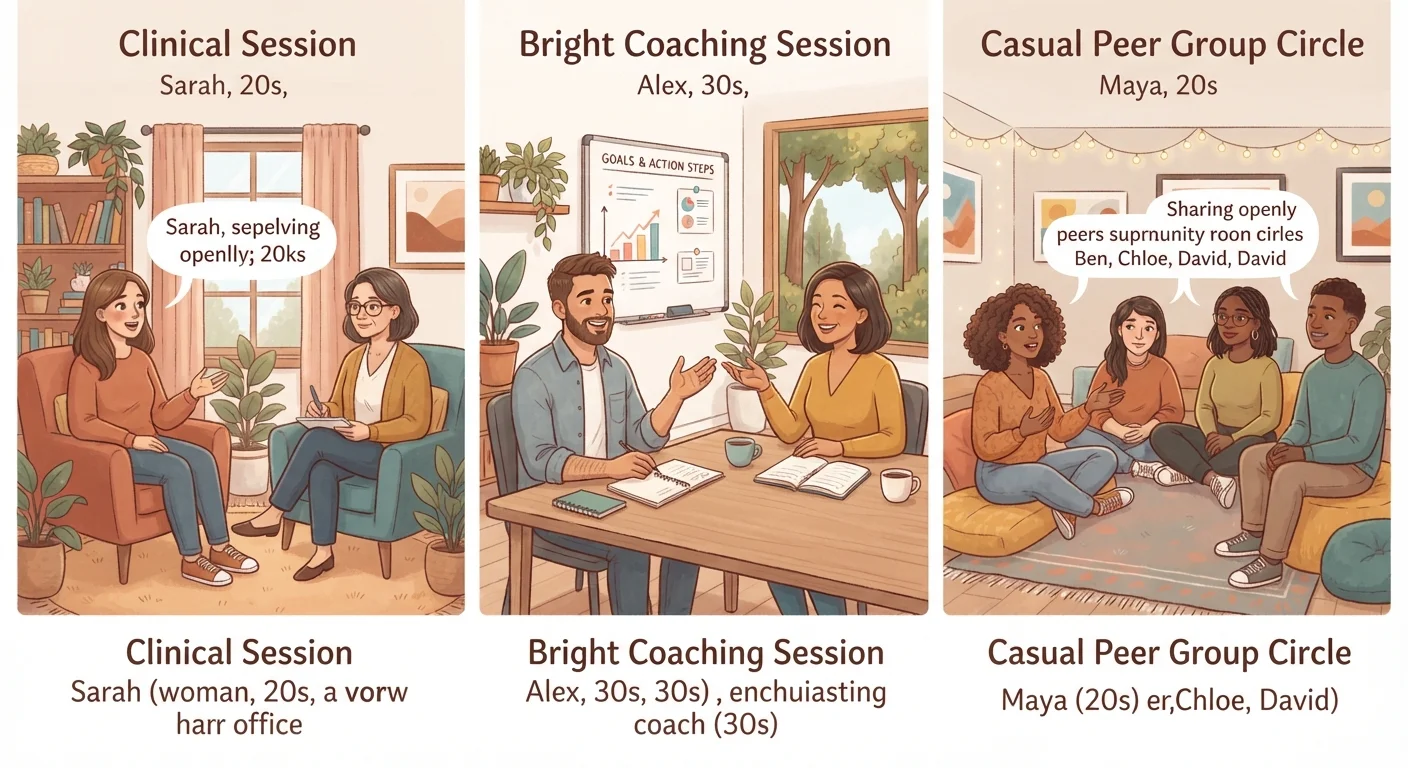
Why the Distinctions Matter
When you're navigating emotional difficulty or trying to grow personally, the landscape of available support can feel overwhelming. Words like therapy, counseling, coaching, and peer support are often used interchangeably in popular culture — but they represent meaningfully different services with different purposes, different providers, and different scopes of practice.
Getting familiar with common mental health terminology is a strong foundation before seeking help. Understanding what each support type actually offers helps you make a clearer, more confident choice — and ensures you get the right kind of help for your specific situation.
This article is for general informational purposes only and is not a substitute for professional medical or mental health advice. Always consult a qualified healthcare provider for personal guidance.
Therapy: Structured, Clinical, and Diagnosis-Informed
Therapy — sometimes called psychotherapy or counseling — is a regulated, clinical service provided by licensed professionals such as psychologists, licensed clinical social workers (LCSWs), licensed professional counselors (LPCs), or psychiatrists. These providers complete graduate-level training, supervised clinical hours, and must pass state licensing exams.
Therapy is designed to assess, diagnose, and treat mental health conditions including depression, anxiety disorders, post-traumatic stress, and more. Evidence-based approaches such as Cognitive Behavioral Therapy (CBT) and Dialectical Behavior Therapy (DBT) have been studied extensively and shown to reduce symptoms across a range of conditions, according to research published by institutions including the National Institute of Mental Health (NIMH).
Therapy also tends to explore the roots of current difficulties — past experiences, patterns of thinking, and emotional regulation. Sessions are typically confidential and governed by professional ethics codes. If you're unsure whether symptoms you're experiencing call for clinical support, this guide on when to seek professional help offers useful signals to watch for.
| Therapy | Life Coaching | Peer Support | |
|---|---|---|---|
| Provider credentials | Licensed clinical professional | Voluntary certification, varies widely | Lived experience; may hold peer specialist certification |
| Primary purpose | Treat mental health conditions | Achieve personal or professional goals | Shared connection and encouragement |
| Regulated by state boards | Yes | No | No (some programs have standards) |
| Appropriate for clinical symptoms | Yes | No | No (complement only) |
| Explores past experiences | Often central to the work | Rarely; focus is forward-looking | May arise naturally in group sharing |
| Typical setting | Private practice, clinic, telehealth | Private sessions, often virtual | Groups, community orgs, online forums |
Life Coaching: Goal-Focused and Forward-Looking
Life coaching is a non-clinical service focused on helping people identify and work toward personal, professional, or lifestyle goals. Coaches are not licensed mental health providers, and coaching is not regulated by state medical boards in the way therapy is. While many coaches pursue voluntary certifications — such as those offered through the International Coaching Federation (ICF) — training and credentials vary widely.
Coaching is best suited for individuals who are emotionally stable and looking for structured accountability around specific goals: a career transition, building confidence, improving relationships, or developing leadership skills. A good coach helps clarify where you want to go and supports you in getting there.
Ask About a Coach's Background
Because coaching is unregulated, it pays to ask prospective coaches about their training, certifications, and experience before beginning. Look for coaches who are transparent about the limits of their role and willing to refer you to a licensed therapist if clinical concerns arise. A well-trained coach will welcome these questions.
It's important to understand what coaching cannot do: it is not appropriate for treating mental illness, processing trauma, or managing psychiatric symptoms. Reputable coaches recognize these limits and refer clients to clinical providers when needed. For a more detailed breakdown of how these roles compare, see what therapy, counseling, and coaching each offer.
Peer Support: Connection Through Shared Experience
Peer support involves people with lived experience of a challenge — mental illness, addiction, grief, chronic illness — offering understanding and encouragement to others in similar situations. This can happen in structured group settings facilitated by a trained peer specialist, or through community organizations, nonprofits, and mutual aid networks.
Research, including studies cited by the Substance Abuse and Mental Health Services Administration (SAMHSA), suggests peer support can meaningfully reduce feelings of isolation, improve engagement with treatment, and enhance overall well-being. Peer supporters are not clinicians, but their firsthand understanding of what it feels like to struggle — and to recover — offers something clinical relationships often cannot: genuine solidarity.
Peer support is not a replacement for therapy when clinical care is needed, but it's a valuable complement. If someone you care about is struggling and you want to understand how to show up for them, this guide on supporting someone emotionally offers practical, evidence-informed direction.
70%+
Adults who benefit from peer support programs
SAMHSA research indicates the majority of participants in structured peer support programs report improved coping and reduced isolation.
1 in 5
U.S. adults experiencing mental illness annually
According to the National Institute of Mental Health, approximately one in five American adults lives with a mental illness in any given year.
Choosing the Right Fit — or Combining Approaches
These three forms of support are not in competition. Many people find that their needs evolve over time — someone might start with therapy to address acute symptoms, add peer support for ongoing community connection, and later work with a coach once they're in a stable and growth-focused place.
The key questions to ask yourself:
- Am I experiencing symptoms that affect daily functioning (sleep, mood, relationships, work)? Therapy is the appropriate first step.
- Am I emotionally stable but feeling stuck or unclear about my direction? Coaching may help.
- Do I need to feel less alone, or connect with others who truly understand my experience? Peer support may be what's missing.
Practices like mindfulness can also support your mental wellness alongside any of these approaches — explore how mindfulness and meditation differ and when each helps to build complementary habits.
If you're unsure where to start, speaking with your primary care physician is a reasonable first step — they can refer you to appropriate licensed professionals and help you navigate your options.
This content is for general educational purposes only and does not constitute medical or mental health advice. Please consult a licensed mental health professional for guidance specific to your circumstances.