
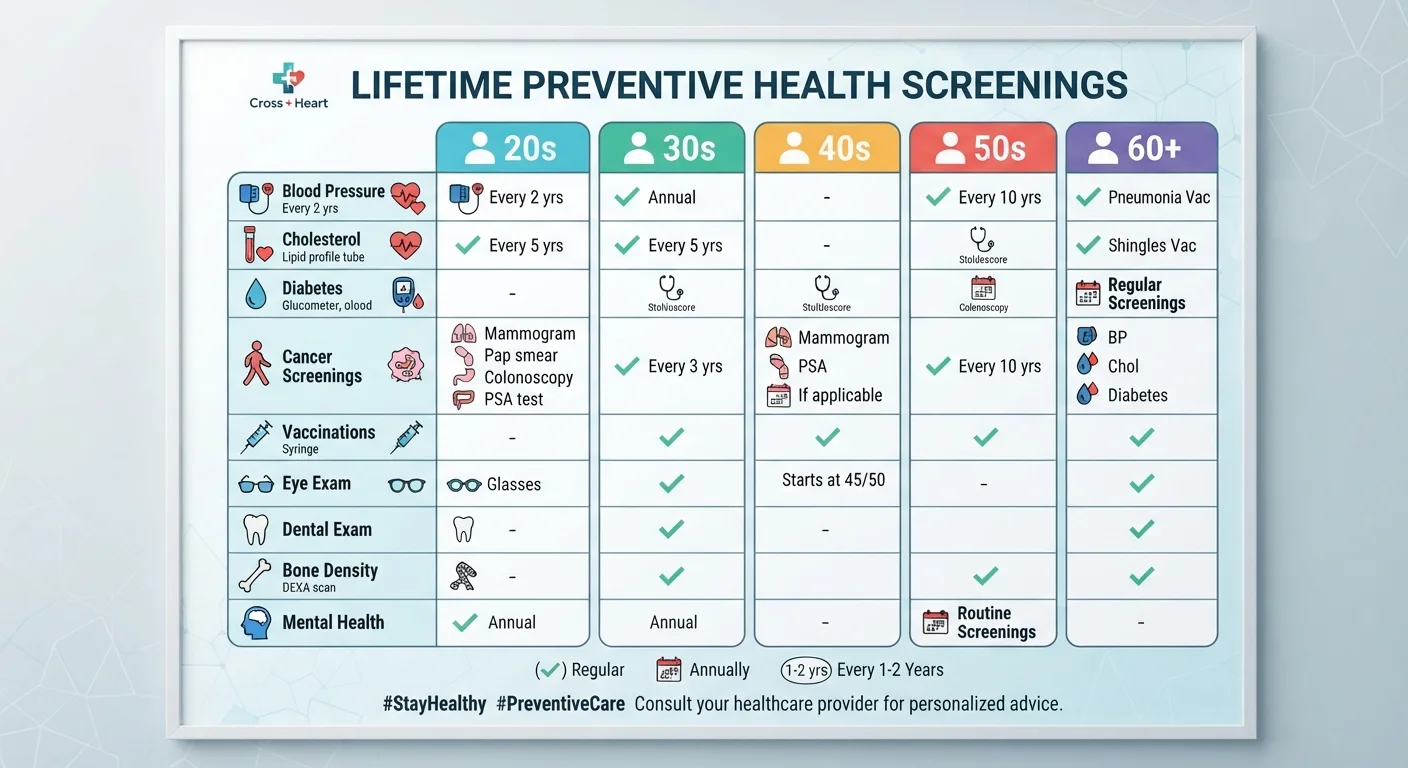
Why Preventive Screenings Matter
Preventive health screenings are one of the most evidence-backed tools in medicine. By detecting conditions early — often before symptoms appear — they can dramatically improve outcomes for diseases ranging from high blood pressure to certain cancers. The U.S. Preventive Services Task Force (USPSTF), the CDC, and other national health bodies regularly evaluate evidence and issue guidance on which screenings are recommended, at what intervals, and for whom.
This article is a general reference for standard preventive screenings organized by age group and biological sex. It is not a substitute for personalized medical advice. Your healthcare provider is best positioned to tailor recommendations to your individual health history, risk factors, and circumstances. See our annual preventive care checklist for a broader year-round framework to discuss with your provider.
| Governing body for U.S. screening guidance | U.S. Preventive Services Task Force (USPSTF) |
| Colorectal cancer screening start age | Age 45 (average risk) (USPSTF, updated 2021) |
| HIV screening recommendation | At least once for all adults ages 15–65 (USPSTF) |
| Cervical cancer screening frequency | Every 3 years (Pap alone) or 5 years (Pap + HPV co-test) (USPSTF) |
| Lung cancer screening eligibility | Adults 50–80 with 20 pack-year smoking history (USPSTF) |
| Osteoporosis screening start age (women) | Age 65 (USPSTF) |
Screenings for Adults Ages 18–39
Many adults in their 20s and 30s assume they are too young for serious health concerns. However, several conditions — including high blood pressure, high cholesterol, type 2 diabetes, and sexually transmitted infections — can develop silently in young adulthood.
- Blood pressure: Screening is recommended at least every 3–5 years for adults with normal readings; annually for those at higher risk.
- Cholesterol (lipid panel): Beginning at age 20, providers may screen based on cardiovascular risk factors. Frequency varies by individual risk profile.
- Blood glucose / Type 2 diabetes: USPSTF recommends screening for adults ages 35–70 who have overweight or obesity. Those with known risk factors may be screened earlier.
- STI screening: Annual chlamydia and gonorrhea screening is recommended for sexually active women under 25, and for older women at increased risk. HIV screening is recommended at least once for all adults 15–65, with more frequent screening for those at higher risk.
- Cervical cancer (Pap smear): Recommended every 3 years for people with a cervix beginning at age 21, or every 5 years when combined with HPV testing starting at age 30.
- Depression: Screening is recommended for all adults in primary care settings.
- Body mass index (BMI) and obesity counseling: Recommended as part of routine primary care visits.
Note: BMI is one of several clinical tools and has recognized limitations; your provider considers multiple factors when assessing weight-related health risk.
Screenings for Adults Ages 40–64
Risk for cardiovascular disease, certain cancers, and metabolic conditions increases through midlife, making this decade a key window for preventive action. The following represent general USPSTF and CDC guidance; individual recommendations will vary.
- Blood pressure: Annual screening is recommended for most adults in this age range.
- Cholesterol: Regular screening is advised, especially for those with cardiovascular risk factors such as smoking, family history, or diabetes.
- Colorectal cancer: Screening is recommended starting at age 45 for adults at average risk. Options include colonoscopy (every 10 years), stool-based tests (annually or every 1–3 years depending on the test), and other methods — your provider can help you choose the right approach.
- Breast cancer: Mammography recommendations vary by organization. USPSTF recommends biennial mammograms starting at age 40; individuals should discuss the benefits and risks with their provider.
- Lung cancer: Annual low-dose CT screening is recommended for adults ages 50–80 who have a significant smoking history (defined as 20 pack-years) and currently smoke or quit within the past 15 years.
- Diabetes: Screening is recommended for overweight adults starting at age 35, and may be appropriate earlier based on risk.
- Abdominal aortic aneurysm (AAA): One-time ultrasound screening is recommended for men ages 65–75 who have ever smoked. This screening begins to be relevant in the late portion of this age window.
USPSTF
The U.S. Preventive Services Task Force — an independent panel of national experts that reviews evidence and issues recommendations on preventive services, including screenings and counseling, for adults and children.
Colonoscopy
A procedure in which a physician uses a flexible, camera-equipped tube to examine the entire colon and rectum for polyps or signs of cancer. It is considered the gold standard colorectal cancer screening method.
DEXA Scan
Dual-energy X-ray absorptiometry — a low-radiation imaging test used to measure bone mineral density and assess osteoporosis risk, most commonly recommended for women 65 and older.
Pack-year
A unit used to measure cumulative tobacco exposure: one pack-year equals smoking one pack of cigarettes per day for one year. It is used to determine lung cancer screening eligibility.
Lipid panel
A blood test that measures levels of total cholesterol, LDL (low-density lipoprotein), HDL (high-density lipoprotein), and triglycerides, used to assess cardiovascular disease risk.
Abdominal aortic aneurysm (AAA)
An abnormal bulging in the wall of the aorta — the main blood vessel running through the abdomen. It often has no symptoms but can be life-threatening if it ruptures; one-time ultrasound screening is recommended for eligible older men.
For a deeper look at screenings men in this group most often postpone, see our guide on preventive care for men.
Screenings for Adults Ages 65 and Older
Older adults face elevated risk across multiple conditions. Screenings remain important even in later life, though individual benefit-risk calculations may shift. Always discuss with a healthcare provider what is appropriate for your age and overall health.
- Blood pressure: Annual monitoring remains essential for most older adults.
- Colorectal cancer: Screening continues through age 75 for most adults; the decision to screen between 76–85 is individualized.
- Osteoporosis: Bone density screening (DEXA scan) is recommended for women age 65 and older, and for younger postmenopausal women with elevated fracture risk.
- Vision and hearing: Routine checks are important, though not covered by a single universal guideline; providers typically assess these at regular visits.
- Cognitive screening: USPSTF notes insufficient evidence for universal dementia screening in asymptomatic adults, but providers may assess cognition as part of comprehensive wellness visits.
- Breast cancer: Mammography decisions for women over 74 should be made on an individual basis with a provider.
- Cervical cancer: Most women over 65 who have had adequate prior screening may stop cervical cancer screening; confirm this with your provider.
- Fall risk assessment: CDC and USPSTF recommend exercise interventions for community-dwelling adults 65+ at increased fall risk.
45%
Adults who are up to date on colorectal cancer screening
According to CDC data, nearly half of eligible adults have not completed recommended colorectal cancer screening.
1 in 3
Adults with undiagnosed high blood pressure
The CDC estimates that approximately one-third of adults with hypertension are unaware of their condition.
Age 65+
Age group with highest fall-related injury risk
The CDC reports that falls are the leading cause of injury and injury-related death among adults 65 and older.
Supporting overall health through physical activity also reduces risk across many of these conditions. Our summary of public health physical activity recommendations outlines evidence-based targets for older adults.
This article provides general health information for educational purposes only and does not constitute medical advice. Always consult a qualified healthcare professional for guidance specific to your health history and needs.