What These Two Terms Actually Mean
When you file a property insurance claim, the dollar amount your insurer pays hinges on one foundational question: how does the policy value what was lost or damaged? Two methods dominate home and auto policies in the United States — Actual Cash Value (ACV) and Replacement Cost Value (RCV) — and they can produce dramatically different payouts for the exact same loss.
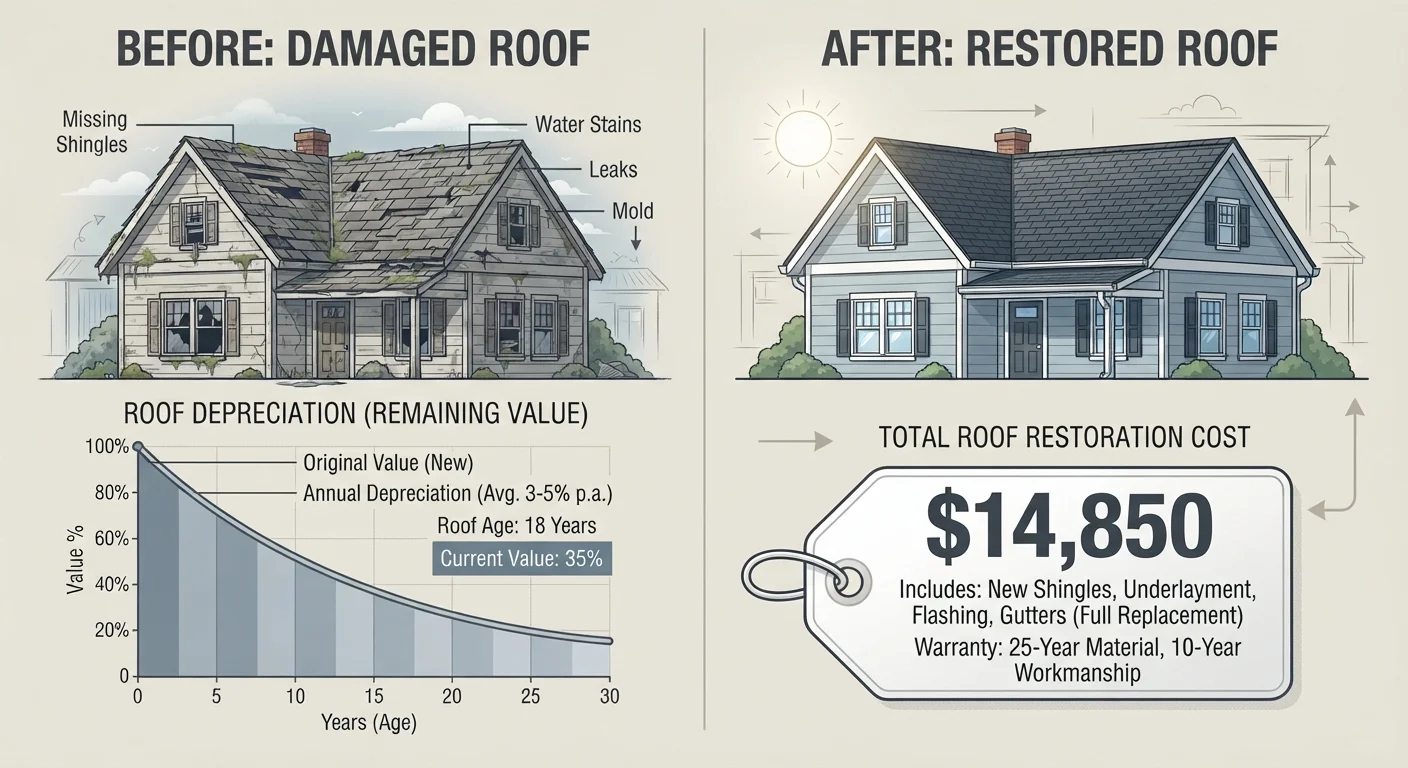
Actual Cash Value is calculated by taking the replacement cost of a damaged item and subtracting depreciation — the reduction in value caused by age, wear, and obsolescence. If a covered storm destroys your 10-year-old roof, the insurer estimates what a new equivalent roof costs today, then applies a depreciation factor reflecting the roof's remaining useful life. The result is typically far less than what you will spend to actually fix the damage.
Replacement Cost Value skips the depreciation step. The insurer pays what it costs to repair or replace the property with a comparable new item at today's prices, subject to your policy's limits and your deductible. You still need to understand your deductible's role in the payout, but the depreciation gap is eliminated.
| Criterion | Actual Cash Value (ACV) | Replacement Cost Value (RCV) |
|---|---|---|
| Depreciation applied? | Yes — subtracted from payout | No — paid at today's replacement price |
| Typical premium cost | Lower | Higher |
| Out-of-pocket gap after claim | Often significant | Minimal (beyond deductible) |
| Common in auto policies? | Yes — standard for collision/comprehensive | Rarely available in personal auto |
| Common in homeowners policies? | Yes — often the default | Available as an upgrade |
| Best outcome scenario | Property is newer with low depreciation | Property is older with high depreciation |
How the Gap Plays Out in Real Claims
The difference between ACV and RCV is easiest to see with a concrete example. Suppose hail damages your roof and a contractor quotes $12,000 to replace it. If the roof is 12 years old with an estimated 20-year lifespan, an insurer using ACV might calculate that 60% of its useful life has passed and pay only $4,800 — leaving you responsible for $7,200 before your deductible even enters the picture.
Under an RCV policy, the same loss would produce a payout much closer to the full $12,000 (minus your deductible), because depreciation is not subtracted from the settlement.
~40%
Potential ACV shortfall on an aging roof claim
A roof at 60% of its useful life may receive only 40% of replacement cost under an ACV policy, based on standard straight-line depreciation methods used by many insurers.
2–15%
Typical premium increase for RCV over ACV
Insurance industry guidance generally suggests replacement cost endorsements add a modest percentage to base premiums, though the exact amount varies widely by insurer, location, and property type.
The same dynamic applies to personal belongings inside your home. A television purchased five years ago carries significant depreciation under ACV; under RCV, your insurer would pay toward a comparable new model. This distinction is covered in depth in our guide to personal property coverage under a homeowners policy.
For auto insurance, ACV is the standard approach for comprehensive and collision claims. There is no RCV equivalent in most personal auto policies — your settlement is based on the vehicle's market value at the time of the loss. Understanding this ahead of time helps set realistic expectations when you file.
Reading Your Policy and Knowing What to Ask
Many policyholders assume they have replacement cost coverage when they actually have ACV — or vice versa. Your declarations page will typically indicate the valuation method, and your policy's definitions section will spell out how depreciation is calculated. If the language is unclear, ask your agent directly: "Does this policy pay ACV or replacement cost on my dwelling? On my personal property?"
Recoverable Depreciation: A Common Source of Confusion
Some RCV policies withhold the depreciation amount until repairs are completed and receipts are submitted — a step called "recovering" the depreciation. If you receive an initial check that looks lower than expected, confirm whether your policy includes recoverable depreciation before assuming the settlement is final. Failing to complete repairs and submit documentation can mean forfeiting that additional payment entirely.
Some homeowners policies use a hybrid approach: they initially pay ACV, then release additional funds — called a recoverable depreciation payment — once you complete repairs and submit documentation. This means your first check may look like an ACV settlement even if your policy is technically RCV. Check for this structure before assuming the initial payment is your final one.
If you ever need to act on a claim, the practices you follow from day one matter. Our article on filing a home insurance claim without undermining your payout walks through documentation habits that protect your settlement under either valuation method. You can also review how to file an insurance claim without making it harder on yourself for a broader walkthrough covering both auto and home situations.
This article is for general informational purposes only and does not constitute insurance, financial, or legal advice. Coverage terms, valuation methods, and claim outcomes vary by policy and insurer. Review your actual policy documents and consult a licensed insurance professional for guidance specific to your situation.