
Why In-Network and Out-of-Network Confusion Is So Costly
Few health insurance mistakes are as financially painful as assuming you're covered — and then discovering you weren't. Out-of-network bills can arrive weeks after a visit, sometimes totaling thousands of dollars. The frustrating part is that most of these surprises trace back to a handful of persistent misconceptions about how provider networks actually work.
This article breaks down the most common myths, replaces them with accurate explanations, and gives you practical ways to protect yourself before your next appointment. As always, this is general educational information — not personalized insurance or medical advice. Coverage details vary by plan, insurer, and state, so review your actual policy documents and consult a licensed insurance professional for guidance specific to your situation.
Myth
If I go to an in-network hospital, all my care will be covered at in-network rates.
Fact
Individual providers within an in-network facility — such as anesthesiologists or radiologists — may be out-of-network, even if the hospital itself is in-network.
This is one of the most common sources of surprise medical bills in the United States. A hospital contracts with your insurer, but the specialists who work inside that hospital often have separate contracts — or none at all. An anesthesiologist, on-call radiologist, or surgical assistant may be employed by an independent group practice that hasn't negotiated with your plan. The No Surprises Act, which took effect in 2022, provides some federal protections for certain situations like emergency care and non-emergency care at in-network facilities when you didn't have a meaningful choice of provider — but it doesn't cover every scenario. Always ask which individual providers will be involved in your care and confirm their network status before a scheduled procedure. See claim surprises that blindside policyholders for more on how this plays out.
Myth
My out-of-pocket maximum protects me no matter where I get care.
Fact
Most plans have a separate — or no — out-of-pocket maximum for out-of-network care, meaning out-of-network costs may never cap out.
The out-of-pocket maximum (the most you'll pay in a year before your insurer covers 100% of costs) typically applies only to in-network, covered services. Out-of-network expenses — especially the portion above what your insurer considers the "allowed amount" — may not count toward that limit at all. Some plans have a combined in-network and out-of-network maximum, but many do not. If you have an HMO or EPO, out-of-network care (outside emergencies) may simply not be covered at all. Always check whether your plan has separate accumulators for in-network and out-of-network costs. For a deeper explanation of how this ceiling works, visit our article on why your out-of-pocket maximum matters more than your premium.
Myth
In an emergency, I can never be billed at out-of-network rates.
Fact
Federal law limits balance billing for emergency care in many situations, but cost-sharing (copays, coinsurance, deductibles) can still apply at out-of-network levels.
The No Surprises Act requires that emergency services at out-of-network facilities be billed at in-network cost-sharing rates — meaning the provider can't send you a bill for the difference between their charge and the insurer's payment (called balance billing) in those specific circumstances. However, you can still owe cost-sharing amounts based on your plan's terms, and the rules apply specifically to emergency services as defined under federal law. Non-emergency follow-up care at that same facility may not carry the same protections. State laws add another layer: some states have broader balance billing protections, others have fewer. Your actual exposure depends on your plan type, your state, and the specific nature of your visit.
Myth
If a provider shows up as in-network on my insurer's website, they definitely are.
Fact
Provider directories are frequently outdated, and a listing online does not guarantee in-network status on the date of your visit.
Insurers are required to maintain accurate provider directories, but in practice these lists can be months behind reality. Providers leave networks, retire, or change group affiliations regularly, and directory updates don't always keep pace. Relying solely on an online directory lookup is one of the leading causes of unexpected out-of-network bills. The safest approach is a two-step confirmation: call the provider's office directly and ask if they accept your specific plan, then call your insurer to verify that provider's in-network status using the provider's NPI (National Provider Identifier) number. Do this for every provider involved in a scheduled visit — not just the primary physician.
Myth
Out-of-network costs count toward my deductible, just like in-network costs do.
Fact
Many plans maintain separate deductibles for in-network and out-of-network care, so paying out-of-network may not move your in-network deductible forward at all.
This misconception leads people to underestimate how much they'll owe in a given year. If your plan has a $1,500 in-network deductible and a $3,000 out-of-network deductible, an out-of-network visit may apply only to the out-of-network bucket. Once you meet the in-network deductible through in-network visits, your plan starts covering in-network care — but the out-of-network deductible remains separate and must be satisfied independently. Some plans use a unified deductible that accepts both, but you need to check your Summary of Benefits and Coverage (SBC) document to know for certain. For help decoding these cost terms, health insurance terms that sound similar but mean very different things offers a plain-language breakdown.
What You Can Do to Protect Yourself
Understanding these myths is only half the battle. A few habits can meaningfully reduce your risk of surprise bills.
- Verify network status directly. Before any non-emergency appointment, call the provider's office and your insurer to confirm in-network status. Online directories can lag behind real-world changes by months.
- Ask about every provider involved. For procedures, surgeries, or hospital stays, ask which anesthesiologists, radiologists, and assistants will participate — and whether they're all in-network.
- Request a cost estimate in writing. Many insurers are required to provide good-faith cost estimates. Use them as a starting point, not a guarantee.
- Know your plan type's rules. HMO, PPO, EPO, and HDHP plans handle out-of-network care differently. Understanding your plan type helps you anticipate what's allowed and what isn't.
EPO Plans Have No Out-of-Network Coverage
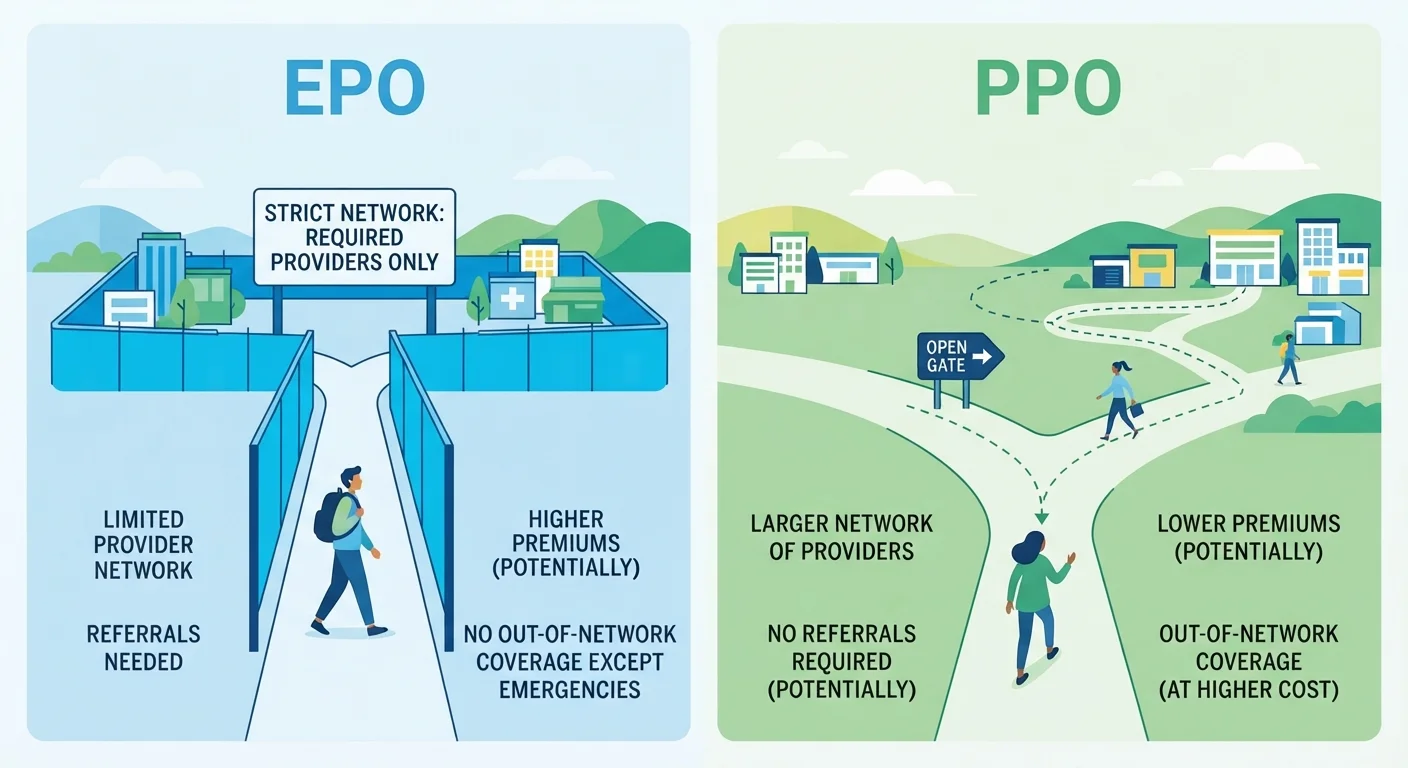
If your plan is an Exclusive Provider Organization (EPO), out-of-network care is generally not covered at all — except in true emergencies as defined by your plan. Unlike PPOs, EPOs don't reimburse any portion of out-of-network costs for routine or elective care. Before seeking care outside your network, confirm your plan type. If you're unsure, call your insurer and ask directly.
For a broader look at how cost-sharing works across your whole plan, see our article on deductibles, copays, and coinsurance. And if you want to understand the financial ceiling on your exposure, what the out-of-pocket maximum actually protects you from is worth a read before your next enrollment decision.
~1 in 5
Emergency visits involving an out-of-network charge
Research published in health policy journals has consistently found that roughly one in five emergency visits results in at least one out-of-network charge, often from a provider the patient had no role in selecting.
Millions
Americans receiving surprise medical bills annually
Before federal balance billing protections took effect in 2022, estimates from health policy researchers suggested millions of Americans received unexpected out-of-network bills each year, many for care at in-network facilities.
Misreading your coverage isn't limited to health insurance. The same pattern of skimming and assuming applies in other lines — see common misreading habits that cost homeowners most for a parallel look at how this plays out with home policies.
This article is for general informational and educational purposes only and does not constitute personalized insurance, financial, legal, or medical advice. Coverage terms, costs, and regulations vary by plan, insurer, and state. Always read your policy documents carefully and consult a licensed insurance agent or adviser for guidance specific to your situation.