
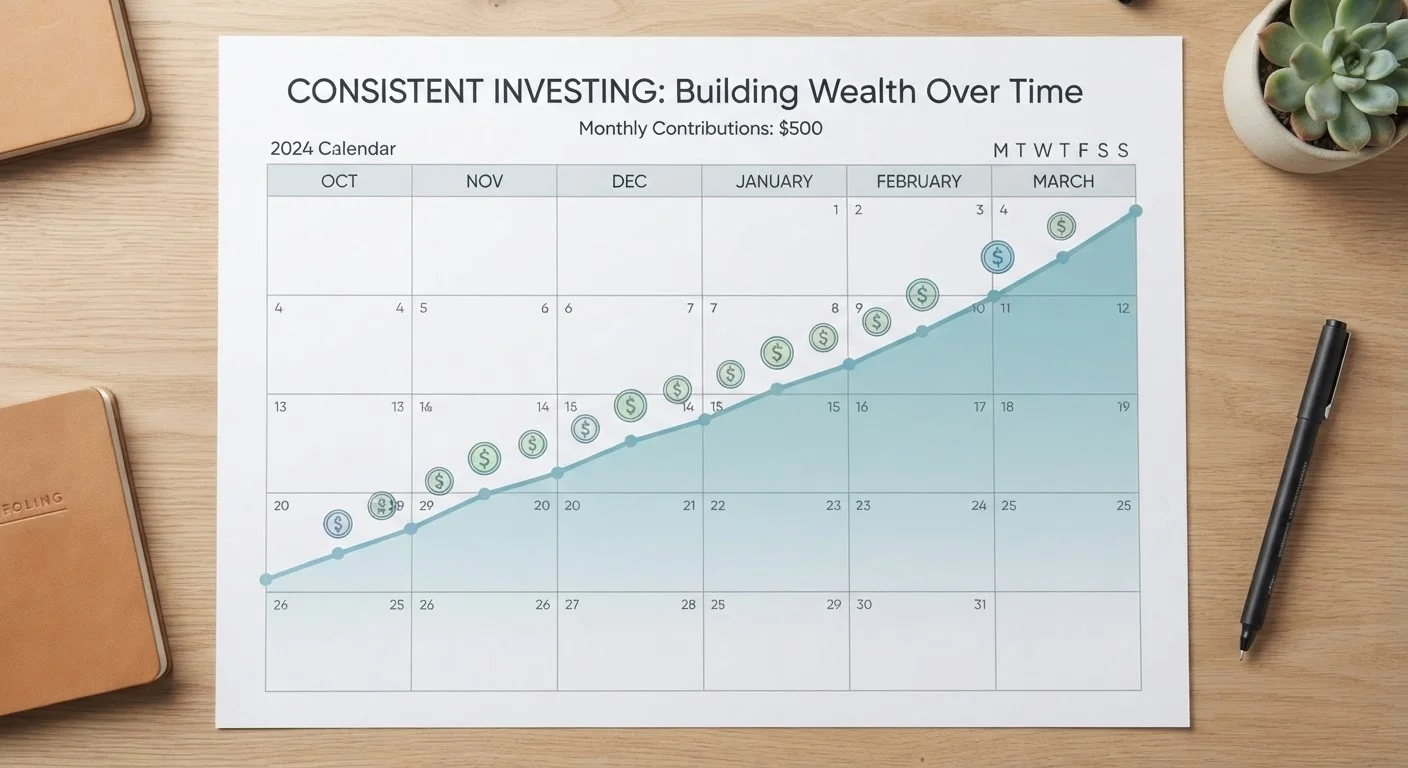
The Problem With Trying to Time the Market
Many new investors hesitate before committing money to the market, waiting for the "right" moment to buy. This instinct is understandable — who wouldn't want to buy at the lowest price possible? The problem is that even professional fund managers, with teams of analysts and sophisticated tools, consistently fail to predict market movements with accuracy.
Waiting for the perfect entry point often means sitting on the sidelines while markets move. And when prices do drop, fear can make investors hesitate even longer — selling in panic or delaying purchases. These behavioral patterns are among the most documented ways new investors undermine their own results. See why new investors derail their own progress for a closer look at these patterns.
Dollar-cost averaging sidesteps this trap entirely. By committing to invest a set amount on a fixed schedule, you remove the decision — and the anxiety — from the equation.
“The stock market is a device for transferring money from the impatient to the patient.”
— Warren Buffett, Chairman and CEO, Berkshire Hathaway
How Dollar-Cost Averaging Works in Practice
The mechanics are straightforward. Suppose you decide to invest $200 every month into a broad market index fund. Some months the share price is $50, so your $200 buys 4 shares. Other months the price drops to $40, and your $200 buys 5 shares. If prices then rise to $100, you buy just 2 shares.
Over time, this schedule means you accumulate more shares during market dips — automatically, without having to make an active decision. Your average cost per share may end up lower than if you had invested the full amount in one lump sum at a higher price.
~$7T
Assets in U.S. index funds and ETFs
According to Investment Company Institute data, index funds and ETFs — common DCA vehicles — held trillions in U.S. investor assets, reflecting broad adoption of systematic, low-cost investing approaches.
70%+
Active funds underperforming their benchmarks
S&P Dow Jones Indices' SPIVA reports have consistently found that the majority of actively managed U.S. funds underperform their benchmark indices over 10- and 15-year periods, underscoring the difficulty of market timing.
This approach works especially well when paired with automation. Setting up recurring transfers from your checking account to a brokerage or retirement account means contributions happen without ongoing effort. For guidance on setting up that kind of system, automating your savings without losing track of your budget covers the practical steps.
Automate to Stay Consistent
The biggest risk to a DCA strategy is skipping contributions during volatile or uncertain markets — exactly when consistency matters most. Setting up automatic transfers removes the temptation to pause. Treat your investment contribution like a recurring bill that gets paid first.
Limitations and Honest Trade-offs
DCA is not a perfect strategy, and it is important to understand where its advantages end. In a market that rises consistently over a long period, a single lump-sum investment made at the start will often outperform a series of smaller contributions — because money invested earlier has more time to compound.
DCA also does not protect against prolonged market downturns. If an asset declines steadily for years, regular contributions will still result in a loss. The strategy reduces the risk of making one poorly timed large purchase, but it does not eliminate market risk altogether.
There are also practical considerations: transaction fees, if applicable, can add up with frequent purchases. Many modern brokerage platforms have eliminated per-trade commissions, but it is worth confirming before setting up a frequent contribution schedule.
DCA works best as part of a broader financial approach — one that includes a solid budget foundation. If you are still working on the basics, budgeting habits that hold up over time can help you build the financial stability that makes consistent investing possible.
DCA and Tax-Advantaged Accounts
Dollar-cost averaging works particularly well inside tax-advantaged accounts such as 401(k)s and IRAs, where contributions have additional incentives and gains grow tax-deferred or tax-free. Contribution limits and eligibility rules apply to these accounts. A financial adviser or tax professional can help you determine which account types suit your situation.
This article is for informational and educational purposes only and does not constitute personalized financial or investment advice. Consult a qualified financial adviser before making investment decisions based on your individual circumstances.