
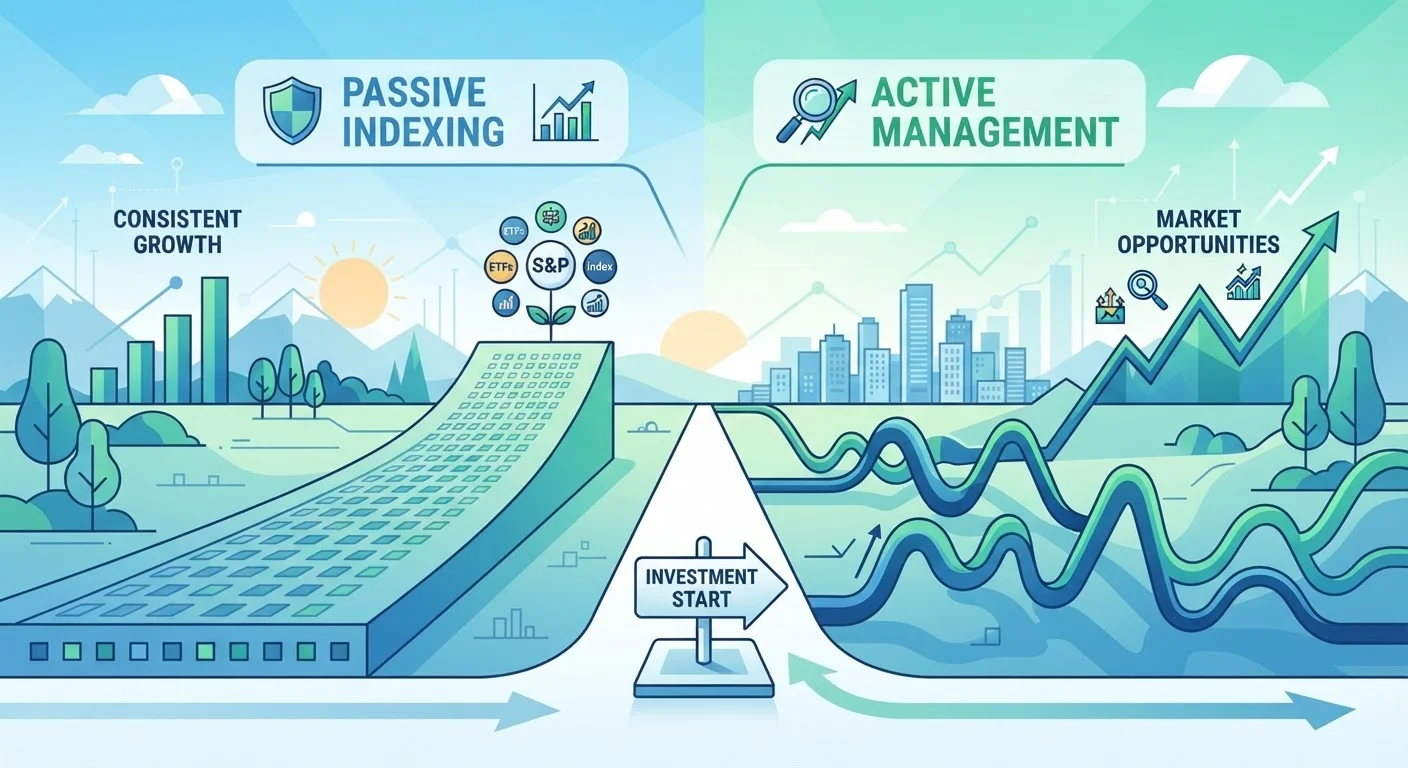
How Each Fund Type Works
An index fund is a pooled investment vehicle — typically a mutual fund or exchange-traded fund (ETF) — designed to replicate the performance of a specific market index, such as the S&P 500 or the Bloomberg U.S. Aggregate Bond Index. Because the fund simply mirrors an index's composition, there is no need for a team of analysts making buy-and-sell decisions. The portfolio changes only when the index itself changes.
An actively managed fund, by contrast, employs portfolio managers and research teams who make deliberate decisions about which securities to buy, hold, or sell. Their goal is to outperform a stated benchmark through research, timing, and judgment. This hands-on approach requires significantly more resources — and those costs are passed on to investors.
Understanding these basics is a useful complement to knowing the core asset classes that make up any portfolio, since both fund types can hold stocks, bonds, or a mix of both.
| Criterion | Index Funds | Actively Managed Funds |
|---|---|---|
| Management style | Passive — mirrors an index | Active — manager makes decisions |
| Typical expense ratio | 0.03%–0.20% per year | 0.50%–1.50%+ per year |
| Goal | Match benchmark returns | Beat benchmark returns |
| Trading frequency | Low — changes with index | High — at manager's discretion |
| Tax efficiency | Generally higher | Generally lower |
| Long-term track record vs. benchmark | Closely tracks index | Majority underperform over 10–15 years |
| Transparency | High — holdings mirror index | Varies — disclosed periodically |
The Cost Gap — and Why It Matters
One of the starkest differences between these fund types is cost, expressed as an expense ratio — the annual percentage of your investment deducted to cover fund operating expenses.
~0.05%
Average index fund expense ratio
Morningstar's annual fee study has documented average passive fund expense ratios near or below 0.05% for broad U.S. equity index funds.
~0.66%
Average active fund expense ratio
Morningstar's research indicates the asset-weighted average expense ratio for actively managed U.S. funds has hovered around 0.66%, though it varies widely by category.
~85%
Active large-cap funds underperforming over 15 years
S&P Dow Jones Indices' SPIVA U.S. Scorecard has consistently shown roughly 80–90% of active large-cap U.S. equity funds underperforming the S&P 500 over 15-year periods.
This gap is not trivial. Over a 30-year investment horizon, even a one-percentage-point difference in annual fees can erode tens of thousands of dollars in potential returns due to the compounding effect. Lower costs do not guarantee better outcomes, but they do mean a smaller portion of your gains is consumed before you see them.
Actively managed funds may also generate more taxable events through frequent trading, which can further reduce after-tax returns for investors holding funds in taxable accounts. Index funds tend to trade less, resulting in lower capital gains distributions.
What the Evidence Shows About Performance
The central promise of active management is the ability to beat the market. The evidence on whether this promise is consistently delivered is mixed, and largely sobering for active funds.
The S&P Indices Versus Active (SPIVA) scorecards — published by S&P Dow Jones Indices and widely cited in the investment industry — have repeatedly found that the majority of actively managed U.S. equity funds underperform their benchmark index over 10- and 15-year periods. Survivorship bias, where poorly performing funds are closed or merged before full data is counted, means the gap may appear even smaller than it actually is.
That said, some active managers do outperform over meaningful periods, particularly in less-efficient market segments. The challenge for investors is identifying those managers in advance — and past outperformance is not a reliable predictor of future results.
If you have encountered arguments for or against active investing, our piece on investing myths that keep people on the sidelines addresses several of the most common misconceptions.
A Note on Fund Labels
Not all funds marketed as 'passive' have identical costs or index-tracking methods, and 'active' strategies range from nearly index-like to highly concentrated. Always review a fund's prospectus — a legally required disclosure document — to understand its strategy, fees, risks, and holdings before investing. Fee and performance data can also be found through independent sources such as Morningstar or your brokerage's fund screener.
Choosing Between Them — or Using Both
The choice between index funds and actively managed funds is not necessarily binary. Many investors use a core-and-satellite approach: a low-cost index fund forms the bulk (core) of the portfolio, while smaller allocations to active funds target specific opportunities (satellites).
Key questions to consider include: How long is your investment horizon? How sensitive are you to costs? Do you have access to institutional-quality active managers, such as through a workplace retirement plan? And are you investing in tax-advantaged accounts, where the tax-efficiency advantage of index funds is less pronounced?
Before making any decisions, it is worth considering whether you are ready to invest at all — or whether saving first makes more sense. Our comparison of saving vs. investing can help clarify that question.
This article is for general informational and educational purposes only and does not constitute personalized investment, financial, or tax advice. All investments carry risk, including the possible loss of principal. Past performance does not guarantee future results. Consult a qualified, licensed financial adviser before making decisions about your own circumstances.