
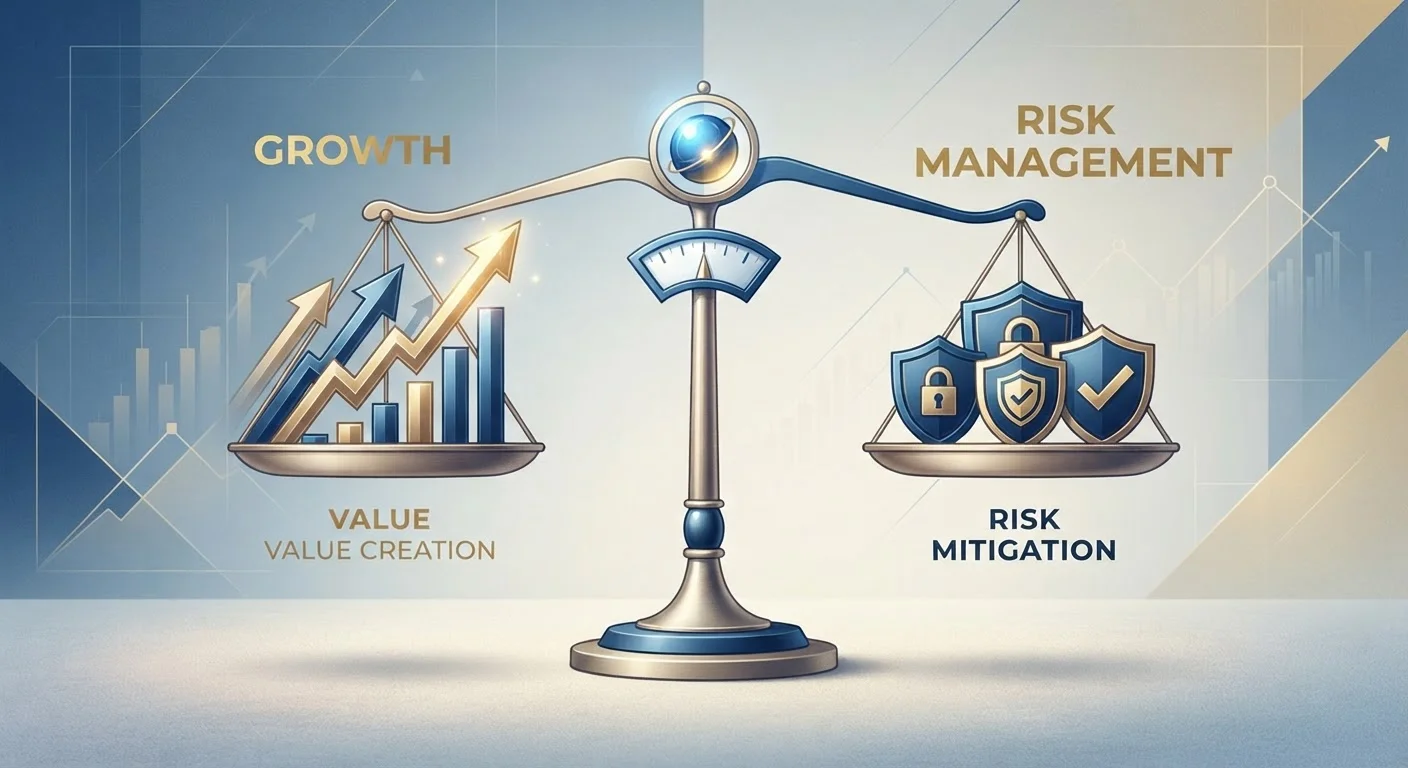
What the Risk-Return Trade-Off Really Means
At its core, the risk-return trade-off means there is no such thing as a free lunch in investing. When you put money into any asset — a stock, a bond, real estate, or even a savings account — you are accepting some level of uncertainty in exchange for a potential reward. The more uncertainty you take on, the higher the potential payoff needs to be to make that trade worthwhile.
This isn't a theory invented by Wall Street. It reflects a basic truth about how markets work: if a risky investment didn't offer the possibility of greater gain, no one would choose it over a safer alternative. To understand this more, see what it actually means to invest your money.
“Risk comes from not knowing what you're doing.”
— Warren Buffett, Chairman and CEO, Berkshire Hathaway; widely cited investor and author on value investing
Types of Risk Investors Face
"Risk" in investing covers more than just the chance of losing money, though that's certainly part of it. Common risk types include:
- Market risk: The possibility that the overall market declines, pulling your investment down with it regardless of its quality.
- Inflation risk: The danger that your returns don't keep pace with rising prices, reducing your real purchasing power over time.
- Liquidity risk: The chance that you can't sell an investment quickly or at a fair price when you need cash. Learn how liquidity affects financial planning.
- Concentration risk: Putting too much money in a single asset or sector, amplifying losses if that area underperforms.
Each type of risk carries its own implications, and recognizing which risks you're exposed to is the first step toward managing them thoughtfully.
~10%
Average annual return of U.S. large-cap stocks (historical)
The S&P 500 has historically averaged roughly 10% annually before inflation, but individual years have varied dramatically from steep losses to large gains.
~4–5%
Historical average return on long-term U.S. government bonds
Long-term Treasury bonds have historically offered lower returns than stocks, reflecting their lower risk profile and the government's backing.
How Risk and Return Play Out Across Asset Classes
Different investment types sit at different points on the risk-return spectrum. As a general framework — not a guarantee — consider how assets are commonly categorized:
| Asset Type | General Risk Level | General Return Potential |
|---|---|---|
| Cash / Money Market | Very Low | Very Low |
| Government Bonds | Low | Low to Moderate |
| Corporate Bonds | Moderate | Moderate |
| Stocks (Large Cap) | Moderate to High | Moderate to High |
| Stocks (Small Cap / Emerging Markets) | High | Higher Potential |
This table illustrates a pattern, not a rule. Individual investments within any category can behave differently, and past performance does not predict future results.
Risk Levels Are Relative, Not Fixed
Asset categories are generalizations. A single stock can be far riskier than the broad stock market average, and certain bond types carry more risk than some equities. Always look beyond the category label to understand what you're actually investing in. Individual circumstances, market conditions, and portfolio composition all affect actual risk exposure.
Matching Risk to Your Situation
Understanding the risk-return trade-off in theory is useful. Applying it to your own situation is where it actually matters. Two factors are especially important: your risk tolerance and your investment timeline.
Risk tolerance reflects how much volatility you can stomach — financially and emotionally — without making panic-driven decisions. Someone who would sell everything during a 20% market dip has a lower practical risk tolerance than someone who can hold steady and wait for recovery.
Your timeline matters because time can be a buffer against short-term losses. A 30-year-old saving for retirement has decades for a portfolio to recover from downturns. Someone five years from retirement has much less runway. Managing risk isn't about avoiding it entirely — it's about calibrating it to what your situation can absorb. For strategies that help manage exposure, see what diversification can and can't do.
Review Your Risk Tolerance Periodically
Your financial situation, goals, and emotional response to market swings can change over time. It's worth revisiting how much risk your portfolio carries whenever you hit a major life milestone — a new job, marriage, a child, or approaching retirement. A licensed financial adviser can help you assess what's appropriate for your circumstances.
This article is for general informational and educational purposes only and does not constitute personalized financial, investment, or tax advice. Consult a qualified financial professional before making decisions about your own finances.