
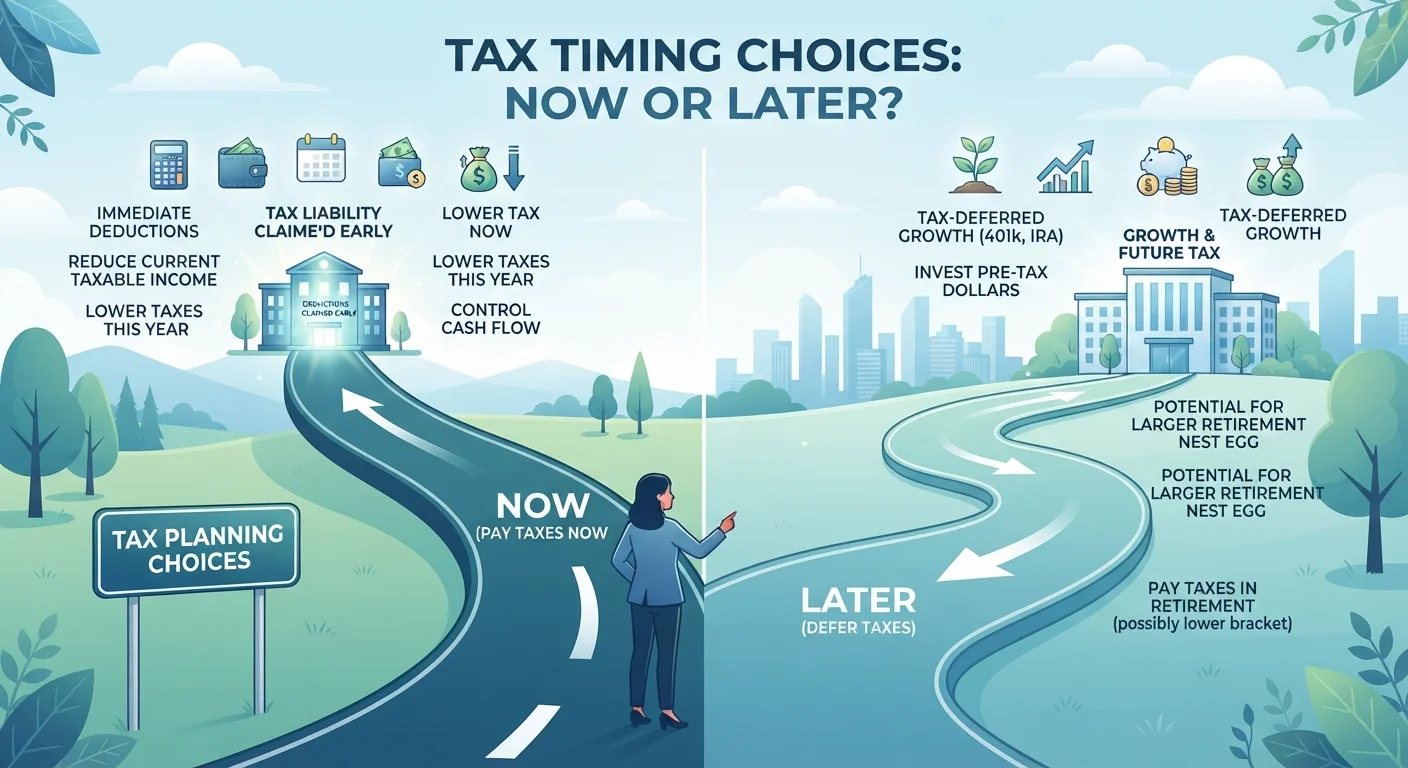
The Core Difference: When You Pay Taxes
Both account types are individual retirement arrangements (IRAs) governed by IRS rules, and both offer meaningful tax advantages. The critical distinction is timing: a Traditional IRA gives you a potential tax break when you contribute, while a Roth IRA gives you a tax break when you withdraw.
With a Traditional IRA, contributions may be tax-deductible in the year you make them — meaning the money goes in before federal income tax is applied (subject to income and workplace-plan rules). Your investments then grow tax-deferred. When you take distributions in retirement, those withdrawals are taxed as ordinary income.
With a Roth IRA, you contribute money you've already paid income tax on. Inside the account, investments grow tax-free, and qualified withdrawals — generally taken after age 59½ with the account open at least five years — are entirely free of federal income tax.
For a broader look at how these accounts fit alongside 401(k)s and other tax-advantaged vehicles, see our overview of tax-advantaged retirement accounts.
| Criterion | Traditional IRA | Roth IRA |
|---|---|---|
| Tax treatment on contributions | Potentially tax-deductible | After-tax (no deduction) |
| Tax treatment on withdrawals | Taxed as ordinary income | Qualified withdrawals tax-free |
| Investment growth | Tax-deferred | Tax-free |
| 2024 contribution limit | $7,000 ($8,000 if 50+) | $7,000 ($8,000 if 50+) |
| Income limits to contribute | None (deductibility may phase out) | Phase-out begins at $146K (single) |
| Required minimum distributions | Yes, starting at age 73 | None during owner's lifetime |
| Early withdrawal of contributions | Taxed + 10% penalty (generally) | Contributions withdrawable penalty-free |
| Best tax scenario | Higher tax rate now than in retirement | Lower tax rate now than in retirement |
Rules, Limits, and Eligibility
For 2024, the IRS sets a combined contribution limit of $7,000 per year across all your IRAs ($8,000 if you are age 50 or older). That limit applies to the total across both account types — you cannot double it by contributing to both.
Traditional IRA deductibility
Anyone with earned income can contribute to a Traditional IRA, but the deductibility of that contribution phases out if you (or your spouse) are also covered by a workplace retirement plan and your income exceeds IRS thresholds. Non-deductible contributions are still permitted, though the tax math becomes more complex.
Roth IRA income limits
Roth IRA eligibility phases out at higher income levels. For 2024, the ability to contribute directly to a Roth IRA begins to phase out at a modified adjusted gross income (MAGI) of $146,000 for single filers and $230,000 for married couples filing jointly. Above the upper threshold, direct Roth contributions are not permitted.
$7,000
2024 annual IRA contribution limit
Per IRS guidance for 2024; savers aged 50 and older may contribute an additional $1,000 as a catch-up contribution.
Age 73
Traditional IRA RMD start age
The SECURE 2.0 Act raised the required minimum distribution starting age to 73 for individuals who turn 72 after December 31, 2022.
$230,000
Roth IRA phase-out threshold (married filing jointly)
According to 2024 IRS guidelines, direct Roth IRA contributions are fully phased out above this MAGI level for married couples filing jointly.
Required minimum distributions (RMDs)
Traditional IRA owners must begin taking required minimum distributions — taxable withdrawals calculated by the IRS — starting at age 73 under current law. Roth IRAs impose no RMDs on the original owner, allowing assets to continue compounding if they aren't needed.
This article is for general informational and educational purposes only and does not constitute personalised financial, tax, or investment advice. Tax rules are subject to change. Consult a qualified financial adviser or tax professional regarding your specific situation.
Choosing Based on Your Tax Situation
The honest answer is that no one knows with certainty what tax rates will look like in 20 or 30 years. That uncertainty is itself a reason many financial professionals discuss tax diversification — holding both pre-tax (Traditional) and after-tax (Roth) retirement assets to reduce dependence on a single tax outcome.
A few practical frameworks can help guide your thinking:
- Compare current vs. expected future tax rate. If your tax rate today is meaningfully lower than what you anticipate in retirement, paying taxes now (Roth) often makes mathematical sense. If the reverse is true, deferring (Traditional) may be preferable.
- Consider your timeline. The longer money stays invested, the greater the compounding benefit of tax-free growth — which tends to favor the Roth for younger savers with decades ahead of them.
- Factor in estate planning. Because Roth IRAs carry no RMDs, they can be valuable for passing assets to heirs, though inherited IRA rules have changed significantly in recent years.
If you're still building the foundation of your financial plan, our guide to saving versus investing can help clarify where retirement contributions fit alongside shorter-term financial goals.
The 'Backdoor Roth' Strategy
High earners who exceed Roth IRA income limits sometimes use a two-step process — making a non-deductible Traditional IRA contribution and then converting it to a Roth IRA. This approach, sometimes called a 'backdoor Roth,' has IRS implications that can be complex, particularly if you hold other pre-tax IRA assets. Because the tax consequences depend heavily on individual circumstances, consulting a qualified tax professional before attempting this strategy is strongly recommended.