Why Cats Hide Pain So Well
Cats are descended from solitary hunters for whom showing vulnerability could be fatal. That instinct to mask weakness remains deeply embedded, which means a cat in genuine discomfort may look deceptively normal to even an attentive owner. Veterinary professionals often refer to this as pain concealment behavior, and it's one of the main reasons feline pain is underdiagnosed.
Understanding your cat's individual baseline — their typical activity level, eating habits, grooming routine, and social patterns — is the foundation of catching anything unusual. Changes from that normal matter far more than a generic checklist. The signs below are the ones veterinarians most commonly look for during pain assessment, and they're worth committing to memory.
Keep a simple behavioral log
Jotting down brief daily observations — appetite, activity, grooming, posture — takes less than a minute and creates an invaluable baseline. When something changes, you'll have documented evidence to share with your vet rather than relying on memory. Even a few weeks of notes can help a veterinarian identify patterns.
Eight Subtle Signs Your Cat May Be Hurting
Changes in grooming habits
A cat in pain often grooms less — or stops entirely — because movement hurts. The result is a coat that looks dull, matted, or unkempt in areas the cat can no longer comfortably reach. Conversely, some cats over-groom a painful spot, creating bald patches or raw skin. Monitoring coat condition regularly makes these changes easier to spot early.
A dull, matted coat in a typically fastidious cat is a quiet red flag worth investigating.
Altered facial expression
Research into feline pain assessment, including tools like the Feline Grimace Scale, has shown that cats display recognizable facial changes when in pain: squinted or partially closed eyes, flattened or rotated ears, a tense muzzle, and whiskers pulled back flat. These are not obvious expressions of distress — they're easy to dismiss as sleepiness — but taken together they're meaningful indicators.
Squinted eyes and flattened ears together suggest pain, not just drowsiness.
Reduced activity or reluctance to jump
A cat that once leaped confidently onto a counter but now hesitates, avoids high surfaces, or seems stiff when rising may be experiencing musculoskeletal pain, arthritis, or an internal issue. Because this change tends to happen gradually, owners often attribute it to normal aging rather than a treatable condition. Stiffness after rest, shorter play sessions, and slower movement are all worth noting.
Hesitation before jumping is often the first visible sign of joint or musculoskeletal pain.
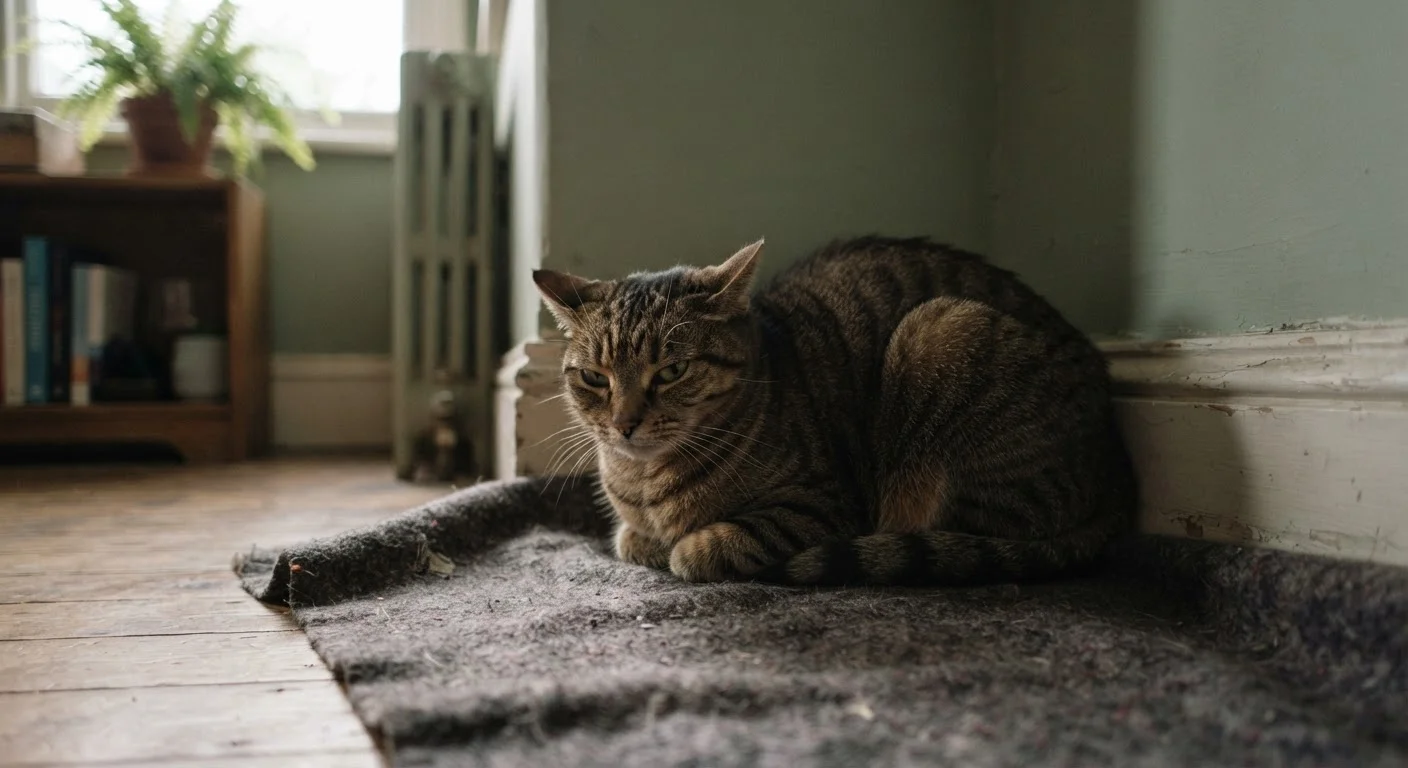
Withdrawal or unusual hiding
Cats sometimes retreat when they're unwell, seeking quiet, dark spaces more than usual. If your cat is spending more time tucked away and actively avoiding contact they normally welcome, that's a behavioral shift worth taking seriously. It differs from a cat that is simply independent by nature — the key is a change from their individual baseline. Our overview of feline stress triggers explains how to distinguish pain-driven hiding from stress-related withdrawal.
A sociable cat retreating and avoiding touch is exhibiting a change that deserves attention.
Litter box avoidance or changes in elimination
Pain — particularly in the joints, abdomen, or urinary tract — can make using the litter box difficult or uncomfortable. A cat that starts eliminating outside the box, strains, or visits the box more or less frequently than usual may be signaling an underlying problem. This is rarely behavioral defiance. Our explainer on litter box problems covers the medical reasons behind this behavior in more depth.
Litter box avoidance is rarely spite — it's frequently the body communicating that something is wrong.
Unexplained aggression or sensitivity to touch
A cat that hisses, swats, or bites when touched in a particular area — especially one that has never done this before — is often protecting a painful spot. This sudden shift in temperament is one of the more reliable indicators of localized pain. Pay attention to which areas trigger a defensive response; that information is genuinely useful to share with a veterinarian.
Sudden aggression when touched is one of the more reliable indicators of localized pain.
Changes in vocalization
Some cats become uncharacteristically vocal when in pain — yowling, growling, or vocalizing at unusual times. Others go unusually quiet. Neither is inherently more normal; both represent a departure from a cat's typical communication style. Understanding your cat's normal vocal repertoire helps here. Our guide to cat sounds breaks down what different vocalizations typically mean.
Both increased yowling and unusual silence can signal that a cat is not feeling well.
Purring in unexpected contexts
Many owners associate purring exclusively with contentment, but cats also purr when anxious, stressed, or in pain. Veterinary research suggests purring may serve a self-soothing function. A cat that purrs while hunched in a tense posture, during a car trip, or at the vet is not necessarily relaxed. For more on this, see our explainer on why cats purr.
Purring combined with a tense, hunched posture may indicate self-soothing in response to pain.
Pain in cats can be acute or chronic
Acute pain comes on suddenly, often from injury, surgery, or infection, and tends to produce more obvious reactions. Chronic pain — such as that from arthritis or dental disease — develops slowly and may produce only the subtlest behavioral shifts over months. Both types warrant veterinary assessment, but chronic pain is especially easy to miss without careful, ongoing observation.
Because so many pain signals overlap with other conditions — stress, illness, or even boredom — a veterinary exam is the only reliable way to determine what's actually happening. Our guide to symptoms that warrant veterinary attention can help you decide how urgently to act.
This article provides general information for educational purposes only. It is not a substitute for professional veterinary advice, diagnosis, or treatment. If you are concerned about your cat's health, consult a licensed veterinarian.