
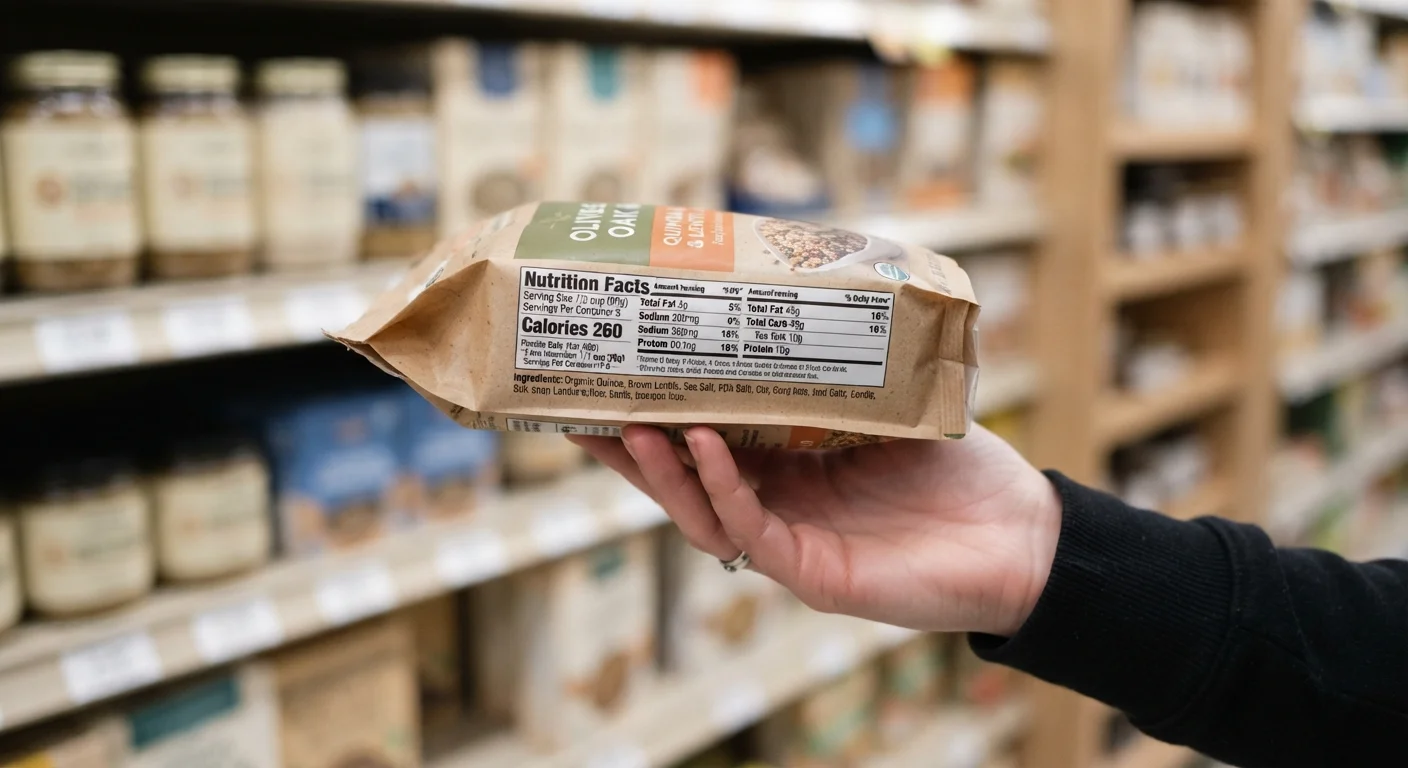
Why Nutrition Labels Exist — and What They Cover
The Nutrition Facts label is mandated by the U.S. Food and Drug Administration (FDA) and appears on nearly every packaged food sold in the United States. Its purpose is straightforward: give consumers standardized, comparable information about what they're eating. Understanding the label can support more intentional food choices — though it's worth remembering that no label replaces guidance from a registered dietitian or healthcare provider for personal dietary decisions.
The label is divided into distinct sections, each answering a different question. Learning to read them in order — rather than scanning randomly for a single number — is what makes the label genuinely useful. To understand how individual nutrients fit into your broader diet, see our guide to macronutrients for a clear breakdown of what carbohydrates, proteins, and fats actually do in the body.
What you will need
How to Read the Label, Step by Step
Follow these steps in order each time you pick up a packaged product. It takes less than a minute once the habit is established.
Start with serving size and servings per container
Every number on the label — calories, fat, sodium, everything — is based on one serving. The serving size is listed at the very top, expressed in a common household measure (e.g., "1 cup") alongside a gram or milliliter equivalent. Directly below that is the number of servings in the entire package. If a package contains 2.5 servings and you eat the whole thing, every nutrient value is multiplied by 2.5.
Note the calories per serving
The large, bold calorie number reflects one serving. This is the total energy you get from that amount of food. Calories from fat are no longer required to be listed separately on updated labels — total calories is what matters here. Use this number in the context of your overall day rather than evaluating it in isolation.
Scan the nutrients to limit
The FDA highlights certain nutrients that Americans tend to overconsume: saturated fat, sodium, and added sugars. These are listed with both a gram amount and a Percent Daily Value (%DV). A %DV of 5% or less is considered low; 20% or more is considered high. Dietary guidelines generally recommend keeping saturated fat, sodium, and added sugars toward the lower end of your daily intake.
Note that added sugars — sugars introduced during processing — now appear as a separate line beneath total sugars. This distinction matters because naturally occurring sugars in whole fruit or plain dairy behave differently in the body than added sugars in processed foods.
Identify the nutrients to get enough of
Below the nutrients to limit, the label lists nutrients that many Americans fall short on: dietary fiber, vitamin D, calcium, iron, and potassium. For these, a higher %DV is generally favorable. Fiber, in particular, supports digestive health and is found in whole grains, legumes, fruits, and vegetables.
Read the ingredient list
Ingredients are listed in descending order by weight — the first ingredient is present in the largest amount. A short ingredient list with recognizable items isn't automatically better, but it can be informative. Look for where sugar (or its many alternate names — corn syrup, dextrose, maltose, honey, agave) appears; if it shows up in the first three ingredients, the product is likely high in added sugar. Whole grains listed first indicate a higher fiber content than refined grain counterparts.
Use the %DV as a quick compass
You don't need to memorize daily nutrient targets in grams. The Percent Daily Value column does that math for you. As a general rule: 5% DV or less is low, 20% DV or more is high. Apply this to both nutrients you want to limit and nutrients you want more of.
Common Pitfalls and What to Watch For
Even careful readers can be tripped up by a few recurring label quirks.
- Multi-serving containers that look single-serve: A bottle of juice or a bag of chips often contains two or more servings. If you eat the whole thing, multiply every number accordingly.
- "0 g trans fat" doesn't mean zero: The FDA allows products containing less than 0.5 g of trans fat per serving to be labeled as 0 g. Check the ingredient list for "partially hydrogenated oils" — that's trans fat by another name.
- Percent Daily Values are based on a 2,000-calorie diet: Your personal calorie needs may differ. The %DV is a directional tool, not a precise personal target.
- Nutrient-content claims on the front of the package: Terms like "light," "reduced sodium," or "high fiber" have FDA definitions — but they can still distract from a complete label read. Always flip to the Nutrition Facts panel rather than relying on front-of-package language.
Front-of-Package Claims Can Mislead
Marketing terms like "natural," "wholesome," or "multigrain" are not regulated the same way Nutrition Facts data is. A product labeled "multigrain" may still be made primarily from refined grains. Always verify claims by reading the actual Nutrition Facts panel and ingredient list rather than relying on packaging language.
For an equally practical skill that applies at the store shelf, our unit pricing guide explains how to compare true cost per serving across different package sizes.
This article is for general informational and educational purposes only and is not a substitute for professional medical or dietary advice. Consult a qualified healthcare provider or registered dietitian for guidance specific to your health needs.