
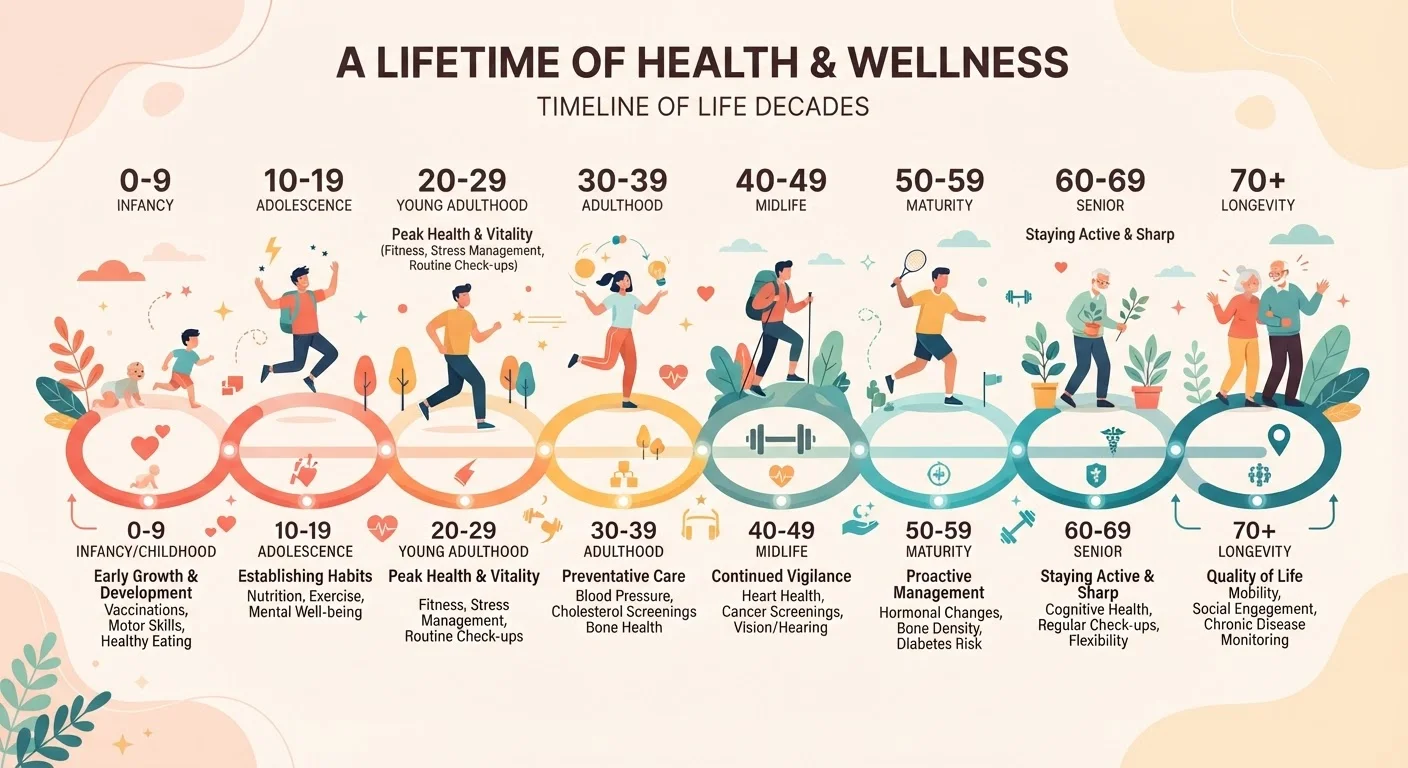
Why Preventive Care Is a Lifelong Commitment
Preventive health is not a single annual appointment — it is a continuous practice that evolves as your body, risks, and circumstances change. According to the CDC, chronic diseases like heart disease, diabetes, and cancer account for the majority of deaths and disability in the United States, yet many of these conditions are significantly preventable or manageable when addressed early.
The challenge is that most people mentally segment preventive care into childhood (vaccines, well-child visits) and old age (screenings for serious disease). The decades in between are often treated as optional — a missed opportunity that can silently accumulate risk. See our guide to preventive care gaps for a deeper look at how deferred care compounds over time.
This roadmap organizes evidence-informed priorities by life decade so you can approach each stage with intention rather than reaction.
This Is General Education, Not Personal Medical Advice
The recommendations outlined in this guide reflect general U.S. health authority guidance and are intended as educational context only. Individual risk factors — including family history, genetics, weight, lifestyle, and existing conditions — can significantly shift what screenings and interventions are appropriate for you. Always work with a licensed healthcare provider to determine the right preventive plan for your personal circumstances.
Your 20s: Building the Foundation
The 20s are often characterized by good baseline health, which makes them easy to take for granted. But this decade is when habits, metabolic baselines, and risk patterns are established. Foundational steps include:
- Establish a primary care provider and schedule regular well-visits, even when you feel healthy.
- Blood pressure and cholesterol checks — hypertension affects younger adults more than commonly assumed and often has no symptoms.
- Mental health screening — anxiety and depression frequently emerge in young adulthood. The U.S. Preventive Services Task Force (USPSTF) recommends screening for depression in all adults.
- STI screening — the CDC recommends annual chlamydia and gonorrhea testing for sexually active women under 25, and testing for others based on risk factors.
- Skin and dental care — UV damage accumulates over time; biannual dental visits help prevent costly problems later.
Physical health habits worth building at every age offers a complementary look at exercise and nutrition priorities during this stage.
Don't wait for symptoms before establishing a primary care relationship. A provider who knows your baseline health can detect meaningful changes years earlier than one meeting you for the first time during a crisis.
Continuity of care is associated with better detection of chronic conditions and higher rates of recommended preventive service completion, according to research published in the Annals of Family Medicine.
When you visit your provider, bring a written list of all supplements and over-the-counter medications you take — not just prescriptions. Many interactions and health signals are missed when this picture is incomplete.
Supplement and OTC drug interactions are frequently underreported and can affect lab results, medication efficacy, and organ function, particularly as medication lists grow with age.
Your 30s: Addressing Emerging Risks
In your 30s, life tends to get busier — careers, families, and competing demands can push health to the back burner. Yet this is the decade when early warning signs of chronic conditions can begin to appear.
- Blood glucose monitoring — the USPSTF recommends screening for prediabetes and type 2 diabetes in adults aged 35–70 who are overweight or obese.
- Blood pressure and lipids — continue monitoring, especially if family history or lifestyle factors are present.
- Cervical cancer screening — Pap smears every 3 years (or HPV co-testing every 5 years) for women aged 21–65, per USPSTF guidance.
- Thyroid awareness — thyroid conditions, particularly in women, often surface in the 30s. Discuss any symptoms like fatigue or weight changes with your provider.
- Vaccination updates — ensure Tdap and influenza boosters are current; discuss hepatitis B vaccination status.
See our guide to building sustainable preventive habits for practical strategies when time is limited.
Your 40s: The Decade of Early Detection
The 40s mark a pivotal shift: several major screening programs begin, and the compounding effects of earlier habits become more visible.
- Breast cancer screening — the American Cancer Society recommends annual mammograms starting at 40 for average-risk women; discuss your personal risk with your provider.
- Colorectal cancer screening — the USPSTF lowered its recommended start age to 45 for average-risk adults. Options include colonoscopy, stool-based tests, and others.
- Eye and hearing exams — presbyopia (age-related near-vision changes) often begins in the early 40s; baseline hearing assessments become useful.
- Cardiovascular risk assessment — a 10-year cardiovascular risk calculation using cholesterol, blood pressure, age, and lifestyle factors helps guide decisions about preventive medications. Your provider can run this calculation.
- Skin cancer checks — annual full-body skin exams become particularly important if you have a history of significant sun exposure.
Track Your Screenings Like Appointments
Keep a simple log — a notes app or spreadsheet works fine — of what screenings you've had and when they're due to repeat. Many people leave a provider's office without a clear sense of when their next colorectal or cholesterol check is due. A written record removes that uncertainty and helps you advocate for yourself at future visits.
Our annual preventive care checklist can help you track which screenings to bring up at your next appointment.
Your 50s and 60s: Managing Chronic Disease Risk
For many Americans, the 50s and 60s are when chronic conditions — hypertension, type 2 diabetes, osteoarthritis — become active rather than theoretical. Preventive care now includes both early detection and active management support.
- Lung cancer screening — the USPSTF recommends annual low-dose CT scans for adults aged 50–80 with a significant smoking history (20 pack-years) who currently smoke or quit within the past 15 years.
- Bone density (DEXA scan) — the USPSTF recommends screening for osteoporosis in women aged 65+, but earlier screening may be warranted based on risk factors including menopause status.
- Shingles vaccine (Zoster) — recommended by the CDC for adults 50 and older; shingles can cause prolonged nerve pain and serious complications.
- Abdominal aortic aneurysm screening — a one-time ultrasound is recommended by the USPSTF for men aged 65–75 who have ever smoked.
- Cognitive health awareness — while formal dementia screening protocols vary, discussing memory concerns early with a provider is valuable.
80%
Of premature heart disease cases that are preventable
The World Health Organization estimates that up to 80% of premature heart disease, stroke, and type 2 diabetes could be prevented through healthier lifestyle choices and early intervention.
45
Age when colorectal cancer screening now begins
The USPSTF lowered its colorectal cancer screening start age from 50 to 45 for average-risk adults in recognition of rising incidence in younger populations.
1 in 4
Adults with undiagnosed hypertension
The CDC estimates that roughly 1 in 4 U.S. adults with hypertension are unaware of their condition, underscoring the importance of routine blood pressure monitoring across all age groups.
Your 70s and Beyond: Protecting Function and Independence
Preventive health in the 70s and beyond shifts toward maintaining mobility, preventing falls, preserving cognitive function, and managing polypharmacy (the use of multiple medications).
- Fall prevention — the CDC's STEADI (Stopping Elderly Accidents, Deaths, and Injuries) framework recommends annual fall risk assessments. Falls are a leading cause of injury-related death in older adults.
- Medication review — older adults are more likely to take multiple medications; an annual review with a pharmacist or provider helps identify unnecessary drugs or harmful interactions.
- Pneumococcal vaccine — recommended for all adults 65+; pneumonia poses significantly higher risk in this age group.
- Vision and hearing — both are directly linked to fall risk and cognitive health; annual monitoring is appropriate.
- Social and mental health — loneliness and social isolation are increasingly recognized as major health risk factors in older adults, linked to elevated rates of depression and cognitive decline.
Even at this stage, lifestyle interventions — including regular movement, adequate nutrition, and social engagement — remain among the most powerful tools available, according to the National Institute on Aging.
“The goal of preventive medicine is not simply to add years to life, but to add life to years — maintaining the function, independence, and quality of experience that make those extra years meaningful.”
— National Institute on Aging, U.S. Government Institute for Age-Related Health Research
Screenings and Vaccinations: A Quick Reference by Decade
The table below summarizes key preventive actions by decade. This is a general reference based on major U.S. health authority recommendations — it is not a substitute for personalized guidance from a licensed healthcare provider, who can factor in your individual history, family background, and risk profile.
| Decade | Key Screenings | Key Vaccinations |
|---|---|---|
| 20s | Blood pressure, cholesterol, STIs, depression, dental | Flu (annual), Tdap, HPV (if not prior) |
| 30s | Blood glucose (35+), cervical cancer, lipids, thyroid awareness | Flu (annual), Tdap booster, hepatitis B |
| 40s | Mammogram (women), colorectal cancer (45+), cardiovascular risk, eye/hearing | Flu (annual), COVID-19 updates |
| 50s–60s | Lung cancer (50+, if eligible), bone density, abdominal aortic aneurysm (men) | Flu (annual), shingles (50+), pneumococcal |
| 70s+ | Fall risk, medication review, vision, hearing, cognitive health | Flu (annual), pneumococcal, COVID-19 boosters |
For a more comprehensive year-round reference, see our adult preventive care checklist.
This article is for general informational and educational purposes only and does not constitute medical advice. Screening recommendations may vary based on individual risk factors, clinical guidelines updates, and insurance coverage. Always consult a qualified healthcare provider to determine which preventive services are appropriate for your specific situation.
Guidelines Evolve — Stay Current
Preventive care recommendations are updated periodically as new evidence emerges. The USPSTF, CDC, American Cancer Society, and specialty organizations regularly revise their guidance. Check in with your provider at least annually and ask whether any recommendations relevant to you have changed since your last visit.