Why the Store Brand Debate Persists
Private-label products — what most shoppers call store brands or generics — have grown from a fringe budget option into a mainstream retail category accounting for roughly one in five units sold in U.S. grocery stores, according to industry trade data. Despite that scale, many consumers still associate lower price with lower quality. That association is understandable but worth examining, because the research picture is more nuanced.
The debate persists for a few structural reasons. Name brands invest heavily in shaping quality perception through advertising — those impressions are durable. Meanwhile, retailers have not always been consistent: early private-label products in the 1970s and 1980s genuinely were lower quality, and that reputation has proven stickier than the products themselves. Today's store-brand landscape is substantially different, but consumer memory is long.
Myth
Store brands are lower quality because they cost less — you get what you pay for.
Fact
Price reflects marketing and distribution costs as much as product quality; independent testing consistently finds store brands comparable in many categories.
The phrase "you get what you pay for" is intuitive but misleading when applied to private-label products. A significant portion of a name brand's retail price covers advertising budgets, slotting fees, and packaging design — costs unrelated to the product itself. Retailers often source private-label goods from the same contract manufacturers that supply name brands, then sell them at a lower margin because they spend far less on promotion. Consumer testing organizations have repeatedly found store-brand staples — from canned vegetables to over-the-counter pain relievers — performing at parity with their name-brand counterparts on taste, efficacy, and ingredient composition.
Myth
Store brand and name brand products are always made in the same factory, so they're identical.
Fact
Co-manufacturing is common but not universal; formulations, ingredient sourcing, and quality-control standards can differ even when facilities overlap.
It's accurate that many retailers contract with name-brand manufacturers to produce their private-label lines. However, "same factory" does not automatically mean identical product. Contract agreements sometimes allow for minor formulation differences, lower-grade input ingredients, or less stringent quality tolerances. The overlap is real and significant in categories like dairy, canned goods, and OTC medications — but consumers should not assume it universally. Understanding what you're actually paying for in each category is a more reliable approach than blanket assumptions in either direction.
Myth
Name brands always perform better in blind taste or product tests.
Fact
Blind testing frequently shows consumers cannot distinguish between store brands and name brands, and sometimes prefer the store brand.
When packaging is removed from the equation, brand preference often disappears. Structured blind taste studies — including those conducted by academic consumer behavior researchers and independent product testing publications — have found that participants rate store-brand foods at parity with, or occasionally above, their name-brand equivalents. The halo effect of familiar branding is well-documented in consumer psychology: the same product tastes or performs better when presented in recognizable packaging. This doesn't mean brand perception is irrational, but it does mean the perceived quality gap is partly a marketing artifact rather than a product reality.
Myth
Buying store brands always saves money.
Fact
Store brands are usually cheaper per unit, but the savings aren't automatic — pack sizes, promotional pricing, and couponing can make name brands competitive.
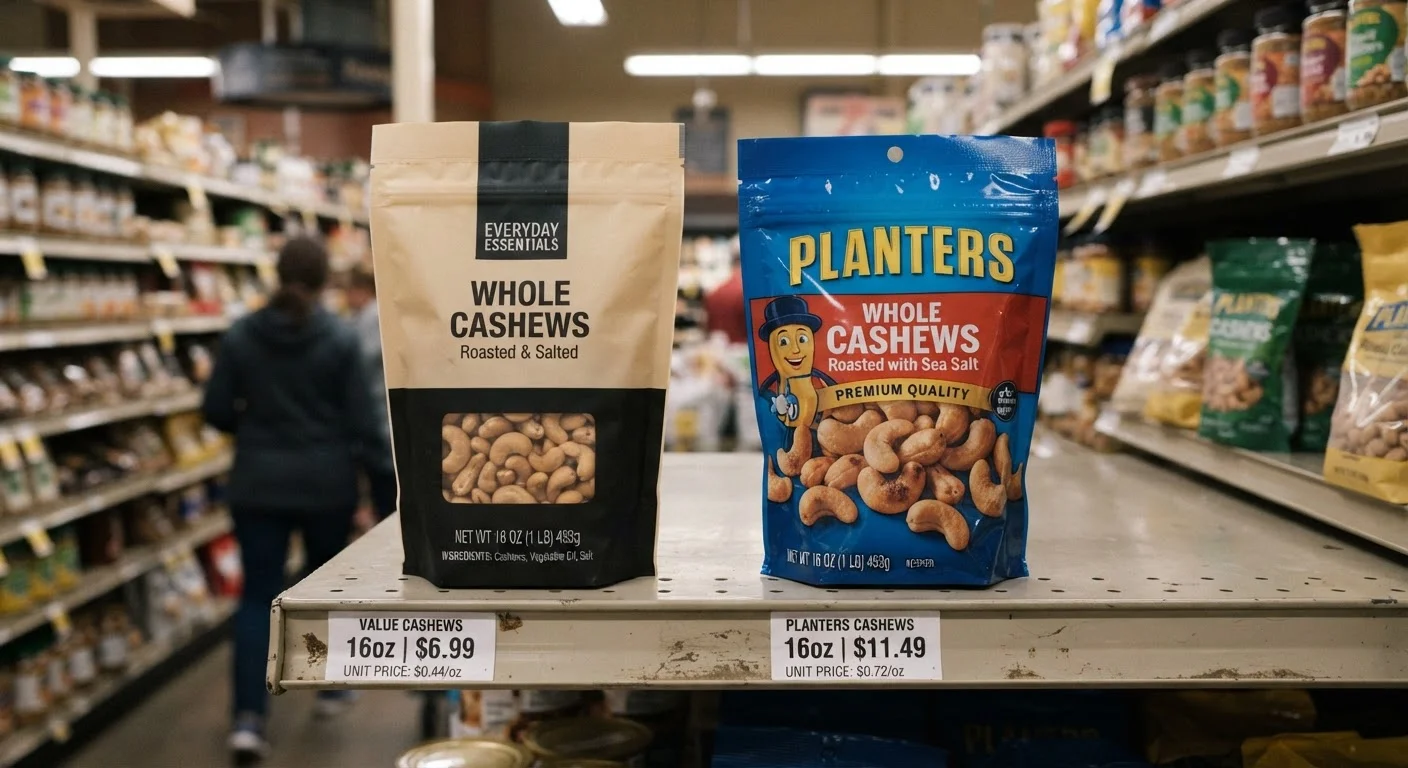
Store brands carry a lower baseline price in most categories, but smart shoppers know that name-brand prices fluctuate. Manufacturer coupons, loyalty program discounts, and periodic sales can close the price gap substantially. Additionally, if a store brand's pack size is smaller, the per-unit cost comparison may not favor the private label as clearly as the sticker price suggests. The difference between price and value matters here: the cheaper item is only the better value if you'll actually use it and it performs adequately for your needs.
Myth
Store brands are a smart choice across the board, in every product category.
Fact
Store brands outperform expectations in many categories but underperform in others — the gap depends heavily on what you're buying.
Research and independent testing suggest store brands perform strongly in staple food categories (pasta, flour, canned goods, dairy), basic cleaning supplies, and OTC medications with the same active ingredients as name-brand counterparts. However, quality gaps tend to be more pronounced in categories like trash bags, batteries, certain personal care products, and complex prepared foods where formulation consistency is harder to replicate at lower cost. For a category-by-category breakdown, see where the gap is real and where it isn't.
What Independent Testing Actually Reveals
The most credible evidence on store brand versus name brand performance comes from blind testing and ingredient-level analysis — methods that strip away packaging and branding to evaluate the product itself. The consistent finding: category matters far more than brand tier.
~20%
U.S. grocery unit share held by store brands
Private-label products account for roughly one in five units sold in U.S. grocery retail, reflecting sustained consumer adoption beyond just budget shoppers.
20–30%
Typical price difference vs. name brands
Store brands are generally priced 20 to 30 percent below comparable name-brand items, though the gap varies significantly by category and retailer.
For commoditized products — basic pantry staples, generic OTC medications governed by FDA standards, household chemicals with regulated active ingredients — the functional differences between store and name brands are often negligible. The active ingredient in a store-brand ibuprofen is the same molecule at the same dosage as the name-brand version, by regulatory requirement. The same logic applies to many cleaning agents and basic food commodities.
Where gaps tend to be real and measurable: durability-dependent categories like garbage bags and batteries, flavor-sensitive prepared foods, and personal care products where proprietary formulations genuinely differ. Treating every category the same way leads to either unnecessary spending or occasional disappointment. For guidance on navigating those distinctions, the categories where quality gaps exist is worth reviewing before you shop.
OTC Medications: Federal Standards Level the Field
For over-the-counter medications — pain relievers, antacids, allergy tablets, and similar products — the FDA requires store-brand generics to contain the same active ingredients at the same dosage as name-brand equivalents. This is a regulatory floor, not a marketing claim. For these products, the quality comparison is largely settled by federal standards. Always read labels and consult a healthcare professional for guidance on any medication use.
Ultimately, the most practical framework is category-by-category evaluation rather than a blanket rule. Visit Smart Shopping Tips for a broader set of practical tools for evaluating purchases on their actual merits.