
Where Online Shopping Genuinely Outperforms
Online shopping's core advantage is scale. A single product category — say, bed pillows or USB-C hubs — can yield hundreds of options online versus a dozen or fewer on any given store shelf. For shoppers who know their requirements, that breadth makes it far easier to find a specific size, specification, or price point.
Price comparison is another clear win. Pulling up two or three tabs to check the same item across multiple retailers takes seconds online. In-store, that same comparison requires physically driving between locations. Tools that track price history can also help you judge whether a listed price is genuinely competitive or just routine — a habit worth building before any significant purchase. See our pre-purchase checklist for a full rundown of what to verify before clicking buy.
Convenience is real but conditional. Shopping at midnight, avoiding parking, or reordering household staples without a trip out are all genuine time-savers — as long as you're not paying more in shipping than you'd spend in gas, or getting nudged toward unnecessary additions to hit a free-shipping threshold. Online habits that quietly raise your spending are worth examining if you shop digitally often.
Use Reviews as a Quality Proxy — Carefully
Customer reviews can substitute partly for in-person assessment online, but volume alone isn't a reliable signal. Look for detailed, verified-purchase reviews that describe the specific attribute you care about — texture, durability, sizing accuracy — rather than overall star averages. A product with 200 detailed reviews often gives more actionable signal than one with 2,000 brief ones.
Where In-Store Shopping Holds the Edge
Physical retail's primary advantage is sensory verification. You can feel the weight of a pan, check the stitching on a jacket, sit in a chair, or confirm that a color matches your wall — none of which a product photo reliably communicates. For categories where material quality, fit, or proportion directly affect satisfaction, that hands-on check is often worth the trip.
Immediacy is another genuine advantage. Need a replacement part today, or want to wear something to an event this weekend? In-store eliminates the one-to-five day wait. There's also no shipping box to dispose of, no porch-delivery risk, and no question about whether the item arrived undamaged.
Returns, too, are often simpler in-store. Walking in with a receipt typically resolves an exchange on the spot, whereas online returns involve repackaging, shipping labels, and waiting for a refund to process. Understanding how each channel handles returns before you buy is practical due diligence — our guide to reading return policies covers what to look for.
Check Return Policies Before You Commit
Return terms vary widely and aren't always prominently displayed during checkout. Some online retailers charge return shipping or restocking fees; others require returns within a narrow window. Confirming these details before purchase — rather than discovering them after — can prevent a frustrating experience, especially for higher-cost items.
Matching the Channel to the Product Category
The clearest framework isn't picking a preferred channel universally — it's matching the channel to what you're buying.
| Category | Online | In-Store | |
|---|---|---|---|
| Selection breadth | Very wide, often unlimited SKUs | Limited to local inventory | |
| Price comparison ease | Simple, multiple tabs | Requires visiting multiple stores | |
| Product assessment | Photos and reviews only | Hands-on, sensory verification | |
| Speed of possession | 1–5 days typical | Immediate | |
| Return process | Repackage, ship, wait | Usually resolved same day | |
| Hidden cost risks | Shipping, return shipping, fees | Travel time and fuel costs |
Clothing is a category where channel choice matters especially much. Fit, fabric feel, and color accuracy are hard to judge from images alone, making in-store try-ons a meaningful risk-reducer for many shoppers. If you do buy apparel online, the real trade-offs of buying clothes online vs. in-store lays out what to realistically expect from each approach.
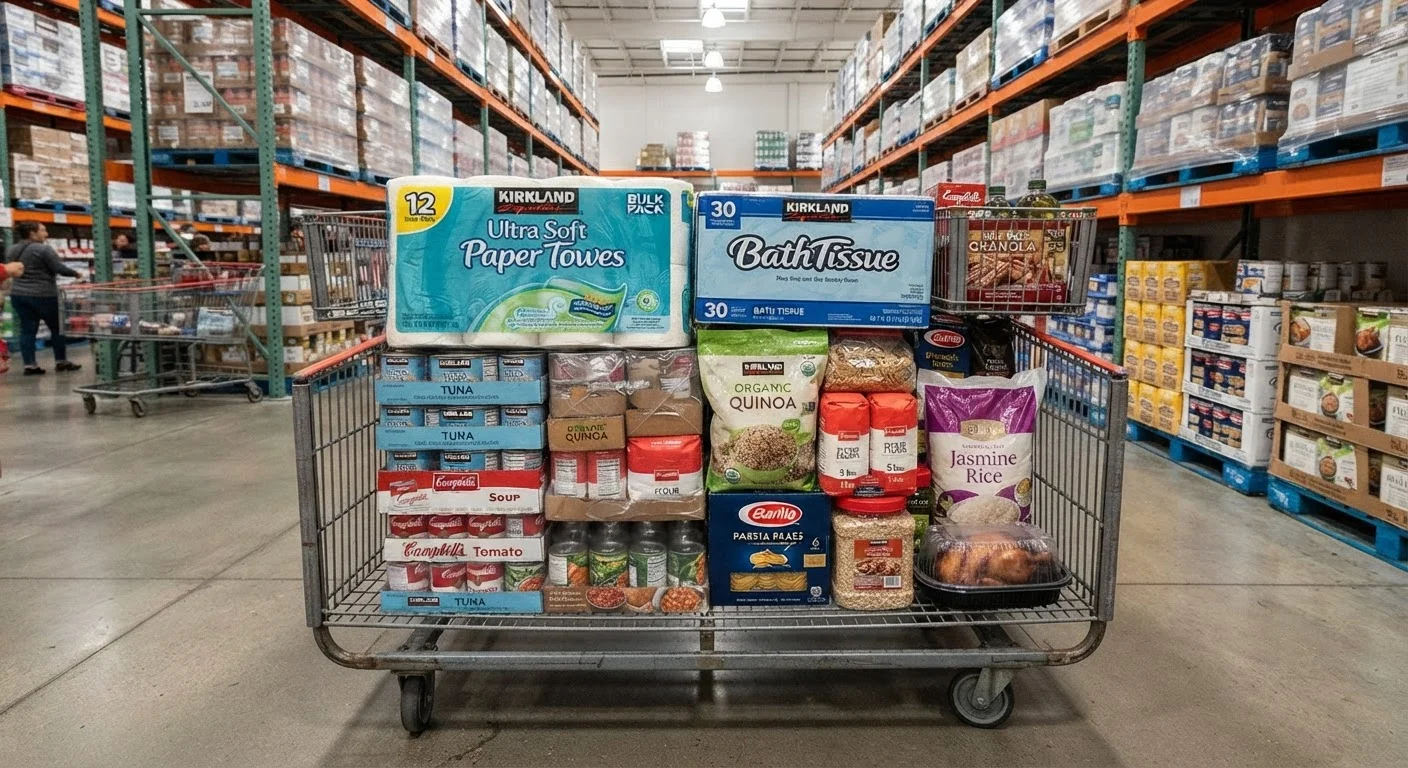
For branded household staples — cleaning supplies, paper goods, pantry items you buy repeatedly — online can make straightforward economic sense once you know the product and can evaluate bulk pricing clearly. In those cases, the main variable to watch is whether subscription or auto-reorder settings are actually saving money relative to local prices.
High-consideration items like appliances, furniture, or electronics often benefit from a hybrid approach: research and price-compare online, then confirm key details in-store before purchasing from whichever channel offers better terms. Home essentials guidance can help with evaluating must-have household products across categories.
Cost Factors That Often Get Overlooked
Neither channel is automatically cheaper. Online prices can look lower before accounting for shipping, handling, or return-shipping costs if the item doesn't work out. In-store prices can look higher but include immediate possession, no return-shipping expense, and often clearer warranty or exchange support.
~21%
Average e-commerce return rate
Industry analyses from logistics research firms have estimated online retail return rates around 20–25%, compared to roughly 8–10% for in-store purchases.
2–3 days
Typical online return processing time
Refund timelines after a return shipment is received vary by retailer but commonly range from two to five business days before funds clear.
Restocking fees — charged by some retailers when an opened item is returned — appear in both channels but are more common and variable online. Reading a retailer's return policy before purchase, rather than after, is one of the simplest ways to avoid an unpleasant surprise.
Sales tax treatment varies by state and retailer type, though the gap between online and in-store has narrowed considerably following changes to state tax law in recent years. It's generally safer not to assume one channel will be tax-free.
Ultimately, the strongest shopping decisions tend to come from treating channel choice as a tool, not a preference. Applying consistent evaluation criteria — necessity, price competitiveness, return terms, and your ability to assess quality — works regardless of where the transaction happens. For a structured way to apply that thinking, our pre-purchase checklist is a practical starting point.