
Why Shared Budgeting Is Harder — and More Important
Managing money alone is already challenging. Add a partner, spouse, or roommate and you introduce different spending histories, financial personalities, and competing priorities. Research consistently shows that money disagreements are among the most common sources of conflict in relationships — not because people have irreconcilable values, but because they've never explicitly aligned on a shared financial plan.
A shared budget doesn't require identical attitudes toward money. It requires a clear, agreed-upon structure that each person has genuinely bought into. Without that structure, even well-intentioned households drift — one person overspends on dining out while the other quietly absorbs more than their share of utilities.
If you're new to budgeting concepts altogether, our Personal Budgeting From the Ground Up is a useful starting point before applying those principles to a shared household context.
This Is General Financial Information
The guidance in this article is educational and does not constitute personalized financial, legal, or tax advice. Every household's situation is different. For decisions specific to your circumstances — including legal arrangements between partners — consult a licensed financial adviser or attorney.
What You'll Need Before You Start
Before sitting down together, gather the information and tools that will make the conversation productive rather than frustrating.
What you will need
Shared budgeting spreadsheet
Tracks combined income, categorized expenses, and each person's contribution in one place.
Joint bank account (optional)
Centralizes shared expense payments, making tracking and accountability straightforward.
Budgeting app with multi-user access
Enables both partners or roommates to view real-time spending without manual updates.
List of individual financial goals
Ensures personal priorities (debt payoff, savings targets) are visible alongside shared goals.
Step-by-Step: Building Your Shared Budget
Follow these steps in order. Each one builds on the last — skipping income disclosure and jumping to expense splitting, for example, reliably creates problems down the line.
Lay all income on the table
Every person in the household discloses their full monthly take-home income — not gross salary, but what actually hits their account after taxes and withholdings. Include side income, freelance earnings, and any regular transfers. Without complete income transparency, every subsequent calculation is built on guesswork.
Catalog every shared expense
List all expenses the household shares: rent or mortgage, utilities, groceries, household supplies, streaming subscriptions, and any shared debt payments. Separate these clearly from personal expenses — individual phone plans, personal subscriptions, clothing, and personal savings goals stay in each person's own column for now.
Choose a contribution model
There are three common structures:
- Equal split: Each person pays the same dollar amount toward shared costs. Simple, but can strain lower earners.
- Proportional split: Each person contributes a percentage of shared costs equal to their share of total household income. More equitable when incomes differ significantly.
- Fully pooled: All income flows into a joint account; all expenses — shared and personal — are paid from it with agreed spending limits per person.
Hybrid approaches are common: a joint account for shared bills and separate personal accounts for discretionary spending. Choose the model both parties genuinely agree on, not just the one that's easiest to explain.
Set shared savings goals
A budget isn't only about covering bills — it should advance goals. Agree on at least one shared savings target: an emergency fund, a vacation, a home down payment, or a major household purchase. Assign a specific monthly dollar amount and treat it like a fixed shared expense. Shared goals give the budget a motivating purpose beyond constraint.
For ideas on keeping shared household costs lean, explore strategies for stretching your household budget.
Document the budget and make it accessible
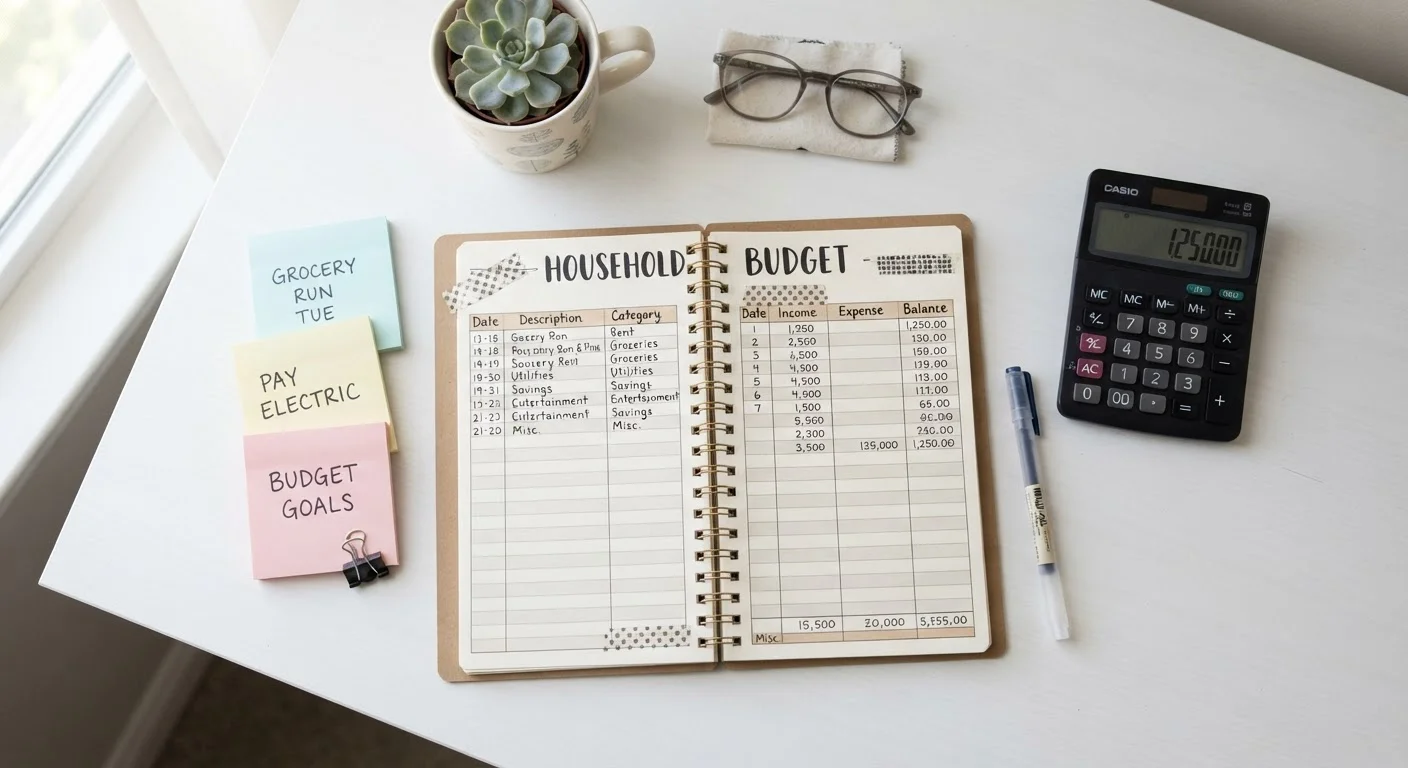
Write the agreed budget down in a format both parties can access and update — a shared spreadsheet or a budgeting app with multi-user access works well. Verbal agreements fade; a written record prevents later disputes about what was decided. Include: total household income, each person's contribution amount, every shared expense line, savings allocation, and each person's remaining personal spending money.
Schedule regular check-ins and adjust as needed
A budget set once and never revisited stops reflecting reality quickly. Commit to a monthly review — 20 to 30 minutes is usually sufficient — to compare actual spending against the plan, flag overruns, and adjust categories as circumstances change. Treat income changes, new expenses, or shifting goals as triggers for an immediate budget revision, not something to address later.
For habits that make this consistency easier to sustain, see our guide to budgeting habits that hold up over time.
Avoid Assuming Equal Contributions Are Always Fair
A 50/50 expense split can create real hardship when incomes are significantly unequal. Consider proportional contribution models — where each person pays a percentage of shared costs matching their share of total household income — to keep things equitable rather than just equal.
Keeping the Shared Budget on Track
The most common reason shared budgets fail isn't math — it's follow-through. One person tracks diligently while the other disengages, or an unplanned expense blows a category and no one adjusts the plan to compensate.
Set a Standing Monthly Money Date
Schedule a recurring 30-minute meeting — same day, same time each month — to review spending, revisit goals, and flag concerns early. Consistency removes the awkwardness of initiating money conversations ad hoc and builds a habit that pays off for years. See our Monthly Budget Review Checklist for a structured agenda to follow.
Households with variable income face an additional layer of complexity. If one or more members earns inconsistently, the proportional contribution model becomes especially useful — contributions scale with what actually came in. For a deeper look at budgeting when income fluctuates, see our article on budgeting with irregular income.
As your household finances stabilize and grow, a shared budget also creates the foundation for longer-term financial planning. Understanding saving and debt management strategies and eventually investing essentials becomes much easier when your baseline spending is already organized and transparent.
This article is for general informational and educational purposes only. It does not constitute personalized financial, tax, or legal advice. Consult a qualified financial professional before making significant decisions about your household finances.