
How Each Approach Works
Understanding the difference between index funds and actively managed funds starts with how they pursue returns. To get a foundation on investing broadly, see what it actually means to invest your money.
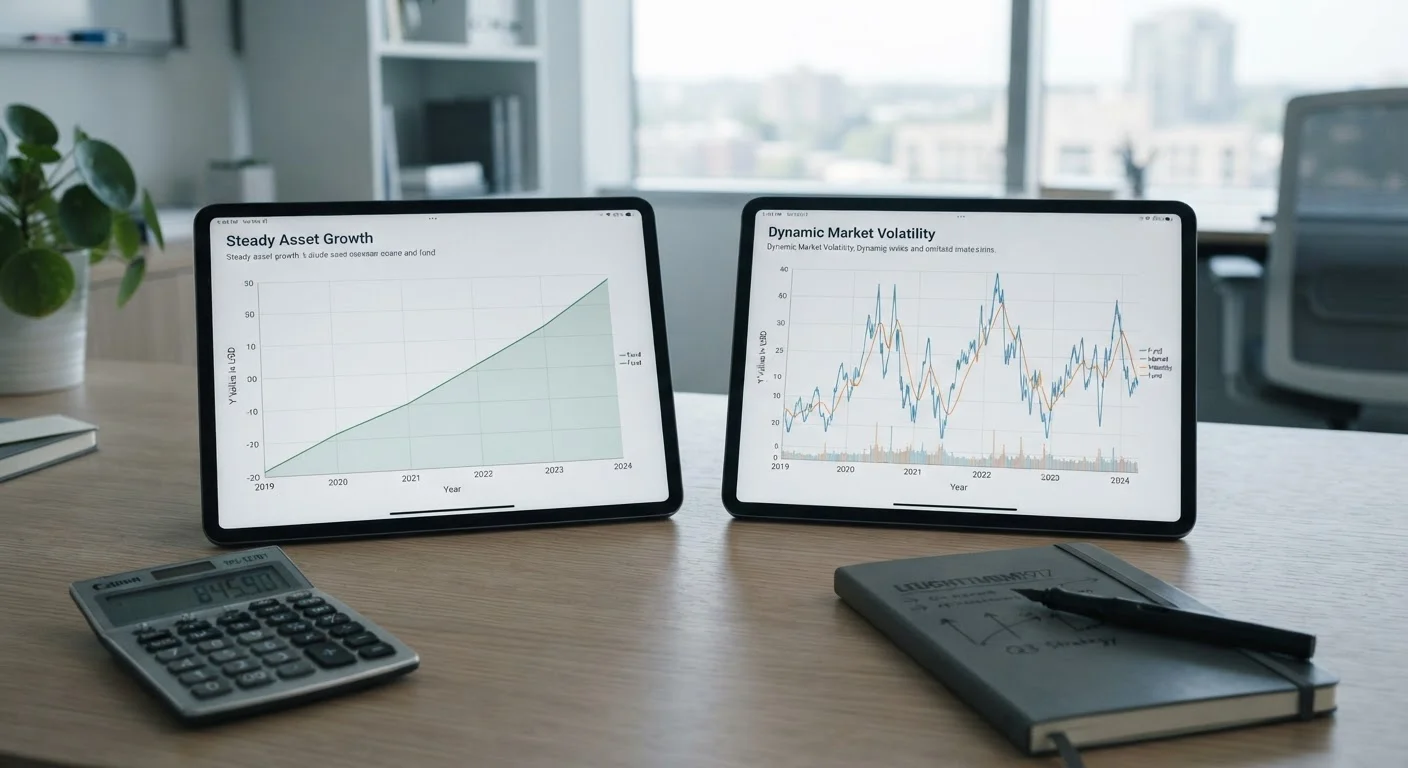
Index funds are passively managed. They are designed to replicate the performance of a specific market index — such as the S&P 500 or the total US bond market. The fund buys and holds the same securities as the index, in the same proportions. No team of analysts is trying to pick winners; the fund simply mirrors its benchmark. This results in very low turnover (buying and selling) and minimal operating costs.
Actively managed funds, by contrast, employ portfolio managers and research teams who make ongoing decisions about which securities to buy, hold, or sell. Their explicit goal is to outperform a benchmark index — not just match it. This requires continuous research, analysis, and trading activity, all of which adds cost.
Both fund types pool money from many investors, offering built-in diversification across multiple securities. For a primer on the underlying assets these funds hold, see stocks, bonds, and cash: the building blocks of a portfolio.
| Criterion | Index Funds | Actively Managed Funds |
|---|---|---|
| Management style | Passive — tracks a benchmark | Active — manager selects holdings |
| Typical expense ratio | Very low (often under 0.10%) | Higher (often 0.50%–1.00%+) |
| Goal | Match market index returns | Outperform market benchmark |
| Portfolio turnover | Low — infrequent trading | Higher — ongoing buying and selling |
| Transparency | High — holdings mirror index | Varies — may disclose holdings quarterly |
| Long-term outperformance rate | Matches index by design | Majority underperform over 10–15 years |
The Cost Difference — and Why It Matters
Fees are one of the most consequential differences between these two fund types. Funds charge an expense ratio — an annual percentage of your invested assets that covers operating costs. For index funds, expense ratios are often a fraction of a percent. For actively managed funds, ratios can be ten times higher or more, and some charge additional sales commissions called loads.
~90%
Active large-cap funds underperforming over 15 years
S&P Dow Jones Indices SPIVA reports have consistently found that roughly 90% of actively managed US large-cap funds underperform the S&P 500 over 15-year periods, after fees.
0.03%–0.10%
Typical index fund expense ratio range
Many broad-market index funds carry annual expense ratios well below 0.20%, compared to actively managed funds that often charge 0.50% or more annually.
Over time, even a seemingly small fee difference compounds significantly. A higher expense ratio means less of your return stays in your account each year. This is why cost is central to almost any comparison of fund types — it is one of the few variables investors can control with certainty.
This does not mean actively managed funds are never appropriate. In certain market segments — such as emerging markets or small-cap stocks — where information is less evenly distributed, skilled managers may have a greater opportunity to add value. However, this potential must be weighed against the higher cost and the statistical reality that sustained outperformance is rare.
Performance: What the Evidence Shows
The central promise of active management is market-beating returns. The evidence on whether this promise is consistently delivered is sobering. Research tracking actively managed funds over long periods — including annual reports published by index provider S&P Dow Jones Indices under their SPIVA (S&P Indices Versus Active) series — has repeatedly found that the majority of actively managed funds underperform their respective benchmark index over 10- and 15-year periods, after fees.
This does not mean no active fund ever outperforms. Some do, sometimes by meaningful margins. The challenge for investors is that identifying in advance which funds will outperform — and whether past outperformance will continue — is genuinely difficult. Manager skill, market conditions, and fee drag all interact in unpredictable ways.
Past Performance Is Not a Guarantee
When evaluating any fund, regulators require disclosure that past performance does not guarantee future results. An actively managed fund that outperformed its benchmark in one period may underperform in the next. This uncertainty is a core reason many financial educators emphasise cost control as a more reliable factor than manager selection. Always review a fund's prospectus and consider speaking with a licensed financial adviser before investing.
Index funds, by design, will never beat the market — they aim to match it, minus a small fee. For many long-term investors, reliably capturing market returns at low cost has proven to be a competitive outcome. That said, every investor's situation is different. Consulting a licensed financial adviser can help you determine which structure aligns with your goals, timeline, and risk tolerance.
For context on how these decisions fit into a broader financial picture, the Traditional IRA vs. Roth IRA comparison explores how account type can affect your investment strategy alongside fund selection.
This article is for general informational and educational purposes only and does not constitute personalised financial, investment, or tax advice. Consult a qualified financial professional before making investment decisions.