Why Mental Stimulation Matters for Indoor Cats
Indoor cats live longer, on average, than cats with regular outdoor access — but the indoor environment creates a real challenge: without intentional enrichment, it can become monotonous. Cats are natural hunters and explorers. When those drives have nowhere to go, boredom sets in, and boredom has measurable consequences.
Veterinary behaviorists link understimulation to a range of problems including overgrooming, aggression, excessive vocalization, and destructive scratching. Some cats become withdrawn and lethargic — symptoms that owners sometimes mistake for a calm temperament rather than a welfare concern. For a fuller picture of what indoor life means for cats, see Indoor Life vs. Outdoor Access: The Real Trade-Offs for Domestic Cats.
The good news: meeting a cat's cognitive and physical needs doesn't require expensive setups. It requires understanding what cats actually need and providing it consistently.
~10 years
Average indoor cat lifespan
Indoor cats generally live significantly longer than outdoor cats, according to veterinary consensus, though environment quality plays a meaningful role in that longevity.
~13–18 hrs
Hours cats sleep daily on average
While cats sleep a large portion of the day, their waking hours benefit greatly from structured stimulation — leaving enrichment gaps can compound boredom.
Best Practices for Keeping Your Cat Mentally Active
These approaches are grounded in feline behavioral science and widely recommended by veterinary professionals. Tailor them to your cat's age, health status, and individual personality.
Rotate toys on a regular schedule rather than leaving all of them out at once.
Cats habituate quickly to objects that remain in their environment. A toy that was exciting on Monday becomes invisible by Friday. Rotating a selection every few days restores novelty and reignites curiosity without requiring new purchases.
Schedule two to three short interactive play sessions every day.
Interactive play — using a wand, feather, or laser pointer — engages the predatory sequence that indoor cats rarely complete otherwise. Short sessions of five to ten minutes are more stimulating than one long session and are easier to maintain as a habit.
Create vertical space and window access to expand your cat's usable territory.
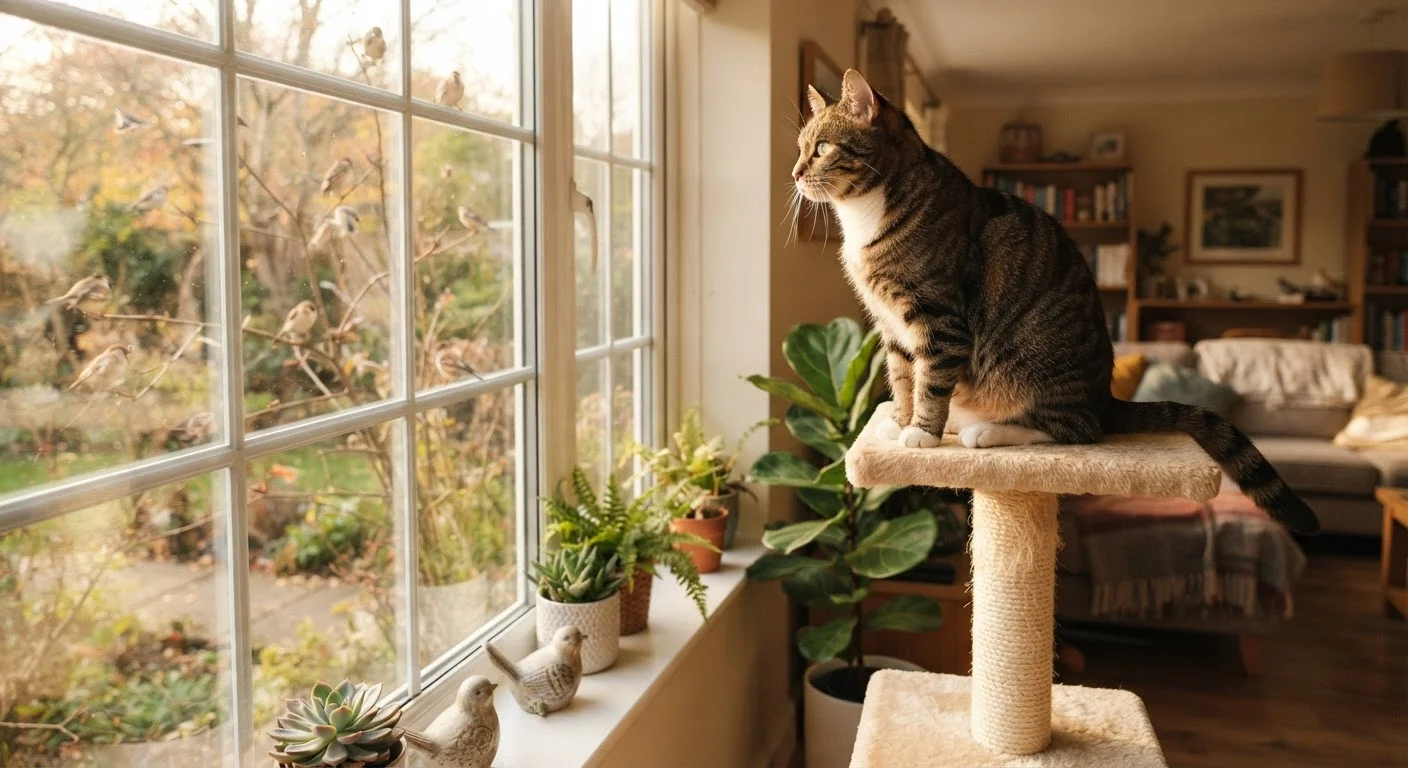
Cats naturally seek elevated vantage points for safety and observation. Adding a cat tree, wall-mounted shelves, or simply clearing a window ledge increases the functional square footage of your cat's world and satisfies their drive to survey their environment.
Use puzzle feeders or food-dispensing toys at mealtimes.
Eating from a bowl takes seconds and provides no cognitive engagement. Puzzle feeders slow eating, require problem-solving, and make food acquisition feel earned — which aligns with natural foraging behavior and reduces boredom-related overeating.
Introduce safe, novel scents and textures regularly.
A cat's sense of smell is many times more sensitive than a human's, and scent exploration is a significant form of environmental enrichment. New smells — from safe herbs, cardboard boxes, or paper bags — activate investigation behaviors that keep cats mentally occupied.
Provide dedicated scratching surfaces in multiple locations.
Scratching is both a physical need — to maintain claw health — and a marking behavior that gives cats a sense of ownership over their space. Without appropriate outlets, cats will find their own, usually on furniture. Offering variety in texture and orientation (vertical and horizontal) meets different individual preferences.
Start Small: Quick Wins You Can Try Today
Enrichment doesn't have to be an overhaul. A few targeted changes can make a meaningful difference in how engaged and content your cat feels day to day. For a more comprehensive enrichment framework, The Indoor Cat Enrichment Playbook is a useful companion resource.
Building Enrichment Into Your Cat's Daily Routine
Consistency matters as much as novelty. Cats are creatures of habit, and a predictable structure — with planned enrichment woven in — helps reduce anxiety and gives your cat something to anticipate. Scheduled interactive play before meals, for example, mimics the hunt-catch-eat sequence cats are wired for and can reduce food-related anxiety and nighttime restlessness.
Match Playtime to Your Cat's Energy Peaks
Most cats are naturally more active at dawn and dusk — a pattern inherited from their wild ancestors. Scheduling interactive play sessions during these windows tends to produce the most enthusiastic engagement. If your cat seems uninterested during midday attempts, try shifting the timing rather than assuming they don't want to play.
Building a Routine That Actually Works for Your Cat covers how to structure your cat's day in a way that supports both enrichment and calm. The key is not perfection — it's reliable repetition that gives your cat a sense of control over their environment.
This article is for general informational purposes only and does not constitute veterinary advice. Always consult a licensed veterinarian for guidance specific to your cat's health and behavioral needs.