Why Enrichment Matters for Indoor Cats
Domestic cats kept exclusively indoors live longer on average than their outdoor counterparts — but longevity alone doesn't equal wellbeing. Without opportunities to stalk, climb, hide, and problem-solve, cats can develop behavioral problems and chronic stress that erode their quality of life.
Veterinary behaviorists describe enrichment as any modification to an animal's environment or daily routine that increases behavioral opportunities and reduces stress. For cats, that means supporting the same predatory, exploratory, and social behaviors they would express outdoors — just within a safe, managed setting.
Weighing the real trade-offs of indoor versus outdoor life helps owners make informed housing decisions, but once the choice to keep a cat indoors is made, enrichment becomes a genuine welfare responsibility — not an optional upgrade.
50–70%
Cats that respond to catnip
Response to catnip is genetically determined; silver vine produces reactions in a broader proportion of cats, including non-responders.
2–3x
Recommended daily interactive play sessions
Veterinary behaviorists generally recommend two to three short owner-led play sessions per day for adult indoor cats.
60%+
U.S. pet cats kept primarily indoors
According to American Veterinary Medical Association surveys, the majority of owned cats in the U.S. are kept exclusively or primarily indoors.
The Five Pillars of Feline Enrichment
The American Association of Feline Practitioners and other veterinary organizations frame enrichment around five core categories. Understanding these helps owners build a balanced routine rather than defaulting to whichever toy caught their attention last.
- Environmental enrichment: Space, vertical surfaces, hiding areas, and window access.
- Feeding enrichment: Puzzle feeders, food-foraging, and varied food delivery methods.
- Sensory enrichment: Scents, sounds, and visual stimulation from outside the home.
- Social enrichment: Positive interactions with humans and, when appropriate, other animals.
- Play and cognitive enrichment: Toys, training, and problem-solving activities that engage the predatory sequence.
No single pillar is sufficient on its own. A cat with a beautiful cat tree but no interactive play is still under-stimulated. Effective enrichment layers multiple pillars throughout the day.
Environmental Design: Space, Height, and Hiding
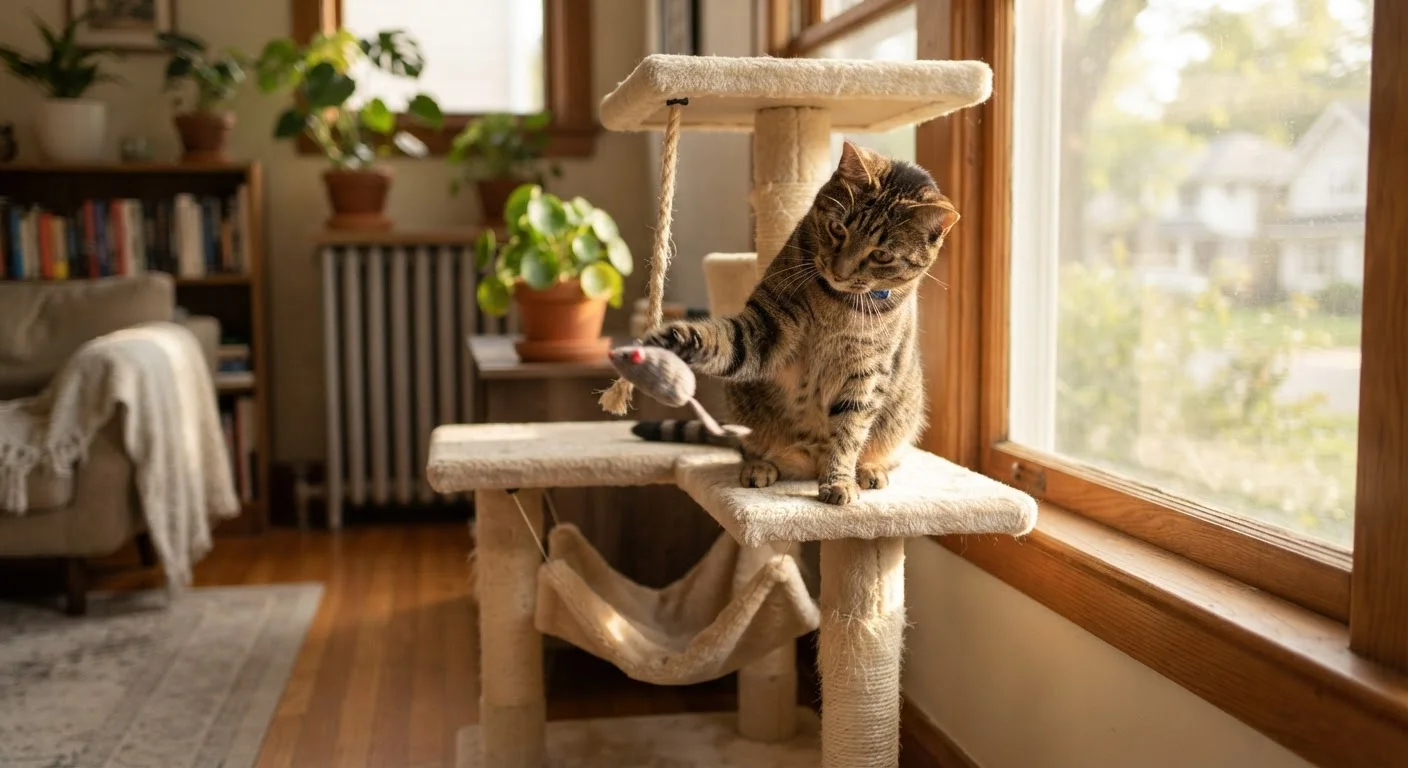
Cats are vertical animals. Access to elevated perches — shelves, cat trees, or window seats — gives them both a physical outlet and a psychological sense of safety and control over their territory. Even in smaller homes, wall-mounted shelves at varying heights can create a meaningful vertical landscape.
Equally important are hiding spots: enclosed beds, cardboard boxes, or covered tunnels. Hiding is a coping mechanism, not antisocial behavior. Cats that have reliable retreats show lower stress markers than those without them.
Window access is a high-value resource. A secured window perch with a view of bird feeders, plants, or passing foot traffic provides ongoing visual and auditory stimulation — essentially free enrichment. For multi-cat homes, managing territory and resources across cats becomes especially important, since competition over key spots like windows and elevated perches is a common source of conflict.
Rotate Perches and Furniture Placement
Periodically rearranging or adding new climbing structures keeps the environment feeling novel. Even moving an existing cat tree to a different window can renew a cat's interest. Novelty itself is a form of enrichment.
Play, Hunting, and Interactive Engagement
Cats are obligate predators, and their nervous systems are wired for the hunt-catch-kill-eat sequence. Play that mimics this — wand toys that dart and pause unpredictably, lightweight prey-sized objects that skitter across the floor — is far more engaging than static toys left out permanently.
Importantly, interactive play requires a human on the other end. Studies in feline behavior consistently show that owner-led play sessions produce greater arousal and satisfaction than solo toy access. Aim for two to three short sessions daily (five to ten minutes each) rather than one long session.
End every interactive play session with a small food reward to complete the hunt-catch-eat sequence. This simple step significantly reduces post-play restlessness and nighttime vocalization in many cats.
Feline predatory behavior follows a neurologically driven sequence; completing that sequence with a food reward provides psychological closure and reduces frustration.
Introduce new toys inside a paper bag or box before placing them in the play area. Cats are neophobic by nature — a brief 'discovery' context makes new items far more appealing than sudden placement in their usual space.
Neophobia (wariness of new things) is a well-documented trait in domestic cats; staged introduction leverages their exploratory instinct rather than triggering avoidance.
For deeper guidance on keeping a cat mentally engaged day to day, see keeping an indoor cat mentally stimulated.
Feeding Enrichment and Puzzle Feeders
In the wild, cats spend a significant portion of their waking hours hunting. Delivering all calories from a bowl in two minutes leaves that drive with nowhere to go. Puzzle feeders, lick mats, snuffle mats, and food-dispensing toys redirect foraging energy constructively.
Start with low-difficulty puzzles if your cat is new to them — frustration without reward can put cats off the activity entirely. Gradually increase complexity as confidence builds. Hiding small portions of food in multiple locations around the home also mimics natural foraging patterns and encourages movement throughout the space.
Puzzle Feeders and Caloric Balance
Puzzle feeders should distribute your cat's normal daily food portions — not supplement them. Increasing food as enrichment without adjusting for total calories can contribute to weight gain. If your cat is on a therapeutic diet, check with your veterinarian before introducing any new feeding method.
Feeding enrichment can also help cats that eat too quickly, as the physical challenge naturally slows intake. Always ensure total daily caloric intake remains appropriate — consult your veterinarian if you are unsure how to divide meals across multiple enrichment methods.
Sensory and Social Enrichment
Beyond sight and movement, cats engage strongly with scent. Rotating novel scents — dried catnip, silver vine, valerian, or safe herbs like rosemary — can trigger exploratory and play behaviors. Catnip produces a response in roughly 50–70% of cats due to a genetic trait; silver vine tends to elicit a response in a broader proportion of cats, including many that do not respond to catnip.
Sound enrichment — nature sounds, bird calls, or ambient outdoor audio — can hold a cat's attention and provide low-level stimulation during quiet periods. Keep volumes moderate; sudden loud sounds are stressful rather than stimulating.
Social enrichment with humans matters too. Cats that receive regular, calm, voluntary petting and lap time show lower baseline stress indicators. The key word is voluntary — forced interaction is counterproductive. Let the cat initiate or clearly accept contact. Owners interested in broadening enrichment beyond cats can find useful parallels in why boredom is a real welfare issue for small pets.
“Environmental enrichment is not a luxury for cats — it is a medical necessity. A cat that cannot express its natural behaviors is a cat at risk for both behavioral and physical health problems.”
— Tony Buffington, Veterinary internist and feline environmental health researcher, The Ohio State University
Recognizing and Addressing Boredom
Boredom in cats rarely looks like a listless dog staring at the door. It tends to manifest as behavioral changes: increased aggression toward humans or other pets, compulsive over-grooming (which can lead to skin lesions), repetitive vocalization, destructive scratching, or withdrawal and hiding beyond normal resting patterns.
If these signs appear, resist the urge to immediately assume a medical cause — though a veterinary visit is always warranted to rule one out. In many cases, a structured enrichment audit (reviewing which pillars are missing or thin) reveals clear gaps. Introducing even one new enrichment activity per week, and rotating toys and puzzles regularly to preserve novelty, often produces visible behavioral improvement within days to weeks.
Sudden Behavior Changes Need Veterinary Attention
Over-grooming, aggression, or prolonged hiding can be signs of pain, illness, or anxiety — not just boredom. Always consult a veterinarian before attributing behavioral changes solely to insufficient enrichment. Early medical intervention prevents many conditions from becoming harder to treat.
This article is for general informational purposes only and is not a substitute for professional veterinary advice. If your cat is showing sudden behavioral changes, please consult a licensed veterinarian or a board-certified veterinary behaviorist.