
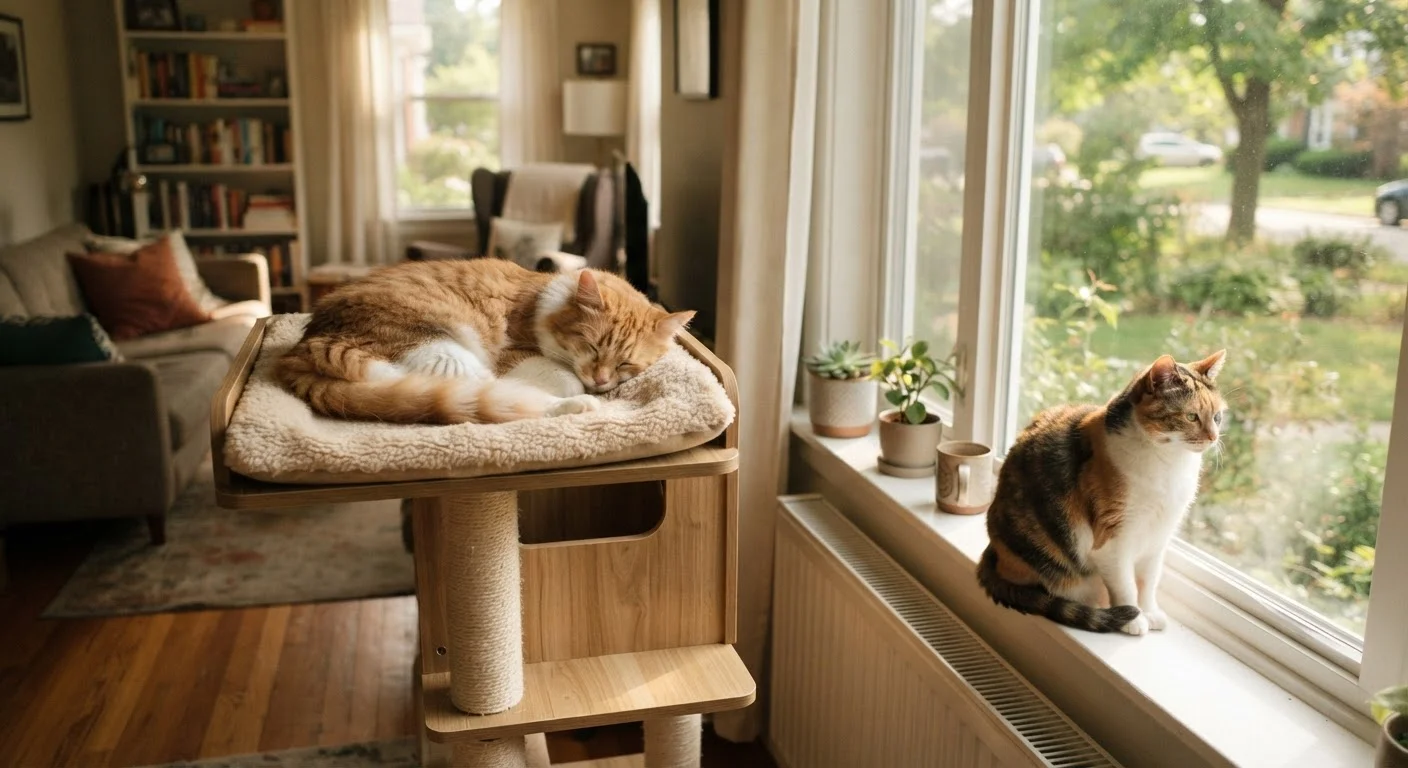
Why Cats Struggle to Share Space
Unlike dogs, domestic cats did not evolve as pack animals. Their wild ancestors were largely solitary hunters who held individual territories. That instinct persists indoors, which means two cats sharing the same square footage are not automatically compatible — they need structure, resources, and time to negotiate coexistence.
Feline social tension often goes unnoticed because cats rarely fight openly. Instead, conflict shows up as one cat blocking another's path to the litter box, subtle staring contests, or a lower-status cat hiding and eating less. Recognizing these quieter signals early is key to preventing lasting stress or injury.
If you are bringing an additional cat into a home that already has one, the groundwork you lay before they ever share a room matters enormously. For context on setting up a cat's first environment, see our guide for first-time cat owners.
Read Low-Level Stress Signals Early
Stress in multi-cat homes often shows up quietly — reduced grooming, over-grooming, hiding, or changes in litter box use. Catching these signs early gives you more options before tension escalates. If a cat's eating or elimination habits change significantly after a new cat arrives, a vet visit is a good first step to rule out stress-related illness.
What You Need Before You Start
Successful multi-cat management depends on having enough of the right resources in the right places. Gather the following before beginning any introduction process.
What you will need
Litter boxes (n+1 rule)
Providing enough boxes in different locations prevents one cat from guarding access and forces another to eliminate elsewhere.
Cat tree or wall-mounted shelves
Vertical space allows cats to establish height-based hierarchy and retreat without conflict on the floor.
Separate food and water bowls
Feeding cats at distance or in separate rooms eliminates resource guarding around meals.
Pheromone diffuser
Synthetic feline facial pheromones may help reduce ambient stress during introductions, though responses vary by individual cat.
Baby gate or screen door
Allows cats to hear, smell, and see each other with a physical barrier before unsupervised contact.
Step-by-Step Introduction and Management
Follow these steps in order. Rushing any stage increases the risk of entrenched aggression that is much harder to reverse.
Set up a dedicated safe room for the new cat
Before the new cat enters the home, prepare a separate room with its own litter box, food, water, bedding, and hiding spots. This space gives the newcomer time to decompress and lets resident cats adjust to the new scent gradually without direct confrontation.
Allow scent exchange before visual contact
For the first several days, slide a towel or soft toy under the safe room door so cats can investigate each other's scent at their own pace. Feed each cat near (but not directly at) the door so they associate the other's smell with a positive experience.
Introduce visual access with a barrier
Once both cats seem calm and curious rather than defensive near the door, crack the safe room door or install a baby gate or screen door. Supervised visual access lets them see each other without the risk of a physical altercation. Keep these sessions short and calm initially.
Allow brief supervised shared access
When barrier interactions are consistently calm, allow the new cat limited supervised time in the main living area while the resident cat is present. Keep sessions to 10–20 minutes at first. Offer high-value treats during these encounters to reinforce calm behavior.
Expand access gradually and monitor ongoing dynamics
Slowly increase shared time over days to weeks, always monitoring for signs of bullying — one cat consistently chasing, blocking, or cornering another. Ensure all cats have visible, unobstructed escape routes and multiple resting spots at varying heights. Full integration timelines vary widely; some cats settle within weeks, others need months.
Persistent Aggression Needs Professional Input
If cats escalate to injurious fighting, or if one cat becomes chronically unable to access food, water, or the litter box, do not simply wait it out. Consult your veterinarian and consider a referral to a board-certified veterinary behaviorist. Prolonged stress can lead to physical health problems in both cats.
Once cats are sharing space comfortably, a consistent daily routine — predictable feeding times, structured play sessions, and stable rest zones — reinforces calm behavior long-term. Enrichment also plays a major role; the Indoor Cat Enrichment Playbook offers evidence-backed ideas for keeping multiple cats mentally engaged without increasing competition.