Boredom Is More Than Just Boring
When people picture animal welfare problems, small pets rarely come to mind first. But hamsters, rabbits, guinea pigs, and birds are cognitively active animals whose brains need stimulation just as much as their bodies need food and water. Without it, they don't simply become quiet — they often become distressed.
Signs of chronic boredom in small pets include repetitive behaviors like bar-chewing or pacing (called stereotypies), over-grooming, lethargy, or sudden aggression. These aren't personality quirks — they're signals that an animal's environment isn't meeting its needs. Understanding this is the first step toward better care.
If you're also a cat owner wondering how enrichment applies across species, our guide on keeping an indoor cat mentally stimulated covers parallel principles worth comparing.
Observe Before Assuming
Not every enrichment item will appeal to every individual animal. Before investing in elaborate setups, spend time watching your pet's natural behavior in its current environment. What does it gravitate toward? What does it ignore? Let those observations guide your enrichment choices rather than relying solely on species generalizations.
Enrichment Strategies for the Most Common Small Pets
There's no single enrichment formula that works for every small animal. The strategies below are organized by species group and rooted in each animal's natural behavior. Use them as a starting point, then observe how your specific pet responds — animals, like people, have individual preferences.
Hamsters: Honor the Urge to Run, Dig, and Forage
Wild hamsters travel several miles each night and excavate complex burrow systems. In a cage, that instinct doesn't disappear — it needs an outlet. A solid-surface wheel (at least 8 inches in diameter for dwarf hamsters, 10–12 inches for Syrians) is a non-negotiable baseline, not an optional accessory.
Layer several inches of substrate — paper-based bedding works well — so hamsters can burrow deeply. Scatter feeding, where you hide small portions of food throughout the enclosure rather than placing it all in a bowl, turns every meal into a foraging session. Cardboard tubes, cork bark, and tissue-box hideouts are low-cost enrichment additions that get used heavily.
Scatter feeding turns every meal into a foraging session, satisfying one of a hamster's core instincts.
Rabbits: Space, Chewing, and Social Connection
Rabbits are highly social, curious animals that suffer significantly from confinement and isolation. At minimum, a rabbit should have multiple hours of supervised free-roaming time outside its enclosure daily. Permanent housing in a small hutch with no exercise opportunity is a welfare concern recognized by veterinary and animal behavior professionals.
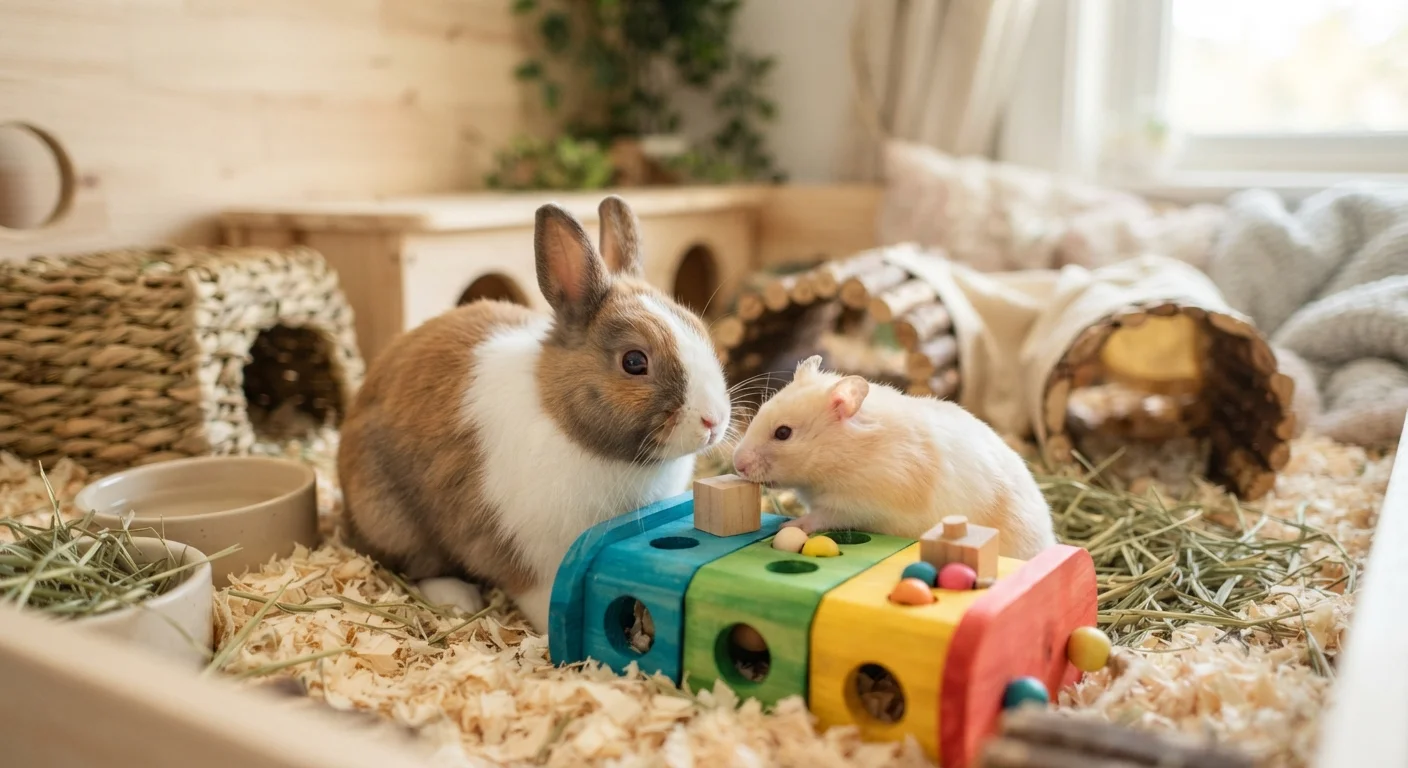
Chewing is both a physical necessity (to wear down continuously growing teeth) and a behavioral need. Provide untreated wood blocks, willow balls, hay tunnels, and cardboard boxes. Puzzle feeders that require manipulation to release pellets or hay add a problem-solving layer. If possible, house rabbits in bonded pairs — social companionship reduces stress substantially. For information on handling these sensitive animals safely, see our guide on handling small animals without stressing them out.
Rabbits need hours of daily free-roaming time — confinement alone is a recognized welfare concern.
Guinea Pigs: Companionship First, Then Environment
Guinea pigs are among the most social small mammals kept as pets. Housing a guinea pig alone is widely considered suboptimal by animal welfare organizations; they communicate through vocalizations, groom each other, and visibly show stress when isolated. If your housing situation prevents a bonded pair, daily human interaction becomes even more critical.
Their enclosures should be large enough for running — a minimum floor area of 7.5 square feet is a commonly cited baseline, with more space always better. Tunnels, low wooden platforms, hay piles to burrow in, and hanging veggie skewers all provide varied stimulation. Rearranging the layout periodically reactivates exploratory behavior.
For guinea pigs, companionship with another guinea pig is often the single most impactful form of enrichment.
Pet Birds: Cognitive Challenge Is Non-Negotiable
Birds — particularly parrots and cockatiels — have cognitive complexity that rivals or exceeds many mammals. Left without stimulation, they develop serious behavioral problems: feather-destructive behavior, screaming, and aggression. A large, varied cage with multiple perch textures, foraging toys, and rotated puzzle feeders is a foundation, not a luxury.
Out-of-cage time with supervised interaction is essential for most companion bird species. Teaching simple behaviors through positive reinforcement also counts as enrichment — it engages problem-solving pathways and builds trust. Our comprehensive article on caring for a pet bird from diet to mental stimulation covers this in detail. For species-specific considerations, see our comparison of budgies, cockatiels, and finches.
Teaching simple behaviors through positive reinforcement engages a bird's problem-solving pathways and builds trust.
All Small Pets: The Power of Novelty and Rotation
Regardless of species, habituation — the process by which animals stop responding to stimuli they've seen many times — limits the long-term value of any fixed enrichment setup. What excites your rabbit on day one may be ignored by week three. Regular rotation is the antidote.
You don't need to constantly buy new items. Move existing toys to different locations, reintroduce stored items after a break, or repurpose safe cardboard packaging. The goal is controlled novelty: enough change to keep the animal engaged, introduced carefully enough not to cause anxiety in more stress-sensitive species.
Rotation — not replacement — is the most practical way to sustain long-term enrichment without ongoing cost.
Enrichment Doesn't Require Expensive Products
Many of the most effective enrichment tools for small pets are free or low-cost: cardboard tubes, paper bags, crumpled newspaper for burrowing, or small boxes stuffed with hay. What matters is that the item engages natural behavior — foraging, chewing, exploring, or problem-solving. Always verify that any material you use is free from inks, adhesives, or coatings that could be harmful if chewed or ingested.
Making Enrichment a Consistent Habit
The most effective enrichment isn't a one-time cage upgrade — it's an ongoing practice. Rotate toys and foraging setups every week or two so the environment stays novel. Introduce new items gradually, especially for prey animals like rabbits and hamsters, who may initially treat unfamiliar objects with suspicion before warming up to them.
Keep a simple mental checklist: Is my pet foraging? Exploring? Moving? Interacting socially (if a social species)? If the answer is rarely, it's time to reassess the setup. For a deeper dive into species-specific strategies, see our companion piece on enrichment ideas that keep small pets mentally active.
And if you notice behavioral changes that persist even after enrichment improvements, it's worth consulting a veterinarian — preferably one experienced with small or exotic animals. Our article on what exotic vets do and why your small pet may need one can help you find the right professional.
This article provides general pet care information and is not a substitute for advice from a qualified veterinarian. Always consult a vet for guidance specific to your pet's health and needs.