How Each Technology Produces a Picture
Understanding the difference between OLED, QLED, and LED starts with one question: where does the light come from?
LED TVs use a panel of liquid crystals (an LCD) that cannot produce light on their own. A grid of LED bulbs behind the screen provides the backlight. The liquid crystals act like tiny shutters, opening and closing to control how much light passes through to create the image. The backlight is always on, which means that even in scenes that should appear completely black, some light leaks through — resulting in dark grays rather than true blacks.
QLED — a term most closely associated with quantum dot LCD panels — works on the same fundamental principle as LED. A layer of microscopic semiconductor particles called quantum dots sits between the LED backlight and the LCD layer. These dots absorb the backlight and re-emit it at very precise wavelengths, producing a wider, more saturated range of colors. QLED is essentially an enhanced LED TV, not a separate underlying technology. For a broader look at how display specifications interact, see our display terms reference guide.
OLED — Organic Light-Emitting Diode — works completely differently. Each individual pixel contains an organic compound that emits its own light when electricity passes through it. There is no separate backlight. When a pixel needs to display black, it simply turns off entirely, producing an absolute zero-light black that backlit panels cannot match.
| Criterion | OLED | QLED / LED |
|---|---|---|
| Light source | Each pixel self-illuminates | LED backlight behind LCD panel |
| Black levels | True black (pixel off) | Dark gray (backlight always on) |
| Contrast ratio | Effectively infinite | High, but limited by backlight |
| Peak brightness | Moderate to high | Generally higher |
| Burn-in risk | Present with prolonged static images | Very low risk |
| Viewing angle | Wide, consistent color off-axis | Varies; VA panels shift noticeably |
| Color gamut (QLED vs OLED) | Wide, accurate | QLED: very wide; standard LED: narrower |
Contrast, Brightness, and Color: The Real-World Differences
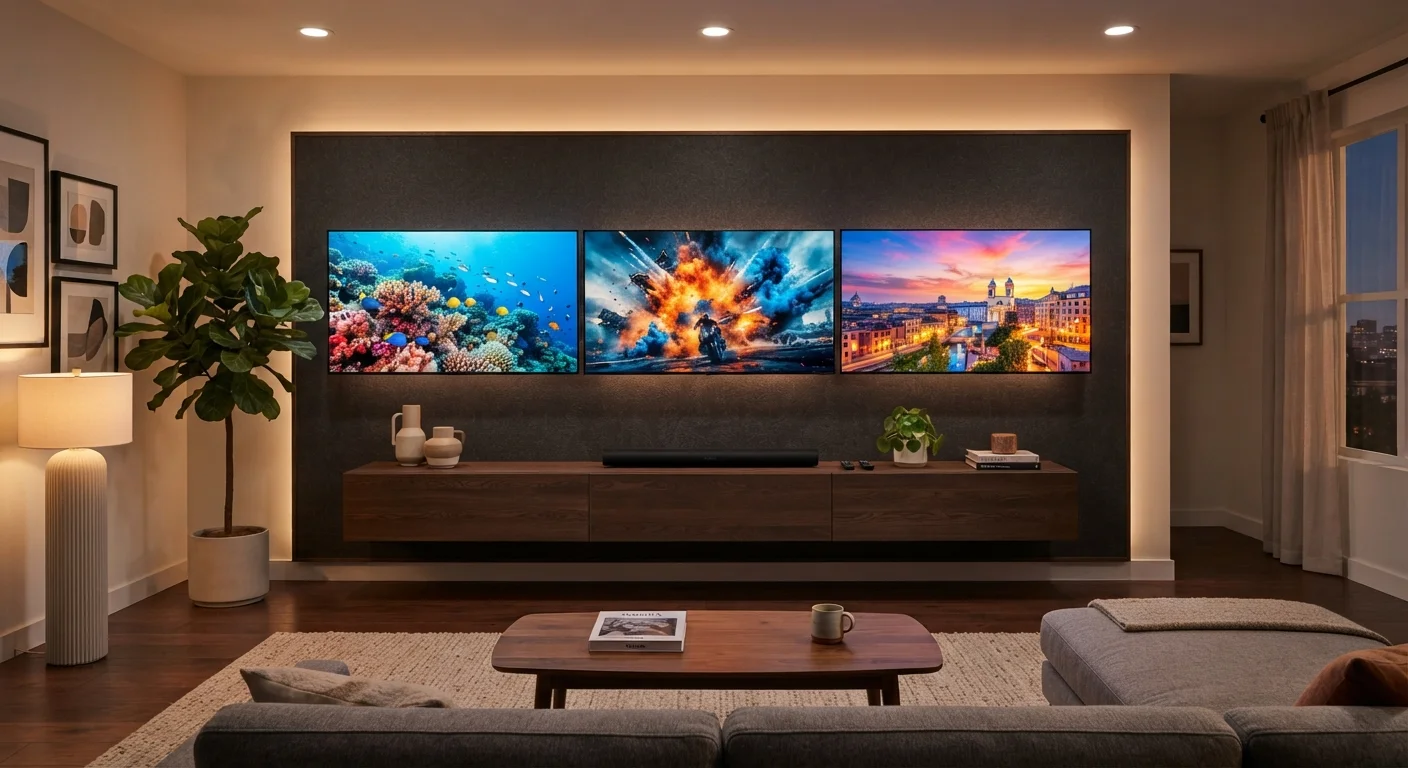
Because OLED pixels turn off completely, the contrast ratio — the difference between the brightest white and the darkest black on screen simultaneously — is theoretically infinite. This produces images with remarkable depth, particularly in cinematic content with a wide range of light and shadow.
Where OLED gives ground is in peak brightness. LED and QLED panels can pump out significantly more light, which matters in rooms where sunlight or overhead lighting competes with the screen. A QLED panel in a bright living room will generally remain legible where an OLED panel may look washed out under the same conditions.
Color is where QLED earns its distinction from standard LED. The quantum dot filter enables a wider color gamut — meaning the TV can display a broader range of hues — which benefits HDR content in particular. OLED also handles color accurately, and its per-pixel control means colors in dark areas of the image are not contaminated by backlight bleed. If you're also navigating resolution specifications alongside panel type, our TV resolution explainer covers how 4K and 8K fit into the picture.
~1,000–2,000 nits
Typical OLED peak brightness range
Consumer OLED panels commonly reach 1,000–2,000 nits peak brightness, while high-end QLED displays can exceed 2,000–4,000 nits in small highlight areas.
~107%
DCI-P3 color volume achievable with quantum dot panels
Quantum dot filters allow some QLED panels to cover over 100% of the DCI-P3 color space used in professional cinema mastering, compared to roughly 70–80% for basic LED sets.
Viewing angle is another practical consideration. OLED panels generally maintain consistent brightness and color accuracy when viewed from the side. Many LED and QLED displays — particularly those using VA-type LCD panels — can show noticeable color shift or brightness drop when viewers sit off to the side of the screen.
Longevity, Burn-In, and What to Watch For
One well-documented concern with OLED technology is image retention, sometimes called burn-in. The organic compounds that emit light in each pixel degrade over time with use, and if the same high-contrast static image — a channel logo, a navigation bar, a sports scoreboard — is displayed for many consecutive hours over months, a faint ghost of that image can become permanently visible on the panel.
Burn-In Risk in Context
OLED burn-in is a real phenomenon but is most relevant for specific use cases — extended gaming with static HUD elements, or using a TV as a full-time computer monitor. For standard TV and streaming use with varied content, the practical risk is low for most households. Manufacturers continue to improve panel longevity with each product generation, though no panel technology carries a zero-risk guarantee over many years of use.
LED and QLED panels do not carry the same burn-in risk because the liquid crystal layer itself is not producing light; it is simply filtering it. The backlight LEDs can dim over many years, but static image content does not etch into the panel the same way.
OLED manufacturers have developed software mitigations — pixel shifting, screen savers, and automatic brightness limiters — that substantially reduce real-world burn-in risk for typical TV viewing habits. For most households that watch varied content and do not leave the TV paused for hours at a time, burn-in is rarely an issue in practice. It is a more legitimate concern for people who use a TV as a permanent PC monitor or gaming display with a persistent heads-up display.
For a comparison of how these panel technologies translate to laptop and portable screens, our laptop screen breakdown walks through the differences in that context.