
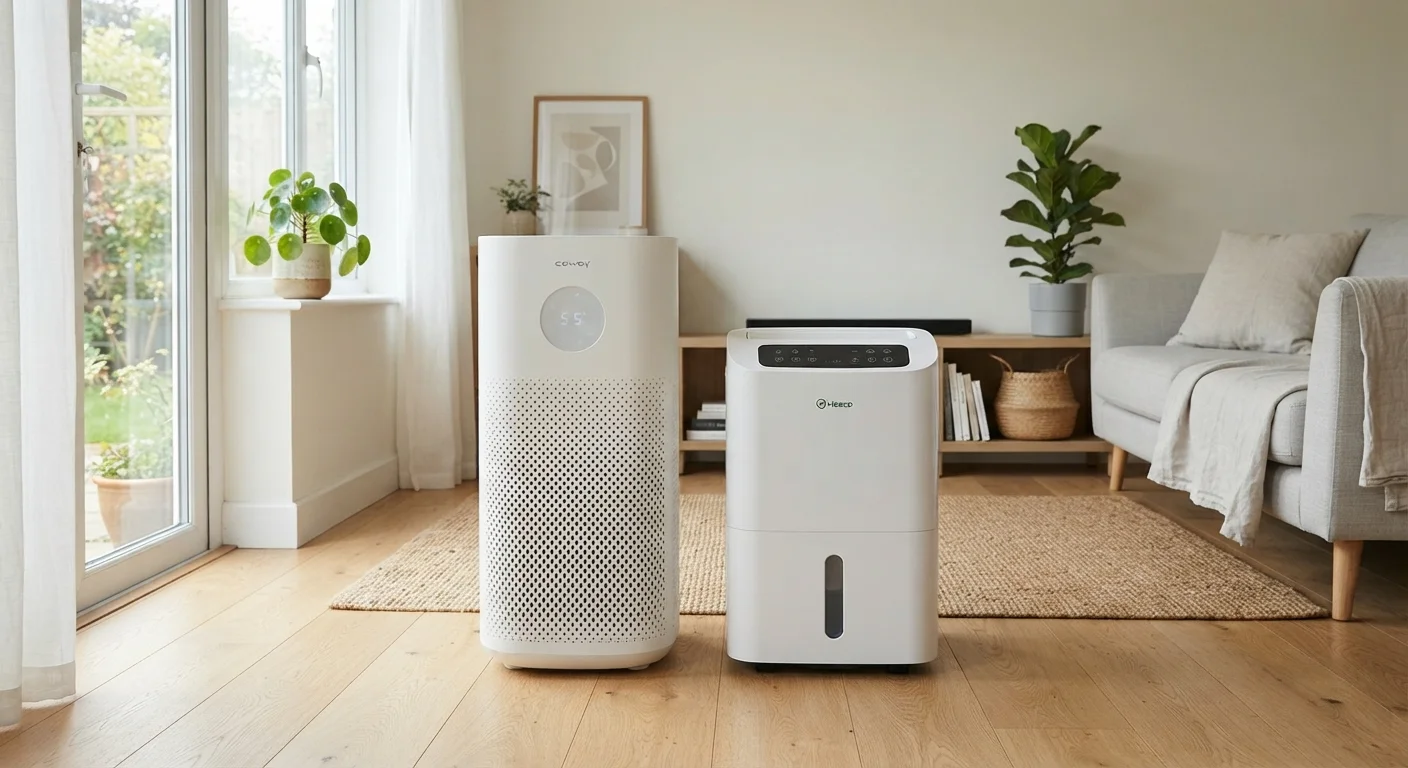
What Each Device Actually Does
The confusion between air purifiers and dehumidifiers is understandable — both improve indoor air quality in a broad sense, but through completely different mechanisms.
An air purifier moves air through one or more filters to capture particles: dust, pollen, pet dander, mold spores, smoke, and some volatile organic compounds (VOCs). The most effective units use HEPA filters (High Efficiency Particulate Air), which are rated to capture 99.97% of particles at 0.3 microns. Some models add activated carbon layers for odor and gas absorption. For a deeper look at how filtration types compare, see our full air purifier breakdown.
A dehumidifier extracts water vapor from the air, lowering the relative humidity of the room. It doesn't filter particles — it pulls in humid air, condenses the moisture over refrigerated coils, and releases drier air back into the space. The collected water drains into a removable tank or through a hose.
Neither device does the other's job. Running a dehumidifier won't clear smoke from the air. Running an air purifier won't prevent mold from growing on a damp basement wall.
| Criterion | Air Purifier | Dehumidifier |
|---|---|---|
| Primary function | Filters airborne particles and gases | Removes excess moisture from air |
| Targets | Dust, pollen, smoke, dander, VOCs | High humidity, mold conditions, condensation |
| Key technology | HEPA filter, activated carbon | Refrigeration coils, condensation collection |
| Addresses mold | Captures spores already airborne | Reduces conditions that allow mold to grow |
| Ongoing maintenance | Filter replacement every 6–12 months | Empty water tank, clean coils periodically |
| Helps with odors | Yes, especially with carbon filter | Partially — reduces musty moisture odors |
| Useful in dry climates | Yes | Rarely needed |
How to Read the Symptoms in Your Home
The fastest way to choose between these devices is to identify the actual problem you're experiencing, not just a vague sense that your air feels off.
Signs you likely need an air purifier:
- Allergy or asthma symptoms that worsen indoors
- Noticeable dust accumulation on surfaces shortly after cleaning
- Pet odors or dander despite regular grooming
- Smoke infiltration from outdoors or cooking
- Chemical smells from cleaning products, paint, or new furniture
Signs you likely need a dehumidifier:
- Musty smell, especially in basements, bathrooms, or closets
- Visible condensation on windows or walls
- Mold or mildew spots, even small ones
- Relative humidity consistently above 50% (measurable with a hygrometer)
- Wood floors warping or feeling sticky indoors during summer
50%+
Humidity level linked to dust mite growth
The EPA notes that indoor relative humidity above 50% creates favorable conditions for dust mites and mold, both common allergy triggers.
0.3 microns
Smallest particle HEPA filters capture
HEPA-rated filters must capture 99.97% of particles at 0.3 microns — smaller than most pollen grains and many airborne bacteria.
30–50%
Recommended indoor relative humidity range
The EPA and ASHRAE generally recommend maintaining indoor humidity between 30% and 50% for both comfort and to limit biological pollutant growth.
Some symptoms overlap. Mold spores, for example, are both a moisture byproduct and an airborne particle. A dehumidifier addresses the root cause; an air purifier captures spores already circulating. In severe mold situations, remediation by a qualified professional is necessary before either device will be fully effective.
Head-to-Head: Key Differences at a Glance
Understanding the practical distinctions between these two appliances helps clarify which fits your situation — and whether you might need both.
A Hygrometer Is a Useful Starting Point
Before purchasing either device, consider picking up an inexpensive hygrometer — a tool that measures relative humidity. If your indoor humidity consistently reads above 50%, a dehumidifier is likely the right first step. If humidity is normal but you're experiencing respiratory symptoms or visible dust, an air purifier is the more targeted choice. This simple measurement can save you from buying the wrong appliance.
Running costs are a real consideration for both devices. Air purifiers require periodic filter replacements (HEPA filters typically every 6–12 months depending on use). Dehumidifiers run compressors similar to a small refrigerator and can add meaningfully to electricity costs during humid months. Factor ongoing maintenance into your decision, not just the upfront price.
For broader home maintenance awareness — including tasks that quietly prevent bigger problems — the overlooked maintenance tasks most homeowners skip is worth a read.
When You Might Need Both
In certain homes and climates, using both devices together makes practical sense. High-humidity regions — the Gulf Coast, Southeast, Pacific Northwest — often combine elevated moisture with significant outdoor pollen and air quality challenges. A dehumidifier keeping humidity between 40–50% reduces the conditions that allow dust mites and mold to multiply, while an air purifier handles the airborne particles that still enter through ventilation and foot traffic.
Basements are a common dual-use case. They frequently struggle with humidity-driven mustiness and dust accumulation from storage and limited airflow. Running a dehumidifier to control moisture and an air purifier near high-traffic or sleeping areas gives more complete coverage.
The devices can operate simultaneously without interfering with each other. Place dehumidifiers in moisture-prone zones (basement, laundry room) and air purifiers in living or sleeping spaces where particle exposure matters most.
If water quality is another home concern alongside air quality, our home water filtration guide covers how to evaluate filtration options from pitchers to whole-house systems.