Why Most Storage Attempts Fall Short
Most clutter problems aren't solved by buying more bins — they're created by buying them. Containers without a clear system just relocate the mess, and before long the shelves look as chaotic as the floor did. The storage solutions that genuinely work share a common trait: they're chosen to match how a specific space is actually used, not how it looks on a shelf display.
This matters especially in homes where square footage is limited. Every room has underutilized zones — the vertical wall above a dresser, the floor space under a bed, the back of a pantry door — and tapping into those areas can dramatically change how a space functions. The list below focuses on specific approaches and the spaces where each method delivers real results. For a complementary framework on evaluating what you even need to store, see our room-by-room clearing checklist.
Modular Shelving for Living Rooms and Home Offices
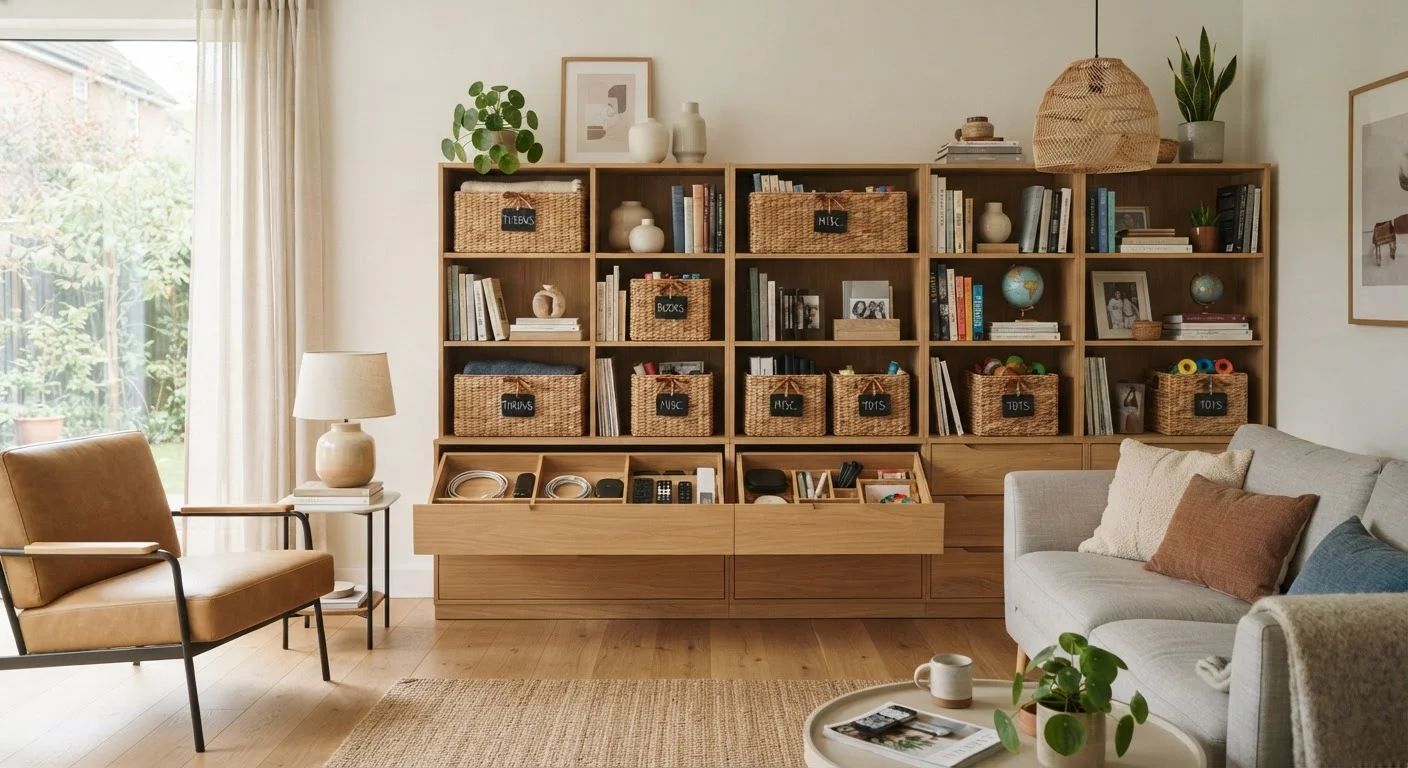
Freestanding modular shelving units are among the most versatile storage options available. Unlike built-ins, they can be reconfigured as needs change, and they make use of vertical wall space that most homes treat as dead area. In living rooms, they consolidate books, media, and everyday items that otherwise drift across surfaces. In home offices, they keep reference materials and supplies visible and accessible without requiring a separate storage room.
The key is restraint: open shelving only works when items on it are curated. Overcrowding a modular unit creates the appearance of clutter even when things are technically put away. The most effective approach is to combine open shelves for frequently used items with closed bins or boxes on lower shelves for things that don't need to be on display.
Open shelving only reduces clutter when the items on it are intentionally curated.
Drawer Dividers in Kitchens and Bedrooms
Drawer dividers solve a specific and common problem: the catch-all drawer where nothing has a fixed place and finding anything requires emptying the whole thing. In kitchens, dividers separate utensils, gadgets, and small tools so the drawer functions rather than just stores. In bedroom dressers, they prevent clothes from merging into a single pile that discourages folding.
One practical note — dividers work best after a declutter pass, not as a substitute for one. Adding structure to a drawer stuffed with items you rarely use just creates organized excess. The setup process itself is useful for identifying what actually belongs in that space.
Dividers work best after a declutter pass — they organize what you keep, not what you haven't reviewed.
Under-Bed Storage for Seasonal and Overflow Items
The space under a bed is frequently wasted in American homes, yet it can hold a meaningful volume of seasonal clothing, spare bedding, or infrequently used items. Flat rolling bins or vacuum-seal bags work particularly well here — they keep contents protected from dust and make the most of the low clearance typical under most bed frames.
For this to function without creating clutter of its own, whatever goes under the bed should be labeled clearly and reviewed seasonally. This is storage for things that are genuinely needed but not regularly accessed — not a default destination for items that haven't been sorted yet.
Under-bed space is best used for genuinely seasonal items — not as a default overflow zone.
Over-Door Organizers in Bathrooms and Pantries
Over-door pocket organizers and mounted racks reclaim vertical surface area that standard storage planning ignores entirely. In bathrooms, they work well for small toiletries, hair tools, and products that otherwise pile up on countertops. In pantries, they can hold spice packets, small canned goods, or foil and wrap rolls that otherwise fall behind shelves.
The most durable versions use reinforced hooks that don't damage door frames and can bear real weight. Thin wire pocket organizers work for lighter items; heavier goods benefit from solid-back designs or mounted rail systems. The format matters — matching the organizer type to the door's actual clearance and the weight of what it'll hold prevents both damage and frustration.
Over-door organizers recover vertical space most storage plans overlook — useful in bathrooms and pantries.
Labeled Bins and Baskets in Entryways and Closets
Entryways and closets accumulate clutter faster than almost any other area because they absorb daily drop-off habits — shoes, bags, mail, seasonal outerwear. Baskets and bins with clear, consistent labels create a system that other household members can actually follow, which is what makes the difference between a solution that works and one that only the person who set it up uses.
Labeling doesn't need to be elaborate. Written tags on solid bins, or clear-front containers, reduce the friction of putting things away and make it immediately obvious when something is in the wrong place. For closets specifically, pairing a labeled bin system with a structured approach to what clothing stays is more effective than any container purchase alone — our wardrobe audit checklist covers that process step by step.
Labels make shared storage systems work — they create accountability without constant reminders.
Pegboards and Wall-Mounted Systems in Garages and Kitchens
Pegboards are one of the most cost-effective ways to store tools, kitchen supplies, or craft materials because they bring items off countertops and surfaces without requiring dedicated cabinetry. In garages, a mounted pegboard system can hold hand tools, extension cords, and small hardware in a visible, accessible arrangement. In kitchens, wall-mounted magnetic strips or pegboard panels keep frequently used utensils within reach without consuming drawer space.
The practical advantage of visible wall storage is that it makes inventory obvious — you can see at a glance what's there and what's missing. This also provides a natural check against accumulation, since the wall only holds what fits, rather than absorbing indefinite additions the way a drawer or cabinet can.
Visible wall storage creates a natural limit on accumulation — the wall only holds what actually fits.
Building a System That Holds
The difference between a storage setup that survives daily life and one that falls apart within a month usually comes down to two things: friction and labeling. If putting something away requires more than two steps, it won't happen consistently. That means containers should be easy to open, items should have a fixed home, and the system should reflect actual habits rather than aspirational ones.
Start With One Zone, Not the Whole House
Attempting to reorganize every room at once tends to stall out before any single space is actually finished. Picking one high-friction zone — the kitchen junk drawer, the entryway floor, the bedroom dresser — and completing it fully before moving on builds momentum and gives you a working model to replicate. A finished space is also a useful test of whether a particular storage approach actually works for your household's habits.
Clutter in the bedroom and wardrobe areas often connects directly to decision fatigue — a disorganized space makes daily choices harder than they need to be. If that resonates, the guide to getting dressed with a full closet addresses that cycle practically. And if you're weighing which storage purchases are worth spending more on versus where to save, this breakdown on home essentials spending offers a useful reference. The goal isn't a perfectly styled home — it's a functional one that stays manageable without constant effort.