The Crossed-Out Price Is Doing a Specific Job
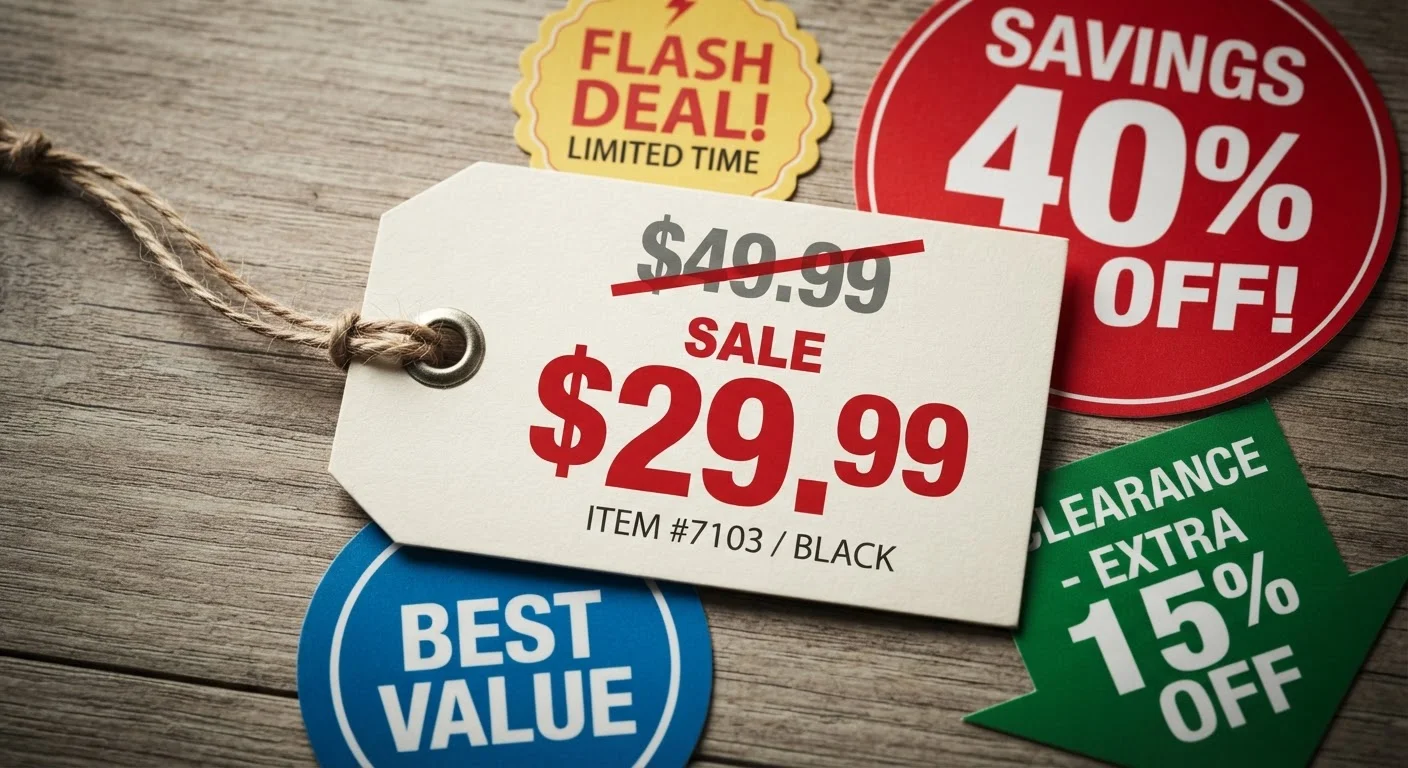
Before you evaluate a discount, it helps to understand what the display is designed to accomplish. That struck-through number above the sale price is an anchor — a reference point your brain automatically uses to calculate how good the deal is. Retailers know that the anchor shapes the entire transaction, which is why "original" prices are often set high.
The problem is that the anchor price doesn't have to reflect reality. In some cases it represents a suggested retail price that few retailers ever charged. In others it reflects a brief, token period at full price before a planned markdown. The result is that a "40% off" label may be more about perception than arithmetic.
This connects directly to how reference pricing works in retail — the headline number is chosen to frame the sale price favorably, not necessarily to describe the item's fair market value.
“The pain of paying is real, and retailers know that anything that reduces that pain — a crossed-out price, a percentage badge, a countdown clock — makes the purchase easier to rationalize. The discount is often less about saving money and more about removing friction.”
— Dan Ariely, Behavioral economist and author of 'Predictably Irrational'
Urgency Cues Are Engineered, Not Incidental
Countdown clocks, "only 3 left in stock" banners, and "today only" messaging all activate the same psychological lever: loss aversion. Behavioral research has consistently found that people are more motivated to avoid losing something than to gain something of equivalent value. Retailers use this to their advantage by framing inaction as a loss.
When you see a timer ticking down, your brain shifts from evaluating whether you want the item to evaluating whether you can afford to miss it. That's a fundamentally different decision process — and one that's more likely to produce purchases you regret.
Try the "Full Price" Test Before You Buy
Before purchasing a sale item, ask: would I buy this at full price if it weren't on sale? If the answer is no, consider whether the discount is genuinely creating value or just lowering the emotional barrier to a purchase you didn't actually need. This single question interrupts the urgency loop that sale framing is designed to create.
A practical counter: ask yourself whether you would purchase the item at the sale price if there were no timer, no "limited stock" notice, and no deadline. If the honest answer is no, the urgency cue is carrying the decision — not your actual preference.
Percentage Framing and Why Numbers Feel Bigger Than They Are
Retailers rarely present discounts in the format that's hardest to contextualize — they choose whichever framing makes the saving feel largest. On a $20 item, "50% off" sounds more impressive than "save $10." On a $2,000 appliance, "save $400" sounds bigger than "20% off." This isn't accidental; it's a deliberate choice based on what anchors more effectively at a given price point.
~80%
Consumers who report buying unplanned items on sale
Consumer behavior surveys consistently show a large majority of shoppers have made unplanned purchases specifically because an item was presented as discounted, regardless of whether it was needed.
2x
How much more loss aversion outweighs equivalent gain
Foundational behavioral economics research by Kahneman and Tversky found people typically feel the pain of a loss roughly twice as intensely as the pleasure of an equivalent gain — a ratio retailers leverage through urgency messaging.
Percentage-off framing also obscures the actual dollar amount leaving your wallet. A disciplined habit is to convert every percentage discount into its dollar equivalent before deciding — this grounds the transaction in real budget terms rather than relative math.
Understanding the difference between price and value is useful here: a 60% discount on something you don't need still costs 100% of the sale price.
How to Shop More Deliberately Around These Tactics
Recognizing the mechanics of sale psychology isn't about becoming cynical — it's about reclaiming the decision. A few practical habits make a meaningful difference:
- Define the need before you browse. If you're shopping for a specific item, the sale environment is less likely to reframe your priorities. Open-ended browsing in sale contexts is where anchoring and urgency cues do their heaviest work.
- Check price history before committing. Several browser tools track historical pricing for major online retailers, making it straightforward to see whether a "sale price" is genuinely below the item's typical selling price.
- Use a waiting period. Introducing 24–48 hours between discovering a deal and buying it dissolves most urgency-driven impulses without requiring willpower at the moment of temptation.
- Compare across sellers. A sale price at one retailer may be the standard price — or a higher price — elsewhere. Retail pricing varies substantially across channels for the same item.
Timing also matters independently of sale psychology. Seasonal pricing patterns mean that some categories genuinely do drop in price at predictable points in the year — which is a different dynamic from manufactured urgency.
This article is for general informational and educational purposes only. It does not constitute financial advice. Readers should evaluate their own circumstances before making purchasing or budgeting decisions.