
How Each Policy Is Structured
At their core, both term and whole life insurance pay a death benefit — a lump sum — to your named beneficiaries when you die. That's where the similarity largely ends. Life insurance types can feel confusing at first, so let's break each structure down plainly.
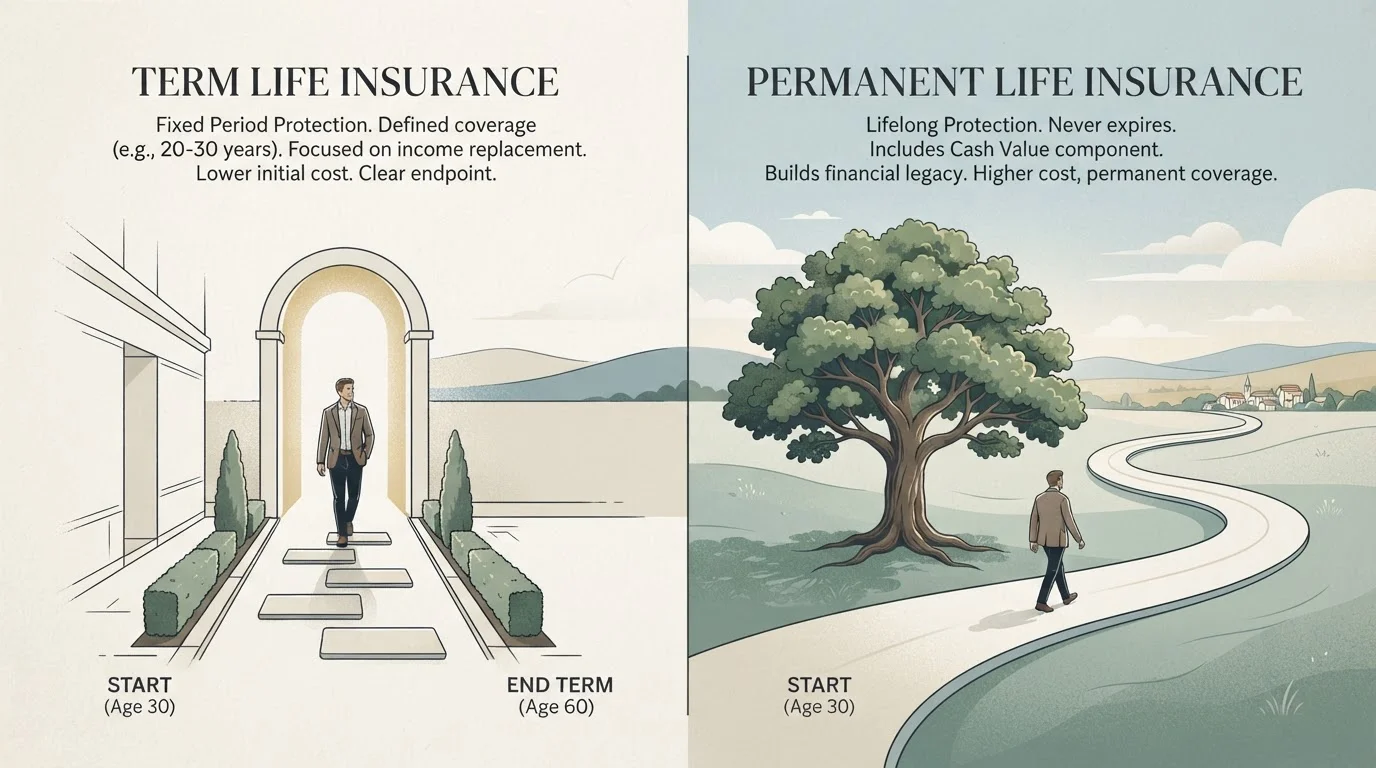
Term life insurance works like renting coverage. You select a coverage period — commonly 10, 20, or 30 years — and pay a fixed premium throughout that term. If you die within the term, your beneficiaries receive the death benefit. If you outlive the term, coverage ends and no benefit is paid. There is no cash accumulation.
Whole life insurance combines a permanent death benefit with a savings element called cash value. A portion of each premium funds the death benefit; another portion accumulates in a cash-value account that grows at a rate set or guaranteed by the insurer. The policy remains in force for your entire life as long as premiums are paid. For a deeper look at the terminology involved, see the life insurance glossary and key policy terms guide.
| Criterion | Term Life | Whole Life |
|---|---|---|
| Coverage duration | Fixed term (e.g., 10–30 years) | Lifetime (permanent) |
| Premium cost | Lower for same benefit | Significantly higher |
| Cash value | None | Accumulates over time |
| Death benefit | Paid if death within term | Paid whenever death occurs |
| Premium flexibility | Fixed during term | Fixed; set at issue |
| Policy complexity | Simple structure | More complex; more features |
| Borrow against policy | Not available | Yes, against cash value |
Cost and Cash Value: What You're Actually Paying For
Premium cost is one of the most significant practical differences between the two policy types. For the same death benefit, whole life premiums are typically five to fifteen times higher than term premiums, depending on age, health, and coverage amount. That gap exists because whole life premiums fund both the death benefit and the cash value account.
5–15×
Higher whole life premiums vs. term
Industry estimates consistently show whole life premiums are several multiples higher than comparable term premiums for the same death benefit amount.
20 years
Most common term length purchased
According to LIMRA research, 20-year term policies are among the most frequently issued term life contracts in the United States.
~54%
U.S. adults with some life insurance coverage
LIMRA's 2023 Insurance Barometer Study found roughly half of American adults carry some form of life insurance, though many feel underinsured.
The cash value in a whole life policy grows on a tax-deferred basis — meaning you don't owe income tax on the growth each year. Policyholders can borrow against this value or surrender the policy for the accumulated amount. However, outstanding loans reduce the death benefit paid to beneficiaries, and surrendering a policy early often results in surrender charges and a smaller payout than total premiums paid. These trade-offs matter and deserve careful evaluation.
Term life, by contrast, has no cash value. The lower premium buys pure death benefit protection — nothing more. Whether that simplicity is an advantage or a limitation depends entirely on what you're trying to accomplish.
Choosing the Right Structure for Your Situation
Most financial professionals describe the choice between term and whole life as a question of purpose rather than quality. Term life tends to align with time-bound financial responsibilities: a 20-year mortgage, years of dependent children at home, or a specific income-replacement window. Whole life tends to align with goals that extend beyond a finite period, such as leaving a guaranteed inheritance or covering final expenses regardless of when death occurs.
It's also worth knowing that some people carry both types simultaneously — a practice sometimes called laddering — to balance affordability with permanent coverage. Others may explore group coverage through an employer as a supplement; see our comparison of group life insurance versus an individual policy for context on those trade-offs.
Universal Life Is a Third Option
Term and whole life aren't the only structures available. Universal life insurance is another form of permanent coverage that offers more flexibility in premiums and death benefits than whole life, though it comes with its own complexity and risk considerations. If a licensed adviser mentions universal life, ask specifically how the cash value is credited and what happens if the policy's assumptions don't hold. For a broader overview, see our plain-language breakdown of life insurance types.
For a broader look at how these policies fit alongside other coverage decisions, you can also explore our overview of term vs. whole life from a long-term value perspective.
This article is for general informational purposes only and does not constitute personalized insurance, financial, or legal advice. Coverage terms, premiums, and eligibility vary by insurer and individual circumstances. Always read actual policy documents carefully and consult a licensed insurance professional before making coverage decisions.