
The Core Difference: Simple vs. Compound Interest
Interest is the cost of borrowing money — or the reward for saving it. How that interest is calculated determines whether your balance grows gradually or accelerates over time.
Simple interest is calculated only on the original principal. If you borrow $1,000 at 5% simple interest for three years, you owe $150 in interest total ($1,000 × 0.05 × 3). The base never changes.
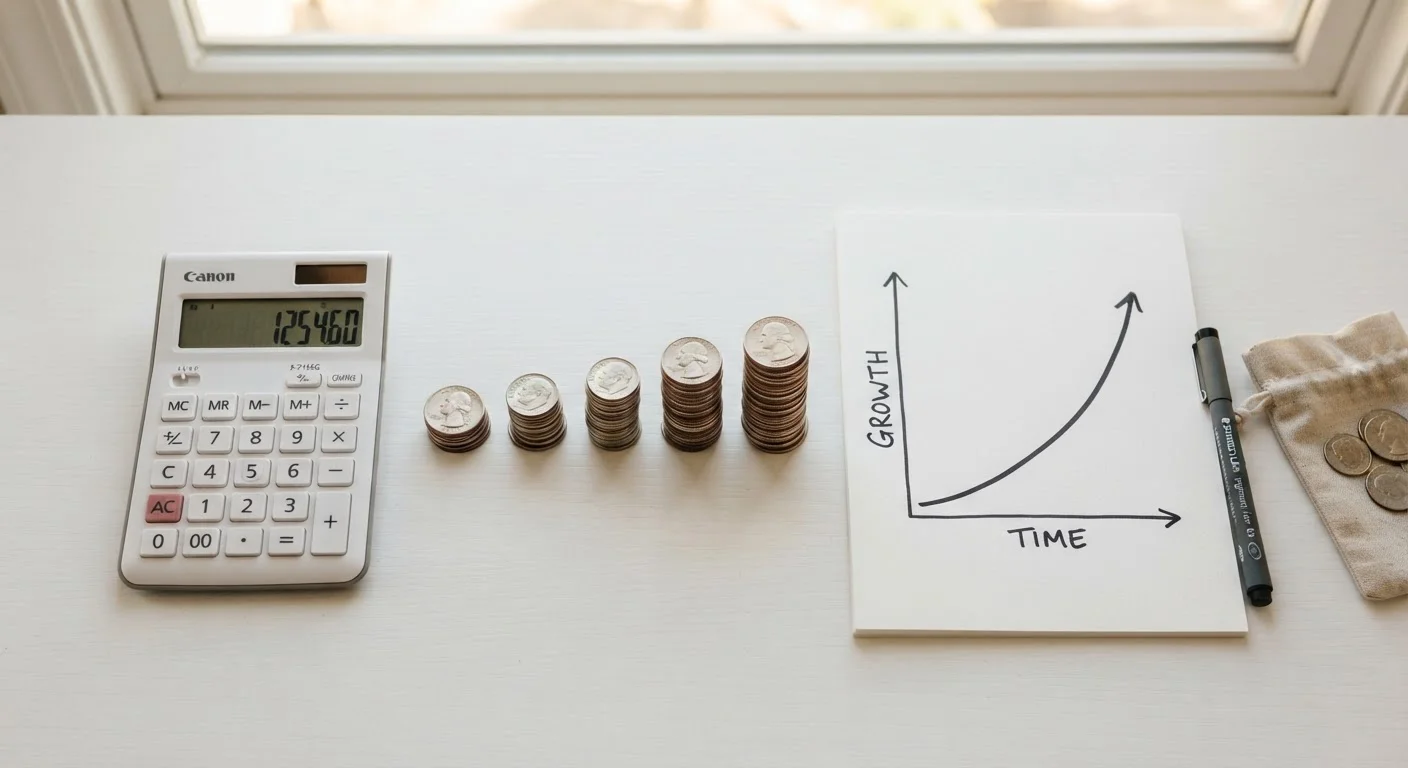
Compound interest is different: it is calculated on the principal and on any interest that has already accumulated. Each compounding period, the balance grows slightly larger, and the next interest calculation uses that larger number. Over time, this creates accelerating growth — in your favor when saving, and against you when borrowing.
See how compound growth affects long-term investing for a deeper look at its role in wealth-building.
Compounding in Practice: Savings and Debt
The same mechanic that grows a retirement account can quietly inflate a credit card balance. Understanding where each type applies helps you use interest strategically.
| Simple Interest Formula | Principal × Rate × Time |
| Compound Interest Formula | Principal × (1 + Rate/n)^(n×t) (n = compounding periods per year, t = years) |
| Common compounding frequencies | Daily, monthly, quarterly, annually |
| Where simple interest typically applies | Auto loans, some personal loans, short-term bonds |
| Where compound interest typically applies | Savings accounts, credit cards, mortgages, investment accounts |
| APY vs. APR | APY reflects compounding; APR generally does not |
On the savings side: Accounts that compound daily or monthly — like high-yield savings accounts or certificates of deposit — generate more return than those that compound annually, even at the same stated rate. This is why financial disclosures show both APR and APY; a higher APY relative to the stated APR reveals more frequent compounding at work.
On the debt side: Credit cards typically compound interest daily on any unpaid balance, which is why carrying a balance can become expensive quickly. A $2,000 balance at 22% APR compounding daily doesn't just cost 22% per year in simple terms — the effective rate is slightly higher once compounding is factored in.
Daily
Most common credit card compounding frequency
Most major credit cards compound interest daily on any unpaid balance, accelerating how quickly debt grows.
365×
Compounding periods per year on daily-compound accounts
Daily compounding means interest is recalculated every single day, amplifying growth for savers — and costs for borrowers — over time.
Auto loans and many personal loans, by contrast, use simple interest. You're charged only on the remaining principal, so extra payments reduce what you owe faster than they would with a compound-interest product.
For more on what happens when you carry a monthly balance, see carrying a balance vs. paying in full every month.
Balancing Saving Goals Against Debt Reduction
Once you understand how interest works in both directions, the saving-versus-debt question becomes clearer — though not always simple.
If a debt compounds daily at 20%+ (as many credit cards do), that rate is almost certainly higher than what a savings account or conservative investment could reliably return. Mathematically, every dollar directed at that balance saves more than the same dollar deposited into savings would earn. High-interest debt signals it should take priority over other financial goals in many — though not all — situations.
On the other hand, low-rate simple-interest debt (like some car loans) may not need to be rushed. The cost of that debt may be low enough that simultaneously building an emergency fund or contributing to a tax-advantaged retirement account could make sense. The trade-offs between saving and paying off debt depend heavily on interest type, rate, and your overall financial picture.
This Article Is General Financial Education
The information here is intended to explain how interest works in general terms. It is not personalised financial, investment, or lending advice. Your specific situation — including the exact terms of any loan or savings account — will depend on the product and provider. Consider speaking with a licensed financial adviser for guidance tailored to your circumstances.
The key principle: compare the effective cost of your debt (accounting for compounding frequency) with the realistic return on your savings or investments. That comparison — not a rule of thumb — should guide your allocation decisions. A licensed financial adviser can help you model your specific numbers.
For a broader foundation, explore budgeting basics and investing essentials.