
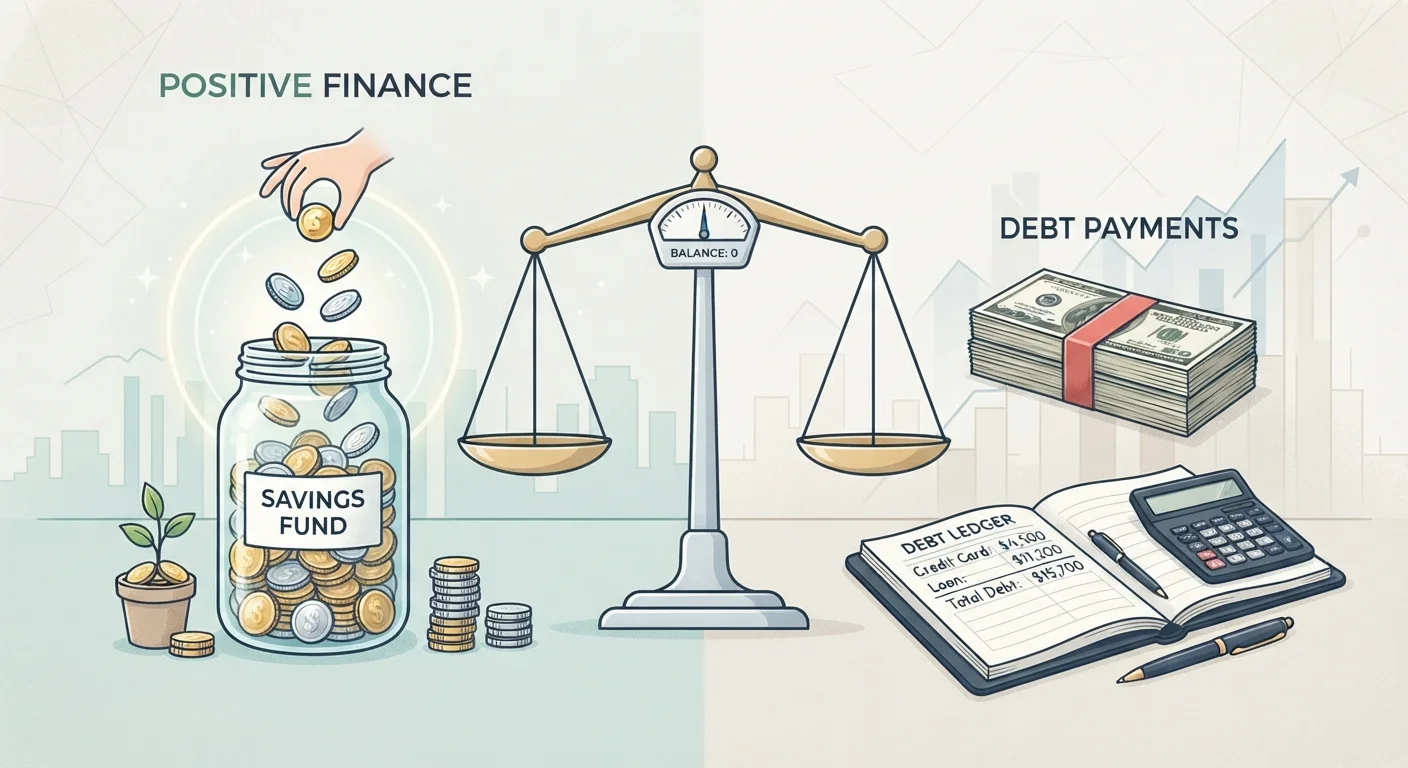
Why This Decision Is Harder Than It Looks
At first glance, the math seems straightforward: if your debt costs more in interest than your savings earn, pay the debt first. But most households don't live inside a spreadsheet. Income fluctuates, unexpected expenses arise, and the psychological weight of debt can influence decisions as much as any interest rate calculation.
The saving-versus-debt question is really a set of smaller questions layered together: How high is the interest rate on your debt? Do you have any emergency savings at all? Are you leaving employer retirement contributions on the table? Understanding those sub-questions — rather than hunting for a single universal answer — is what leads to a genuinely useful decision. For a broader framework on how these pieces fit together, see our Budgeting Basics hub.
The Core Trade-Off: Interest Rates vs. Returns
The central tension is a rate comparison. If a credit card charges 22% APR and a high-yield savings account pays around 4–5%, every dollar directed toward savings instead of the credit card balance effectively costs the difference. Paying down that debt delivers a guaranteed, risk-free "return" equal to the interest rate avoided.
Low-rate debt changes the picture. A federal student loan at 4.5% or a mortgage at 3% may cost less than a diversified investment portfolio could reasonably be expected to earn over a long time horizon — though past market performance never guarantees future results, and investing carries real risk of loss. The gap between your debt rate and your expected return (after taxes and fees) is the key figure to evaluate.
| Factor | Favor Saving | Favor Debt Repayment | |
|---|---|---|---|
| Debt interest rate | Below ~5–6% | Above ~7–8% | |
| Emergency fund status | None — build a buffer first | Already in place | |
| Employer retirement match | Available and uncaptured | Already maximized or unavailable | |
| Expected investment return | Meaningfully exceeds debt rate | Below or close to debt rate | |
| Income stability | Variable or uncertain | Stable and predictable | |
| Psychological impact | Debt stress is manageable | Debt causes significant anxiety |
For a closer look at how specific repayment strategies stack up once you've decided to focus on debt, the debt avalanche and snowball methods each offer a structured approach worth understanding.
When Saving Should Come First
Even with significant debt, financial planners broadly agree that a minimal emergency fund — commonly suggested in the range of $500 to $1,000 — should exist before aggressively paying down debt. Without any liquid cushion, a single car repair or medical bill often requires new borrowing, undoing progress already made.
A second scenario where saving takes priority: an employer-sponsored retirement plan that matches contributions. A 50% or 100% match on contributions up to a defined threshold is immediate, guaranteed return on your dollar — a benefit worth capturing before directing all extra cash toward debt repayment. This isn't investment advice tailored to your situation; consulting a licensed financial adviser can help you weigh the specifics. For a nuanced look at doing both at once, see building an emergency fund while carrying debt.
Don't Overlook the Employer Match
If your employer matches retirement contributions and you aren't contributing enough to claim the full match, you may be leaving part of your compensation on the table. Even while carrying debt, it's generally worth contributing at least enough to capture the full match before directing extra dollars elsewhere. Check your plan documents or HR resources to understand exactly how your match works.
When Debt Repayment Should Take Priority
High-interest debt — particularly credit card balances — is widely recognized as a financial drain that compounds quickly. When interest rates are in the double digits, the guaranteed savings from eliminating that balance typically outpaces anything a savings account or conservative investment can offer, especially after accounting for taxes owed on interest or investment gains.
Signals that debt repayment deserves top priority include: interest rates above approximately 7–8%, balances that are growing despite minimum payments, or income instability that makes carrying debt feel precarious. High-interest debt signals worth recognizing are explored in depth in a dedicated piece on this site. Also worth reviewing: why paying only the minimum balance costs more than most people realize.
Minimum Payments Can Be Deceptive
Making only minimum payments on high-interest debt can keep an account in good standing while the underlying balance grows — or shrinks at a very slow pace. Before deciding any extra dollars should go to savings, calculate how long minimum payments alone would take to eliminate your balance and how much total interest you'd pay. That figure often changes the calculus significantly.
A Practical Framework for Splitting the Difference
For many people, the answer is neither "all debt" nor "all savings" but a deliberate split. A common general approach — not a prescription, since individual circumstances vary widely — involves three tiers:
- Establish a minimal emergency buffer before accelerating debt payments.
- Capture any employer retirement match available to you, as this represents immediate value.
- Direct remaining discretionary funds toward high-interest debt until it is eliminated, then broaden saving and investing goals.
If you're considering restructuring multiple balances before pursuing this kind of plan, debt consolidation may be worth exploring as a prior step. And if the either-or framing feels constraining, the case for treating saving and debt repayment as simultaneous goals is worth reading.
This article is for general informational and educational purposes only and does not constitute personalized financial, investment, tax, or legal advice. Consult a qualified, licensed financial professional for guidance specific to your situation.