
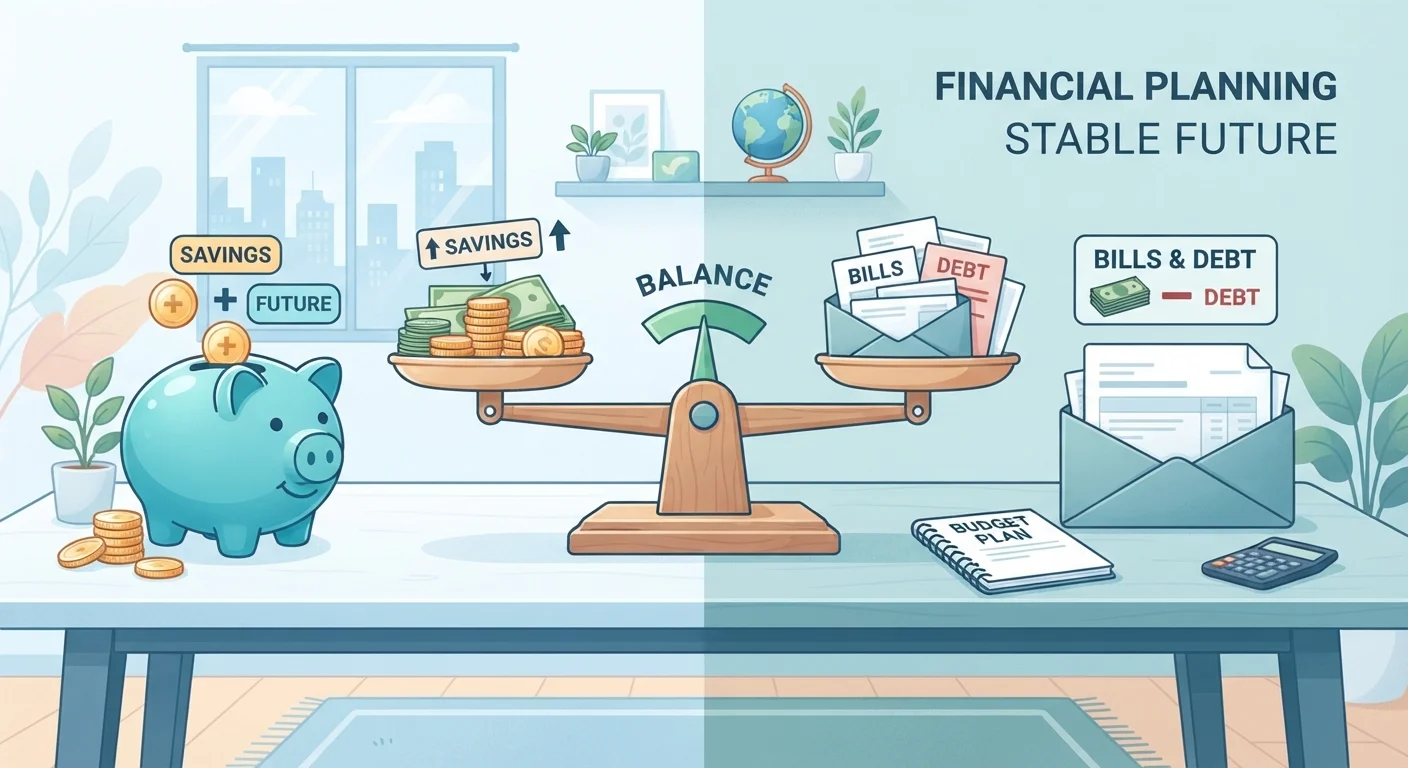
The False Choice Between Saving and Debt Repayment
Personal finance discussions often frame saving and paying off debt as opposing forces — as if choosing one means abandoning the other. In practice, treating them as a binary decision can leave people financially exposed in ways that end up costing more in the long run.
Consider what happens when someone channels every spare dollar into debt repayment and skips building any savings. The moment an unexpected car repair or medical bill arrives, they may be forced to put the expense on a credit card — potentially creating new high-interest debt that erases recent progress. A small financial cushion breaks that cycle.
The real question isn't whether to do both, but how much to allocate to each goal given your specific situation. That calculation involves your debt's interest rates, the stability of your income, employer benefits, and your personal comfort with financial risk.
This Is General Financial Information
The guidance in this article reflects broadly accepted personal finance principles and is intended for educational purposes. Individual circumstances — including debt type, income stability, tax situation, and risk tolerance — vary significantly. A licensed financial advisor or planner can help you determine the right balance for your specific situation.
This article provides general financial information for educational purposes only. It is not personalized financial advice. For guidance tailored to your situation, consult a qualified financial professional.
Why a Starter Emergency Fund Comes First
Before aggressively splitting funds between saving and debt, most financial guidance points to establishing a basic emergency reserve — often cited as $500 to $1,000. This isn't about building wealth; it's about installing a circuit breaker that protects your debt-repayment progress.
Without any cushion, a single unplanned expense can push you back into revolving debt. With even a modest buffer, you can absorb minor financial shocks without disrupting your repayment plan. See our guide to building an emergency fund while carrying debt for a practical look at doing both at once.
40%
Adults who couldn't cover a $400 emergency
According to the Federal Reserve's Report on the Economic Well-Being of U.S. Households, a significant share of American adults have limited ability to absorb even small unexpected expenses without borrowing.
3–6 months
Recommended emergency fund coverage
Most mainstream financial guidance, including from the Consumer Financial Protection Bureau, suggests maintaining three to six months of essential living expenses in accessible savings.
Once a starter fund exists, the strategic question shifts: how much of your remaining cash flow goes toward extra debt payments versus growing savings further?
The Interest Rate Framework: When Math Points the Way
The most objective lens for this decision is an interest rate comparison. If your debt carries an interest rate significantly higher than what a savings account or conservative investment would earn, paying down that debt first delivers a measurable financial return — the equivalent of earning that interest rate, risk-free.
For example, a credit card charging 22% APR costs you more than nearly any savings vehicle can reliably offset. In that scenario, extra payments on the card offer a better "return" than parking cash in a savings account earning 4–5%. For a deeper look at when high-interest debt should take clear priority, see High-Interest Debt: Signals It Should Take Priority Over Other Financial Goals.
Conversely, lower-interest debt — such as a federal student loan at 5% or a mortgage — may not warrant the same urgency. In those cases, the math can reasonably support directing some funds toward savings or retirement contributions instead.
Don't Leave Employer Match on the Table
If your employer offers a 401(k) match, contributing at least enough to capture the full match is widely considered a high-priority step — even when you're carrying debt. The immediate return from a dollar-for-dollar or partial match typically exceeds the interest cost of most non-credit-card debt. Confirm the specifics of your employer's plan with your HR department or a financial professional.
One widely discussed exception to aggressive debt repayment: capturing an employer's full 401(k) match. Because the match represents an immediate guaranteed return — typically 50 to 100 cents per dollar contributed — it often exceeds the cost of carrying moderate-interest debt. Check with a financial professional about how this applies to your situation.
Practical Frameworks for Splitting the Difference
If you decide a blended approach fits your circumstances, structured budgeting frameworks can formalize the split. The 50/30/20 rule allocates 20% of take-home pay to financial goals — encompassing both savings contributions and debt payments above minimums. That structure legitimizes doing both at once within a single budget category.
For the debt repayment side, methods like the debt avalanche or debt snowball help prioritize which balances to attack with extra payments. These approaches work alongside a savings habit — they're about sequencing debt payoff, not replacing saving entirely.
If you're weighing whether to use existing savings to eliminate debt outright, work through our decision checklist before tapping savings to pay off debt first. And for a broader comparison of the trade-offs involved, Saving vs. Paying Off Debt: Weighing the Financial Trade-Offs offers a detailed breakdown.
Building these habits within a consistent budget is also foundational — the Budgeting Basics hub covers practical tools for tracking spending and finding room for financial goals.