
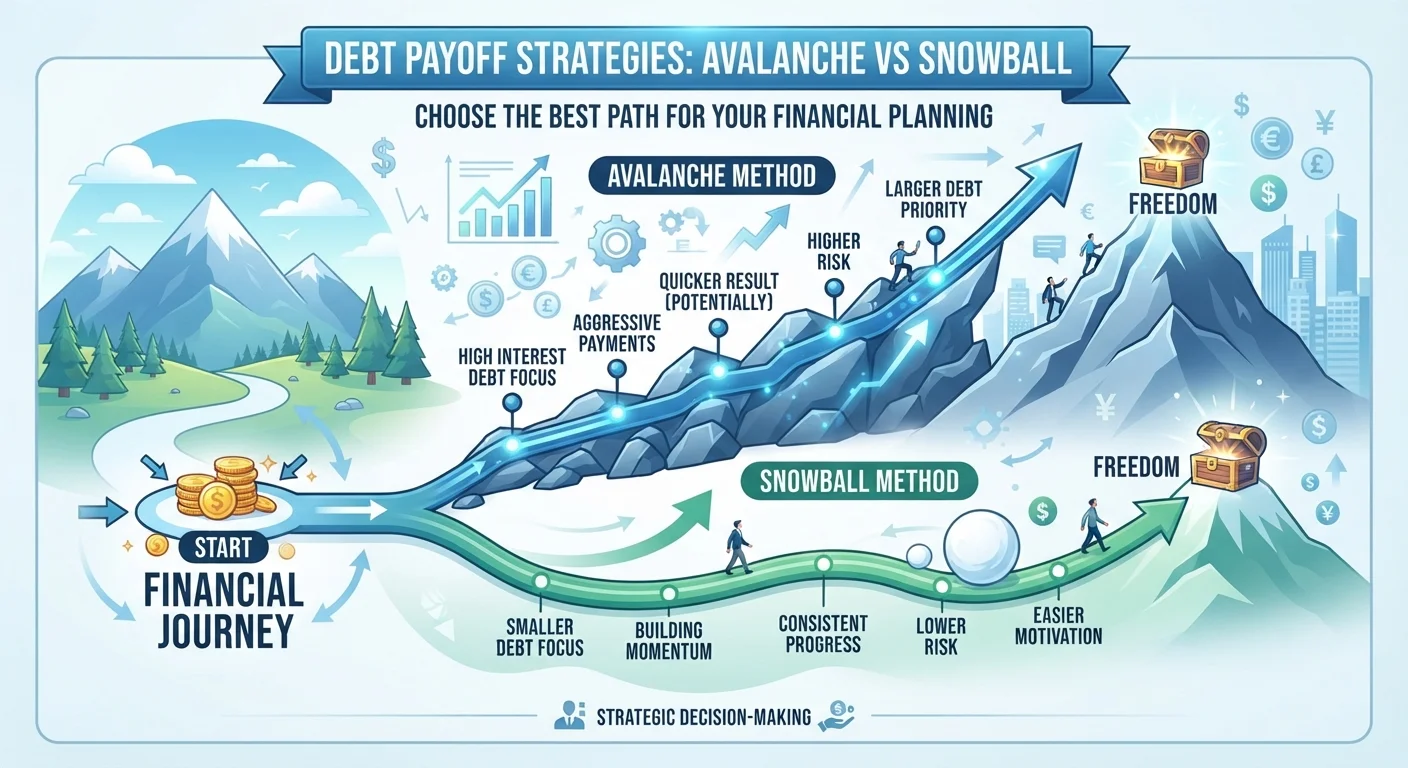
How Each Method Works
Both strategies share the same foundation: pay the minimum required on every debt each month, then direct any extra money toward one specific target. They differ only in how that target is chosen.
Debt Avalanche: You rank all debts by interest rate, from highest to lowest. Extra payments go entirely to the highest-rate balance until it's gone, then you roll that freed-up payment into the next highest-rate debt, and so on. The cascade of payments — like an avalanche — gathers force as each debt falls.
Debt Snowball: You rank debts by balance, from smallest to largest. Extra payments attack the smallest balance first. Once it's cleared, you redirect that full payment to the next smallest. Each payoff adds to the momentum — much like a snowball growing as it rolls downhill.
For a deeper look at the mechanics of both approaches, see The Debt Avalanche and Debt Snowball, Explained.
| Criterion | Debt Avalanche | Debt Snowball |
|---|---|---|
| Payoff Order | Highest interest rate first | Smallest balance first |
| Total Interest Paid | Lower (mathematically optimal) | Potentially higher |
| Time to First Payoff | Longer if high-rate debt is large | Faster — targets smallest balances |
| Motivational Structure | Requires patience and discipline | Quick wins build momentum |
| Best Scenario | Disciplined borrowers, high-rate disparity | Motivation-driven; many small debts |
| Complexity | Slightly more analytical setup | Simple and intuitive to track |
The Real Cost Difference
In purely mathematical terms, the avalanche method almost always wins. By neutralizing the highest-rate debt first, you prevent compounding interest from accumulating on your most expensive balance. Over a multi-year payoff timeline, this can translate into meaningful savings — the exact amount depends on your specific balances, rates, and monthly payment amounts.
~$1,000+
Potential interest savings with avalanche vs. snowball
The gap varies widely, but analyses of typical multi-debt households suggest avalanche users commonly save several hundred to over a thousand dollars in interest, depending on rates and balances.
33%
Americans with no structured debt repayment plan
According to a National Foundation for Credit Counseling survey, roughly one-third of adults carrying debt have no defined payoff strategy, leaving them vulnerable to rising interest costs.
20%+
Average APR on credit card debt (U.S.)
The Federal Reserve reports average credit card interest rates have exceeded 20% APR in recent periods, making the choice of payoff method financially significant for cardholders.
The snowball method, by contrast, may cost more in total interest because lower-rate debts (which might carry larger balances) are left accruing longer. However, the difference varies widely by situation. If your two smallest balances happen to also carry the highest rates, the methods may converge in cost.
It's also worth considering that the behavioral advantages of the snowball can have real financial value: a plan abandoned halfway through generates no savings. Research in consumer behavior consistently suggests that perceived progress is a strong predictor of follow-through on financial goals.
If you're weighing debt repayment against other financial priorities, Saving vs. Paying Off Debt: Weighing the Financial Trade-Offs walks through the broader calculation.
Choosing the Strategy That Fits Your Life
Neither strategy is universally superior — the right choice depends on your debt profile, personality, and financial goals. Here's how to think through it:
- Assess your rates and balances. If your highest-rate debts also happen to be among the smallest balances, the avalanche and snowball may produce very similar outcomes. In that case, the behavioral fit becomes the deciding factor.
- Be honest about motivation. If you've started debt repayment plans before and stalled, the snowball's quick wins may be more valuable than the avalanche's eventual savings.
- Consider your savings needs. Carrying high-interest debt while maintaining no emergency fund is a common vulnerability. Building an Emergency Fund While Carrying Debt explores how to pursue both goals without sacrificing either.
- Think about debt consolidation. In some cases, tools like personal loans or balance transfer cards can simplify the picture before applying either strategy. Personal Loan vs. Balance Transfer Card for Debt Repayment compares those options.
Whichever method you choose, consistency matters most. Both strategies work significantly better than making no structured plan at all. Pair your approach with a clear budget — Budgeting Basics offers practical frameworks for tracking spending alongside your payoff plan.
Hybrid Approaches Are Valid Too
Some borrowers blend both methods — paying off one or two small balances first for a motivational boost, then switching to the avalanche order. This isn't a compromise that ruins the math; it's a practical acknowledgment that sticking to a plan requires more than just numbers. What matters is that you have a plan and follow it consistently.
This article is for general informational purposes only and does not constitute personalized financial or legal advice. Consult a qualified financial professional for guidance tailored to your specific situation.