
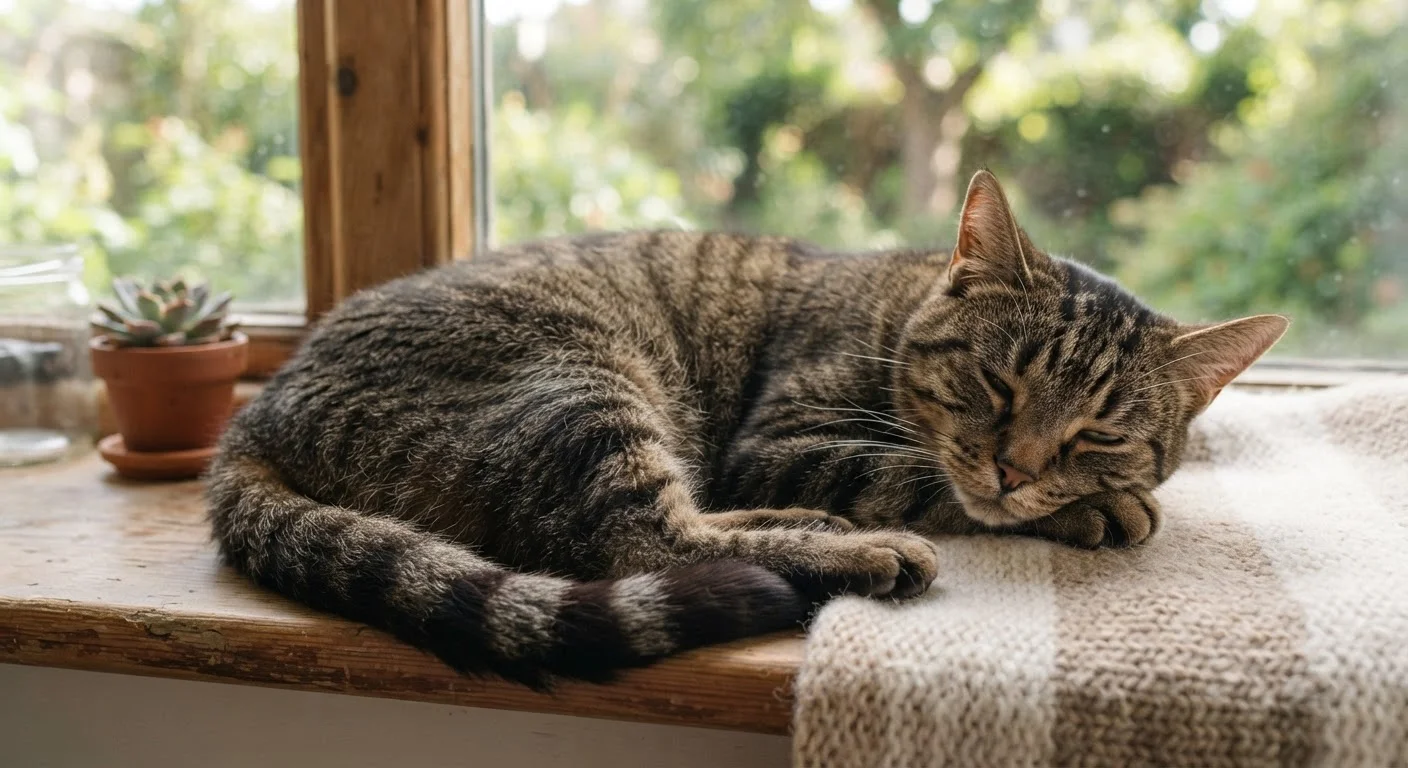
Why Cats Communicate Through Body Language
Unlike dogs, cats evolved as both solitary hunters and social animals, which means their communication is often subtle and context-dependent. While cats do vocalize — see our guide to cat vocalizations for a full breakdown — body language carries the bulk of their moment-to-moment messaging.
Reading these signals accurately helps you respond appropriately, avoid accidental conflict, and catch early signs of stress or discomfort. Because cats mask vulnerability by instinct, behavioral changes in posture and movement can sometimes precede visible illness. For a deeper look at pain-related cues, see subtle signs a cat may be in pain.
| Primary communication channel | Body language and scent (vocalizations secondary) |
| Key body parts to watch | Tail, ears, eyes, whiskers, and overall posture |
| Slow blink meaning | Trust and relaxed comfort |
| Puffed tail signal | Fear or threat response |
| Belly exposure meaning | Trust — not always an invitation to touch |
| Tail held high (tip hooked) | Friendly greeting |
Tail Positions and What They Signal
The tail is one of the most readable parts of a cat's body. Here's what common positions typically communicate:
- Tail held high, tip slightly hooked: Friendly and confident — a standard greeting posture.
- Tail held high, puffed out: Fear or aggression; the cat is trying to appear larger.
- Tail tucked low or between legs: Anxiety, submission, or pain.
- Tail lashing or whipping side to side: Irritation or intense focus — not contentment. This often signals the cat wants space.
- Tail wrapped around body while sitting: Relaxed but self-contained; the cat is comfortable and settled.
- Tail curled around another cat or person: A social bonding gesture indicating affection and trust.
Context matters: a twitching tail tip during play differs significantly from the same motion during petting, where it often means overstimulation is approaching.
Piloerection
The involuntary raising of fur along the back and tail, making the cat appear larger. It occurs during fear or aggression and is triggered by the autonomic nervous system, not deliberate choice.
Slow blink
A deliberate, unhurried closing and reopening of the eyes that cats direct at trusted individuals. It is widely interpreted by animal behaviorists as a signal of relaxed trust and non-threat.
Overstimulation
A state in which continued petting or handling becomes aversive to a cat, often suddenly. Signs include tail lashing, skin rippling, and dilated pupils — and can precede a bite or scratch without obvious warning.
Scent marking
The behavior of depositing a cat's personal scent onto objects or individuals via rubbing, scratching, or bunting (head pressing). It establishes familiarity and social bonds rather than territory in domestic settings.
Bunting
The act of pressing the forehead or cheeks against a person, animal, or object. Cats have scent glands in these areas, and bunting is an affiliative gesture — a sign of comfort and acceptance.
Ears, Eyes, and Whiskers
These three facial features work together to broadcast a cat's emotional state at any given moment.
Ears
- Forward and upright: Alert, curious, engaged.
- Rotated back or flattened sideways ("airplane ears"): Irritation or mild anxiety — a warning to back off.
- Pinned flat against the skull: Fear or aggression; the cat feels threatened and may act defensively.
Eyes
- Slow blink directed at you: A widely recognized sign of trust and relaxed comfort. Many cats will respond to a slow blink returned by a human.
- Dilated pupils in normal light: Excitement, fear, or overstimulation — pupil size alone doesn't tell you which, so read the full posture.
- Hard, direct stare with constricted pupils: Challenge or predatory focus; avoid staring back.
- Soft, half-closed eyes: Contentment and ease.
Whiskers
- Relaxed and fanned to the sides: Calm and at ease.
- Pushed forward: Heightened curiosity or predatory interest.
- Pulled back flat against the face: Defensive fear or aggression.
16+
Distinct ear positions cats can form
Researchers studying feline communication have catalogued more than 16 independent ear orientations cats use to signal emotional states.
~25
Recognized feline facial action units
A 2021 study published in Frontiers in Veterinary Science identified approximately 25 discrete facial muscle movements in cats used in social communication.
Full-Body Posture and Touch Responses
Whole-body positioning tells you whether a cat is open to interaction or needs distance.
- Exposed belly: This is commonly misread. A cat showing its belly is signaling trust and comfort, not necessarily an invitation to be touched. Many cats will swat at a hand that reaches for their exposed abdomen.
- Loaf position (paws tucked under body): Relaxed and content, not on high alert.
- Crouched low, body tense: Fear, uncertainty, or readiness to flee.
- Arched back, sideways stance: Classic fear-threat display; the cat is trying to look larger and feels cornered.
- Rubbing head or body against you: Scent marking combined with affection — the cat is claiming you as part of its social group.
- Kneading ("making biscuits"): Comfort behavior originating in kittenhood; usually a sign of deep relaxation.
If you're bringing a new cat home and interpreting early behavior, our guide for first-time cat owners covers how posture shifts as a cat settles into a new environment. Cat behavior also differs meaningfully from canine signals — compare with reading your dog's body language to see how differently the two species communicate the same emotions.
This article is for general informational purposes only. If your cat shows sudden changes in behavior or body language, consult a licensed veterinarian, as these may indicate an underlying health concern.