
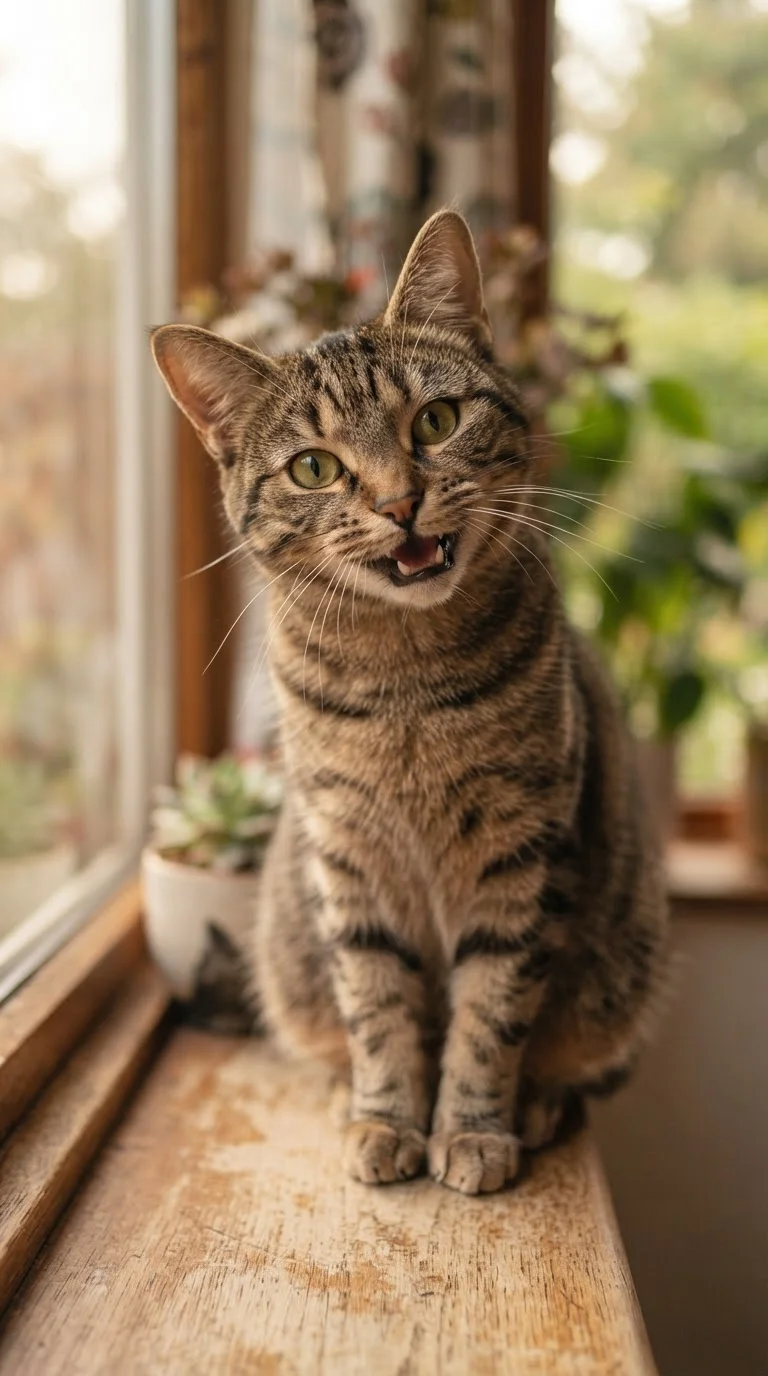
Why Cats Vocalize (and Who They're Talking To)
Cats are among the most vocally versatile domestic animals — yet much of that repertoire is aimed specifically at humans, not other cats. Adult cats rarely meow at one another in the wild; researchers generally agree that meowing evolved largely as a form of communication directed at people. This makes understanding your cat's sounds both practical and fascinating.
Vocalizations typically fall into three broad categories: sounds produced with the mouth closed (like purring or trilling), sounds made with the mouth opening and closing (like chirping or chattering), and sustained open-mouth sounds (like yowling or hissing). Context — what your cat is doing, looking at, and experiencing — is essential for interpreting any sound accurately.
For a broader look at how cats communicate beyond sound, see Reading Your Cat's Body Language for a full breakdown of posture and gesture cues.
Trill
A closed-mouth vocalization with a rolling, melodic quality. Cats use trills as friendly greetings or to invite interaction, and mother cats use them to guide kittens.
Chattering / Chirping
A rapid, staccato clicking sound cats make when observing prey they cannot access. It is associated with predatory arousal and sometimes frustration.
Yowling
A loud, prolonged, open-mouth vocalization that can signal pain, distress, territorial conflict, reproductive behavior, or cognitive changes in senior cats.
Cognitive Dysfunction Syndrome
An age-related neurological condition in older cats that can cause disorientation, altered sleep patterns, and increased or unusual vocalizations, particularly at night.
A Guide to Common Cat Sounds and What They Signal
Below is a reference breakdown of the most frequently heard cat vocalizations, what each typically communicates, and how you might respond.
| Number of sounds cats can produce | More than 100 distinct vocalizations (Animal behavior research, general consensus) |
| Primary audience for meowing | Humans (rarely used between adult cats) (Feline communication research) |
| Purring frequency range | 25–150 Hz (Veterinary physiology literature) |
| When yowling warrants a vet visit | When sudden, frequent, or accompanied by behavior changes (General veterinary guidance) |
Meow
The classic meow is almost exclusively used to communicate with humans. Short meows often signal a greeting; repeated meowing can indicate hunger, attention-seeking, or frustration. A high-pitched meow sometimes signals pain or alarm, while a drawn-out meow may mean your cat wants something specific. Pay attention to pitch and repetition patterns — your individual cat will develop a personal vocabulary over time.
Purring
Purring is widely associated with contentment, but it isn't exclusively a happy sound. Cats also purr when anxious, unwell, or in pain — possibly as a self-soothing mechanism. Why Cats Purr — And What It Doesn't Always Mean explains the full physiological picture behind this behavior.
Chirping and Trilling
Trills are warm, rolled sounds mothers use to call kittens; adult cats often direct them at their owners as a friendly greeting or invitation to follow. Chirping or chattering — a rapid, clicking vocalization — typically occurs when a cat spots prey it cannot reach, like a bird through a window. It may reflect excitement, frustration, or a predatory instinct firing without an outlet.
Yowling and Howling
Loud, sustained yowling is harder to ignore — and it shouldn't be. Yowls can signal territorial distress, the onset of heat cycles in unspayed females, or disorientation in older cats (sometimes linked to cognitive changes). A cat that suddenly begins yowling frequently, especially at night, warrants a veterinary evaluation. Persistent yowling is one of the subtle signs a cat may be in pain that owners sometimes overlook.
Hissing and Growling
These are defensive sounds signaling fear, aggression, or extreme discomfort. A hissing or growling cat is communicating a clear boundary. Respect it — pushing closer can escalate the situation. Remove the source of stress where possible and give the cat space to de-escalate on its own terms.
When to Take Vocalizations Seriously
Any sudden or significant change in your cat's vocal patterns deserves attention. A normally quiet cat that begins vocalizing frequently, or a vocal cat that goes silent, can both signal that something has changed health-wise. This is especially true for older cats, for whom changes in vocalization may point to conditions like hyperthyroidism, hypertension, or cognitive dysfunction.
If your cat's sounds are accompanied by changes in appetite, litter box use, mobility, or grooming habits, schedule a veterinary visit promptly. Sound alone rarely tells the whole story — combining vocal cues with body language gives you a much clearer picture. You might also find it useful to compare approaches across species: Reading Your Dog's Body Language illustrates how differently dogs signal their internal states.
This article is for general informational purposes only and is not a substitute for professional veterinary advice. If you have concerns about your cat's health or behavior, consult a licensed veterinarian.