How Each Technology Actually Works
The labels OLED, QLED, and LED describe fundamentally different ways a TV creates the image you see — and understanding the basics makes every spec sheet far easier to read.
LED TVs use a traditional LCD (liquid crystal display) panel. The crystals themselves don't produce light; instead, a separate backlight — made up of LEDs — shines through them. The LCD layer controls how much light passes through for each pixel, and a color filter adds color. The result is a bright, affordable display, but because the backlight illuminates the whole panel, perfectly black areas are difficult to achieve — some light always bleeds through.
QLED TVs are LED TVs with one important addition: a layer of quantum dots — nanoscale semiconductor particles — placed in front of the backlight. When LED light hits these dots, they emit more precisely tuned colors, widening the color range and boosting brightness. QLED is not a different panel type; it is an enhancement applied to an LED/LCD panel. For more on how display terms stack up across devices, see our display terms reference guide.
OLED TVs (Organic Light-Emitting Diode) work differently at a fundamental level. Each pixel is its own light source. When a pixel needs to be black, it simply turns off — no light is emitted at all. This is why OLED delivers contrast ratios LED panels cannot match: true black is the complete absence of light, not a dimmed backlight.
| Criterion | OLED | QLED / LED |
|---|---|---|
| Light source | Each pixel self-illuminates | LED backlight behind LCD panel |
| Black levels | True black (pixel off) | Near-black; depends on local dimming |
| Peak brightness | Moderate; improving in newer models | Very high; strong in bright rooms |
| Color accuracy | Excellent at standard brightness | Excellent; QLED excels at high brightness |
| Burn-in risk | Present with prolonged static images | Not a concern |
| Viewing angle | Wide, consistent | Varies; IPS better than VA |
| Typical price range | Higher at equivalent sizes | Lower; wide range available |
Picture Quality Trade-Offs You'll Actually Notice
Knowing the underlying technology matters because it predicts real-world performance differences in your living room.
Contrast and Black Levels
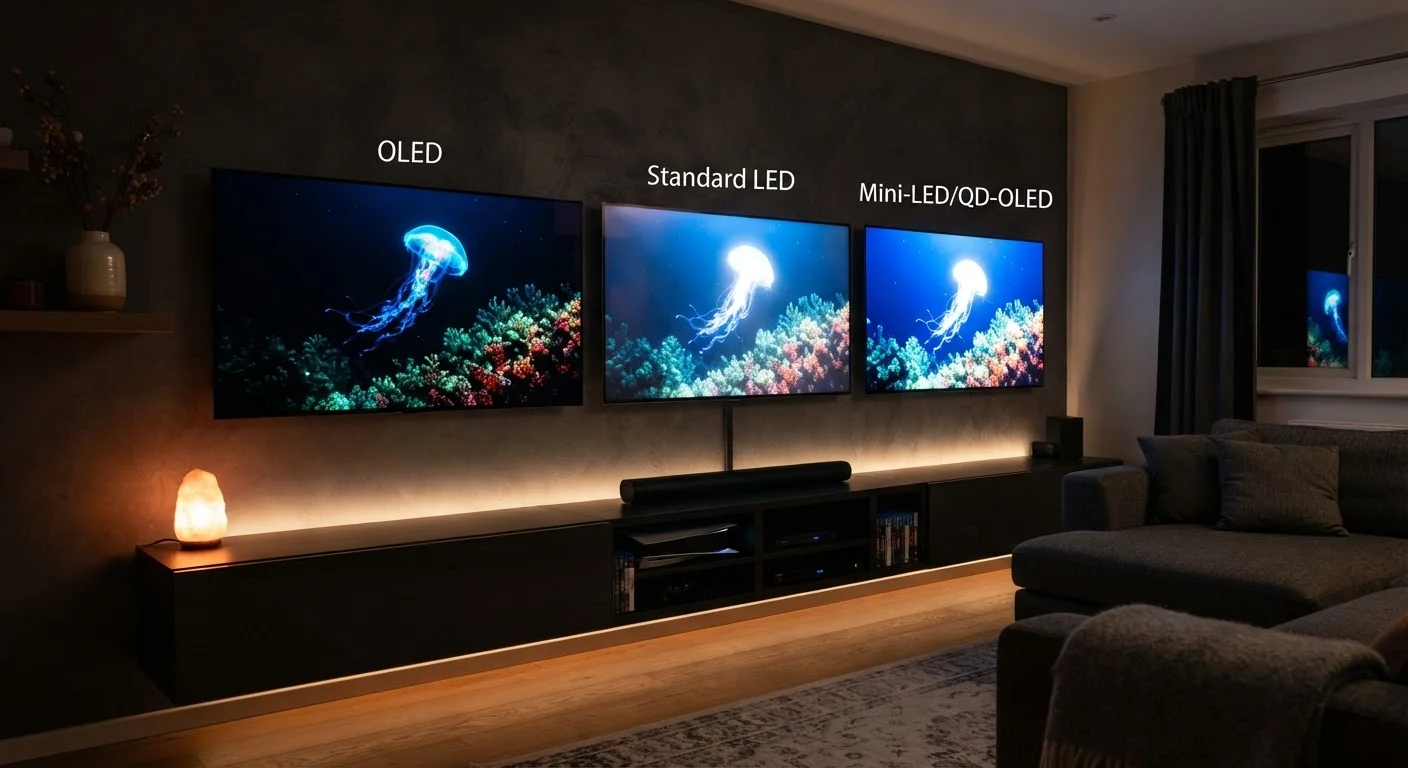
OLED's pixel-level dimming gives it a clear advantage for contrast. Dark scenes in movies or games look genuinely deep rather than a muddy gray. LED TVs use "local dimming" — grouping LEDs into zones that can dim independently — but this is a workaround. In practice, you may see a halo of light around bright objects on a dark background, an artifact called blooming. QLED reduces this somewhat through better brightness control, but the fundamental limit remains.
Brightness
Here QLED and LED gain the upper hand. LED-based panels can pump out significantly more nits (a measure of brightness) than most OLED panels. In a sunlit room, that extra brightness keeps the image visible and colors punchy. OLED panels have improved substantially in this area, but brightly lit environments still generally favor LED-based displays.
Color
QLED's quantum dot layer gives it a wider color gamut and higher color volume — meaning it maintains accurate, saturated colors even at high brightness levels. OLED delivers excellent, accurate color at normal brightness, but colors can look slightly less saturated in very bright scenes compared to QLED.
Burn-In Risk
Because OLED pixels degrade from use, static images — network logos, game HUDs, navigation bars — displayed for many continuous hours over years can leave a permanent faint ghost on the screen. This risk is real but often overstated for typical TV viewing. LED and QLED panels do not face this issue. If you plan to leave news channels running all day or use the screen as a dedicated monitor, this is worth factoring in. Our article on common smart TV myths covers more misconceptions worth clearing up before you decide.
~1,000+
Nits typical QLED peak brightness
Many QLED-class TVs can exceed 1,000 nits of peak brightness, a significant advantage over most OLED panels in bright-room conditions.
∞ : 1
Contrast ratio marketed for OLED
Because OLED pixels can fully switch off, manufacturers describe the contrast ratio as effectively infinite — black produces zero measured light output.
~8–10 years
Estimated OLED panel lifespan
Industry estimates generally place OLED panel half-life (the point at which brightness drops to 50%) at roughly 8–10 years of average daily use, though actual results vary.
Factors Beyond Panel Type
Panel technology is one piece of the picture quality puzzle, but it doesn't operate in isolation.
Resolution — whether a screen is HD, 4K, or 8K — is entirely separate from whether it uses OLED or LED. A 4K OLED and a 4K QLED both render the same number of pixels; what differs is how those pixels are lit and colored. For a plain-language breakdown of what resolution numbers mean in practice, our TV resolution explainer is a useful companion read.
Refresh rate determines how many times per second the image updates — relevant for sports and gaming. Both OLED and QLED panels are available with high refresh rates; this spec is not tied to one panel type.
Viewing angle is another practical consideration. OLED panels maintain consistent color and contrast when viewed from the side. Many LED panels — particularly VA (vertical alignment) LCD variants — show color shifting and contrast loss at wider angles. IPS LCD panels perform better off-axis but typically sacrifice some contrast.
Screen size and availability also shape real choices. LED and QLED TVs are broadly available across a wider range of screen sizes, while OLED manufacturing constraints historically limited the technology to mid-to-large sizes, though this has been expanding. If you want to understand how these same distinctions apply to laptop and tablet displays, the laptop screen types breakdown applies many of the same principles.
Mini-LED and MicroLED: Newer Variations
You may also see Mini-LED and MicroLED used in TV marketing. Mini-LED is still an LED/LCD technology — it just uses thousands of smaller LEDs arranged in more precise dimming zones, narrowing the gap with OLED in contrast performance. MicroLED is a distinct emerging technology where each pixel is a tiny inorganic LED, aiming to combine OLED's contrast with LED's brightness — but it remains expensive and limited in mainstream availability. These terms don't replace OLED, QLED, or LED; they add nuance within the same broad categories.