Why Smart TV Myths Are So Costly
Shopping for a smart TV is genuinely confusing. Spec sheets are packed with technical terms, showroom conditions rarely match real living rooms, and marketing materials routinely stretch the truth. The result is that many households either overpay for features that won't matter in their space or dismiss genuinely useful technologies as gimmicks.
The myths below aren't obscure edge cases — they're the beliefs most likely to steer everyday buyers in the wrong direction. Understanding them won't just help you evaluate TVs more clearly; it can also help you get more out of the one you already own. For a deeper look at how display technologies actually differ, see our breakdown of OLED, QLED, and LED.
Myth
A higher refresh rate — say, 120Hz — always means smoother, better-looking video.
Fact
Native refresh rate matters, but many advertised rates are interpolated, and most streaming content is shot at 24 or 30 frames per second anyway.
Refresh rate describes how many times per second a screen redraws its image. A true 120Hz panel can display up to 120 unique frames per second, which benefits fast-moving content like live sports or gaming. However, manufacturers sometimes advertise "effective" or "motion rate" figures that are double the panel's actual hardware refresh rate, achieved through software processing rather than additional hardware capability.
More importantly, most films and standard TV programming are produced at 24 or 30 frames per second. The TV's motion processing fills in the gaps — a feature called motion interpolation — which some viewers find unpleasant because it gives live-action footage an unnaturally smooth, soap-opera appearance. That effect can typically be turned off in settings. Unless you game or watch a lot of live sports, a high refresh rate should be lower on your priority list than contrast ratio or panel type.
Myth
All HDR (High Dynamic Range) is the same — if a TV says HDR, it supports full HDR quality.
Fact
HDR is a broad category with multiple competing standards, and many budget TVs meet the minimum threshold without delivering the intended viewing experience.
HDR describes a TV's ability to display a wider range of brightness levels and colors than standard dynamic range. But the term covers several distinct formats — including HDR10, HDR10+, Dolby Vision, and HLG — that differ in how brightness data is encoded and applied. A TV may technically support HDR while lacking the peak brightness (measured in nits) or local dimming capability needed to make HDR content look noticeably better than standard content.
A TV labeled "HDR compatible" might only reach 300–400 nits of peak brightness, while the HDR10 specification targets up to 10,000 nits. At lower brightness levels, HDR content may look only marginally different from non-HDR content. When evaluating HDR claims, look beyond the label to the peak brightness specification and whether the panel has full-array local dimming, which allows it to create deep blacks alongside bright highlights simultaneously.
Myth
A bigger screen always looks better, regardless of room size.
Fact
Screen size needs to match your viewing distance; an oversized TV in a small room can actually reduce picture clarity and cause visual discomfort.
Display manufacturers and home theater standards organizations have published guidelines suggesting that for a typical 4K TV, a comfortable viewing distance is roughly 1 to 1.5 times the screen's diagonal measurement. At closer distances, you may begin to see individual pixels or notice compression artifacts in streamed content, which undermines the resolution advantage you paid for.
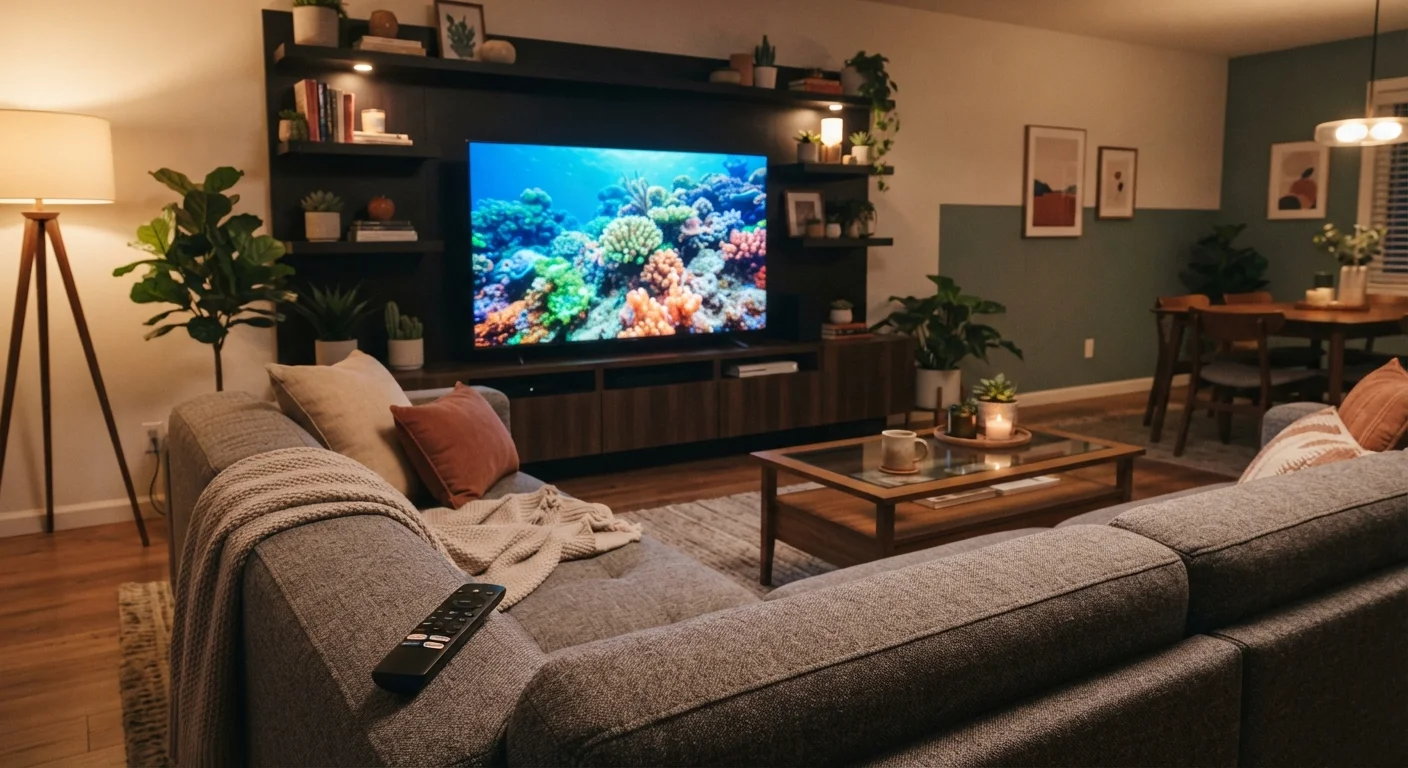
In a small apartment with a 10-foot viewing distance, a 75-inch screen may not look sharper than a 55-inch screen — and the oversized image can require you to move your eyes or head noticeably to follow the action, which becomes tiring. Room dimensions, seating arrangement, and ambient light reflection from a larger panel surface all factor into whether going bigger is actually better for your specific space.
Myth
Smart TV apps don't slow down over time — performance stays the same as the day you bought it.
Fact
Smart TVs run on embedded processors and limited RAM; as apps update and operating systems grow more complex, older hardware often struggles to keep up.
A smart TV is a computer. Its processor, memory, and internal storage are fixed at manufacture, while the streaming apps it runs — Netflix, YouTube, and others — are regularly updated with new features, higher-resolution interfaces, and more demanding codecs. Over two to four years, the gap between what the apps require and what the TV's hardware can deliver often widens noticeably.
Signs of this include slower app launch times, occasional crashes, menus that stutter, and search functions that feel sluggish. Some manufacturers push operating system updates that partially offset this, but there are limits to how much software optimization can compensate for aging hardware. An external streaming device — plugged into the TV's HDMI port — can restore fast, current performance without replacing the screen itself, since the display panel typically outlasts the smart platform by years.
Myth
Poor streaming quality means you need a better TV.
Fact
Streaming video quality is determined largely by internet connection speed, network congestion, and the streaming service's own servers — not the TV's display hardware.
When a stream looks pixelated, blocky, or keeps buffering, the TV's screen is rarely the cause. Streaming services dynamically adjust the quality of video they deliver based on the bandwidth available at that moment. A slow or congested home network results in a lower-quality stream regardless of how capable the TV is.
Common contributing factors include Wi-Fi signal strength at the TV's location, the number of devices simultaneously using your network, and the streaming platform's own infrastructure during peak hours. Connecting the TV to your router via an Ethernet cable rather than Wi-Fi often produces a measurable improvement in stability and picture quality. Streaming quality issues deserve their own diagnosis before attributing them to the TV itself.
What Actually Matters When Evaluating a Smart TV
Once the myths are out of the way, a clearer picture emerges: the most important factors in real-world viewing are room lighting, viewing distance, content source quality, and network connection. A modest TV in a well-managed environment often outperforms a premium model in a bright, poorly positioned room.
~9 ft
Recommended viewing distance for a 65-inch 4K TV
Display industry guidelines suggest sitting approximately 1.5 times the screen's diagonal measurement away for comfortable 4K viewing.
25 Mbps
Minimum speed recommended for 4K streaming
Major streaming services publicly recommend at least 25 Mbps of dedicated bandwidth to stream 4K Ultra HD content reliably.
Resolution is a good example of context mattering more than specs. Our guide to TV resolution explains how screen size and seating distance interact to determine whether 4K is actually visible. And if your picture quality still disappoints after setup, the culprit is often your network — see why streaming video looks blurry or keeps buffering for a full rundown.
Don't Rely Solely on In-Store Demos
Showroom lighting, demo content, and display calibration settings in retail environments are often optimized to make TVs look their most impressive — not to reflect normal home use. Vivid or dynamic picture modes that pop under bright store lighting frequently look oversaturated and harsh in a typical living room. Ask whether you can see a demonstration mode closer to a calibrated or cinema preset before drawing conclusions about picture quality.
Smart TVs are essentially computers attached to a display, and they benefit from the same basic care: periodic software updates, occasional restarts, and attention to what's running in the background. Treating them as pure appliances leads to frustration when performance degrades over time — which it will without some maintenance.