The Core Trade-Off: Price Now vs. Cost Over Time
Most consumers experience the durable vs. disposable question as a straightforward budget decision: which option costs less at the register? That framing, while understandable, misses the more financially meaningful question — which option costs less over its entire useful life?
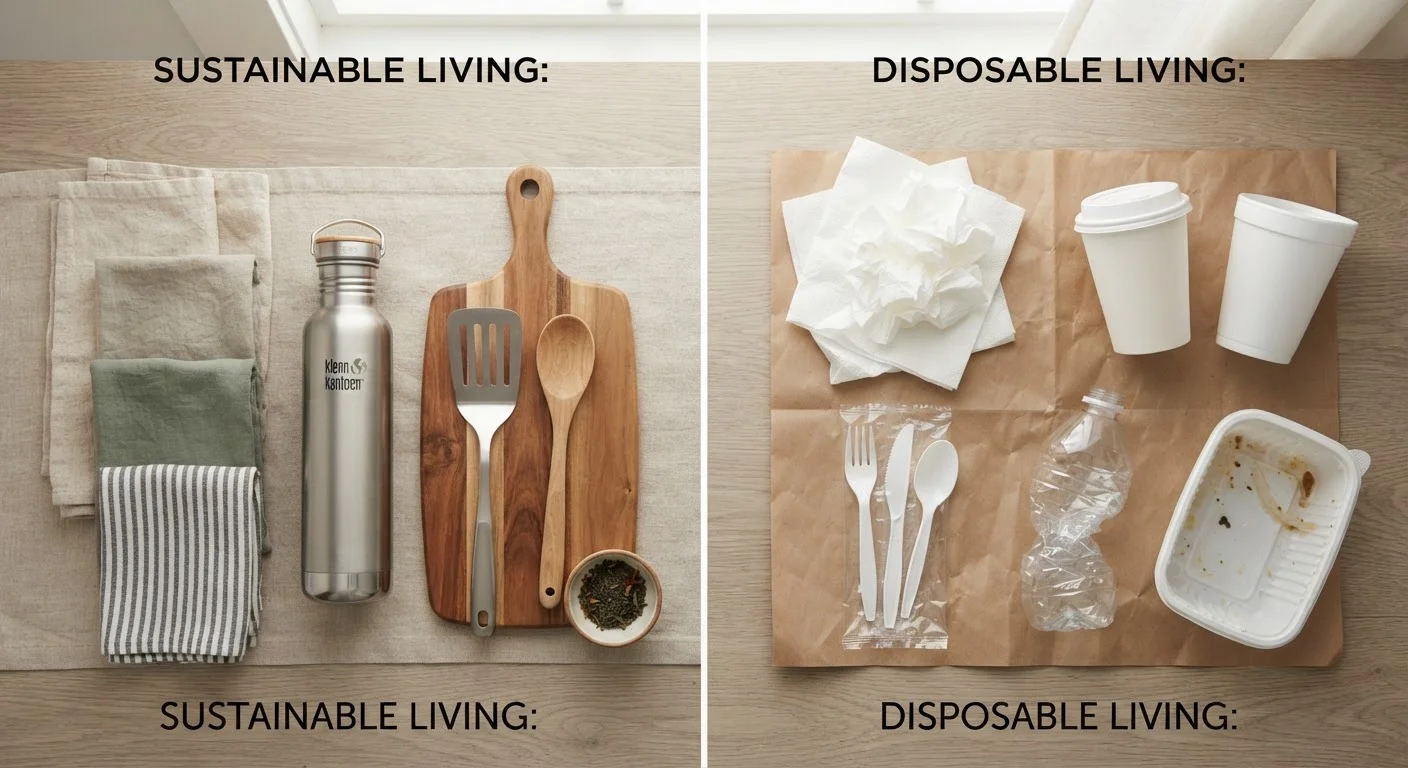
A roll of paper towels costs a few dollars. A set of reusable cloth towels costs considerably more upfront. But paper towels are a recurring purchase; cloth towels, washed and reused, are not. Stretch that out over a year or two of regular use, and the arithmetic shifts substantially in favor of the durable option.
This is cost-per-use thinking — dividing total expenditure by the number of times you actually use something. It's one of the most reliable ways to cut through the noise of upfront pricing. Cost-per-use thinking reframes the purchase decision around value delivered, not just dollars spent at checkout.
The challenge is that cost-per-use requires you to honestly estimate how often and how long you'll use something — and people tend to overestimate both.
Where Disposables Actually Make Sense
Disposables aren't inherently wasteful choices. In specific contexts, they're the practical and even the economical option:
- One-time or rare events. If you're hosting a single large gathering and don't own — or want to store — enough dishware for 40 people, disposables or rentals are reasonable. Renting infrequently used items is worth considering before purchasing anything you'll rarely reach for.
- Hygiene-critical applications. Some contexts — certain medical or food-safety situations — genuinely call for single-use items where contamination risk outweighs cost concerns.
- Transitional situations. If you're moving, traveling long-term, or in temporary housing, investing in durable goods may not make sense until your living situation stabilizes.
Outside these scenarios, disposables tend to become an expensive default rather than a deliberate choice. The cumulative cost is easy to underestimate precisely because each individual purchase feels small.
Don't Let 'Durable' Become a Justification for Overspending
The durability argument can be misused to rationalize purchasing premium items you don't genuinely need or will rarely use. A product only delivers long-run savings if you actually use it often enough to reach the break-even point. Before committing to a higher-priced durable, be honest about your realistic usage habits — aspirational use cases rarely translate into actual cost savings.
The Real Cost of Durable Products
Durable items come with their own hidden costs that a simple sticker comparison won't reveal:
- Upfront capital. Higher purchase prices can strain a budget, even when the long-run math favors the investment. For households managing tight cash flow, the upfront barrier is real.
- Maintenance and repair. Durable goods may need occasional upkeep — sharpening, cleaning, battery replacement, or professional servicing. These costs should be factored in.
- Storage requirements. Physical durables take up space. A set of reusable containers, cloth bags, or kitchen tools requires somewhere to live. For smaller homes or apartments, this is a genuine constraint.
- Obsolescence risk. Some categories — particularly electronics — can become functionally outdated before they physically wear out, which complicates the long-term value calculation.
For guidance on identifying products that genuinely last, see what separates a durable purchase from one you'll replace too soon. Build quality signals matter more than price tier alone.
Start With One Category at a Time
Switching from disposable to durable across your entire household at once is expensive and rarely sustainable. Instead, identify the category where you spend the most on disposables — paper products, plastic bags, or single-use kitchen items are common culprits — and start there. Once that switch pays for itself, reinvest the savings into the next category. A phased approach keeps upfront costs manageable and makes the transition easier to maintain.
A Framework for Making the Call
Rather than defaulting to one approach, a simple evaluation can guide most everyday purchase decisions:
- Estimate your use frequency. Daily? Weekly? A few times a year? Items used regularly benefit most from the durable model.
- Calculate a rough break-even point. Divide the extra cost of the durable option by what you'd spend per period on the disposable equivalent. That tells you how long it takes to come out ahead — and whether that timeline is realistic for you.
- Account for storage and maintenance. If you won't maintain it or don't have space for it, a durable item may lose its edge in practice.
- Consider your stability horizon. Are you likely to stay in your current home, job, or life situation long enough to realize the benefit? If not, durables may not pay off in time.
Cheap household items often carry hidden costs beyond the shelf price — frequent replacement, performance gaps, or safety issues — making the break-even calculation more favorable to durables than it first appears.
| Durable Products | Disposable Products | |
|---|---|---|
| Upfront cost | Higher initial outlay | Low per-unit purchase price |
| Long-run cost (frequent use) | Lower overall spend | Accumulates quickly with regular use |
| Convenience | Requires washing, maintenance, storage | Ready to use, no cleanup needed |
| Best use case | Daily or weekly household tasks | One-time events or rare tasks |
| Storage requirement | Moderate to significant | Minimal until stocked in bulk |
| Environmental footprint | Lower waste over time | Higher waste generation with frequent use |
For anyone navigating these decisions as part of a broader budgeting effort, the Saving & Debt hub offers practical context on managing household spending over time.