The Core Question: How Often Will You Actually Use It?
The decision to rent or buy an infrequently used household item almost always comes down to one honest question: how many times per year will you realistically reach for it? Most people overestimate frequency — a pressure washer sounds indispensable until you realize you've cleaned the driveway twice in three years.
A simple break-even calculation clarifies the math. If a tool rents for $60 per day and costs $300 to purchase, you'd break even after five uses. If that use case realistically happens once a year, buying means carrying a five-year payback period — before accounting for storage and any maintenance. For context, our framework for occasional-use items walks through this calculation in more detail across a broader range of scenarios.
Frequency alone isn't the whole story, though. Item cost, storage footprint, perishability, and the logistics of renting all factor in — and they shift depending on the category of item you're considering.
| Criterion | Renting | Buying |
|---|---|---|
| Upfront cost | Low — pay per use | Higher — full purchase price |
| Long-term cost (high use) | Can exceed purchase price | Cost per use drops over time |
| Storage required | None | Yes — can be significant |
| Maintenance responsibility | Handled by rental provider | Owner's responsibility |
| Immediate availability | Requires scheduling/pickup | On-demand access |
| Best use frequency | 1–3 times per year or less | Multiple times per year |
| Resale option | None | Possible — offsets total cost |
Where Renting Has a Clear Edge
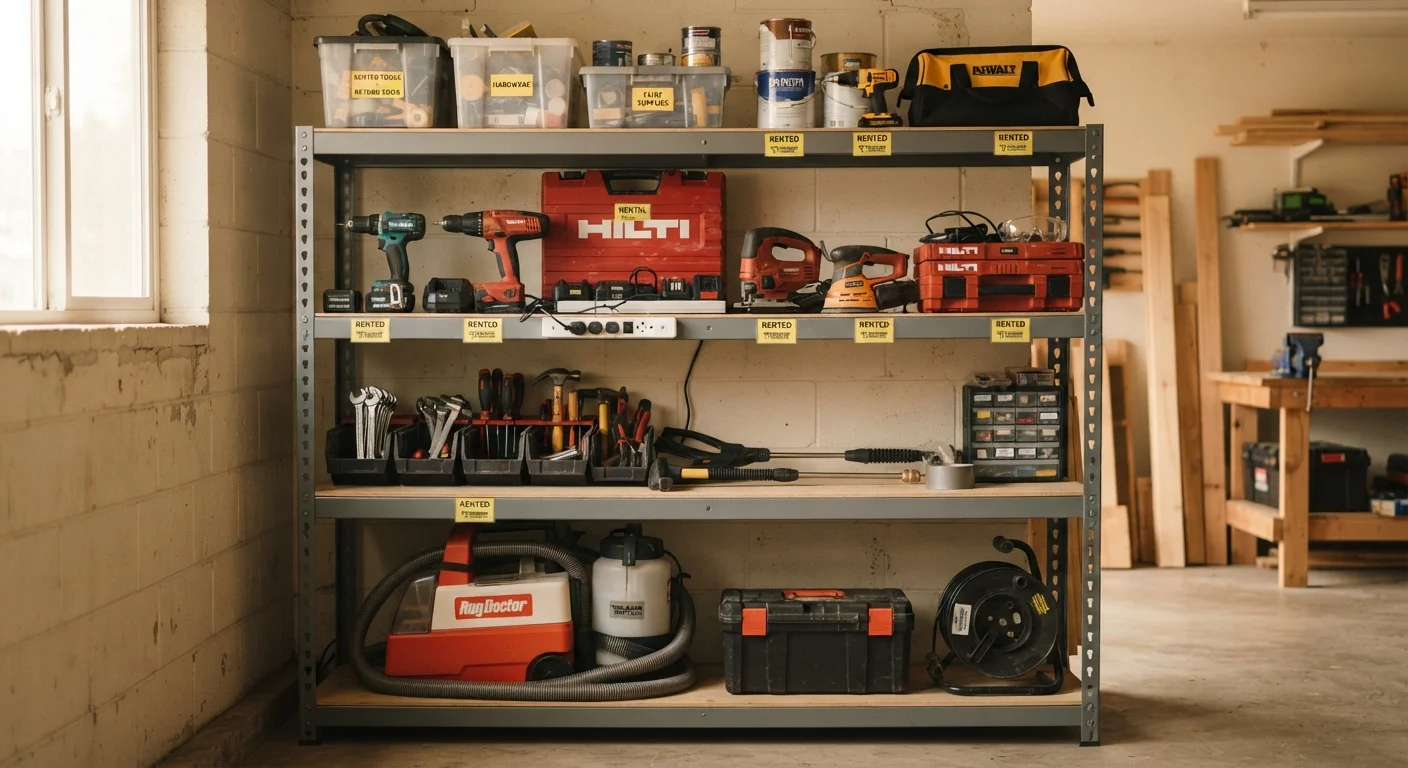
Certain item categories almost always favor renting for typical households. Large power equipment — tile saws, floor sanders, concrete mixers, log splitters — is expensive to buy, heavy to store, and requires periodic maintenance to stay functional. Using one twice a decade makes ownership hard to justify on any basis other than convenience.
Party and event supplies are another strong renting case. Tables, folding chairs, tent canopies, and dishware can serve hundreds of guests without taking up your basement for years. The same logic applies to specialty kitchen equipment: an ice cream machine or commercial-style pasta press might be used twice and then gather dust.
1 in 3
Homeowners who rarely use specialty tools they own
Consumer surveys on household tool ownership consistently find a significant share of purchased tools go unused for a year or more after initial purchase.
$60–$150
Typical daily rental rate for large power equipment
Rates vary by region and equipment type, but daily rental fees for items like floor sanders and concrete mixers commonly fall in this range at general tool rental centers.
It's worth noting that some items appear cheap to buy but carry hidden downstream costs. Our article on why cheap household items sometimes cost more explores how low upfront prices can mask replacement rates and performance shortfalls — relevant when you're tempted by an inexpensive version of a specialty tool.
When Buying Makes More Sense
Ownership earns its place when use frequency is high enough that rental fees accumulate faster than a purchase price. A cordless drill used for routine home maintenance throughout the year is a textbook buy — rental logistics alone (driving to a location, returning on time) add friction and cost that compound over repeated uses. If you're weighing power source decisions for tools you do buy, this guide on corded vs. cordless tools offers a useful framework.
Immediate availability is also underrated. Owning a wet/dry shop vacuum means using it at 7 p.m. on a Sunday without a rental center being open. For time-sensitive situations — a burst pipe, a home project before guests arrive — availability has real value that doesn't show up in break-even math.
Don't Overlook the Cost of Renting Logistics
Renting isn't free of friction. Driving to pick up and return equipment, working within rental windows, and potentially paying late fees all add real cost — in time and money. For items you'd rent frequently, those logistics can tip the math toward buying faster than the dollar comparison alone suggests. Factor in your time and how convenient the rental source is before making a final call.
Longer-term, items that hold their value and can be resold also improve the ownership calculation. A quality ladder or hand truck doesn't depreciate to zero — if you decide you no longer need it, resale recaptures part of your initial spend. That's worth factoring into the comparison alongside which household items are worth spending more on.
Making the Call: A Practical Decision Framework
Before committing either way, run through four practical questions. First, how many times per year will you genuinely use this? Second, what does the rental fee cost per use, and what is the purchase price? Third, do you have suitable storage space, and does storing it incur any indirect cost? Fourth, does the item require maintenance — and are you willing to handle it?
If the honest answers point toward infrequent use, limited storage, and low appetite for upkeep, renting is the lower-friction, lower-total-cost path. If use is regular, the item is compact, and maintenance is minimal, buying generally makes more sense over a two-to-three year horizon.
For a broader view of how ownership costs compare to alternatives — including borrowing from neighbors or community tool libraries — see our related guide on rent vs. own vs. borrow for occasional-use items. And if you're budgeting more broadly for household spending, the Budgeting Basics hub offers strategies for tracking where these decisions fit into your overall spending picture.