
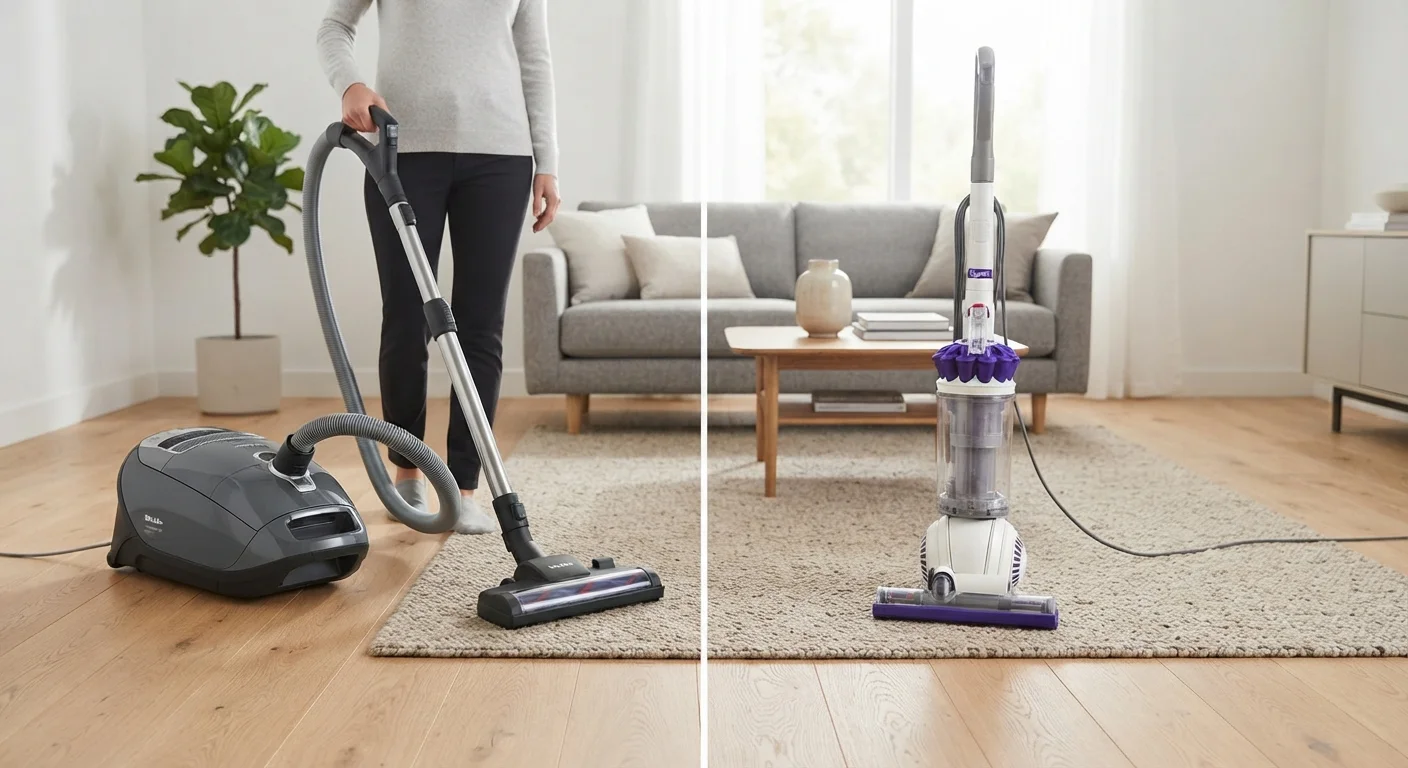
How the Two Designs Work
The fundamental difference between canister and upright vacuums comes down to how the motor, dustbin, and cleaning head are arranged. An upright vacuum integrates everything into a single unit — the motor and collection bin sit directly above the cleaning head, which you push along the floor. A canister vacuum separates the motor and bin into a rolling body connected to the cleaning head via a flexible hose and wand.
That structural difference cascades into real-world performance differences across carpet, hard floors, stairs, and tight spaces. Understanding the mechanics helps you predict how each will feel to use in your specific home — before you commit to one. For a broader look at what separates a reliable vacuum from a frustrating one, see what actually makes a vacuum worth keeping.
Performance Across Different Floor Types
Carpet: Upright vacuums have a long-standing advantage here. The motor-to-head proximity typically delivers stronger brush-roll agitation, which lifts embedded debris and pet hair from carpet pile more effectively. Wide cleaning paths also make covering large carpeted rooms faster.
Hardwood and tile: Canister vacuums tend to perform better on hard floors. Their separate powerhead can be swapped for a bare-floor attachment, and the lighter wand makes it easier to glide without scattering debris. Many upright vacuums allow you to disengage the brush roll for hard floors, but the heavier head can still be cumbersome.
Area rugs: Both handle area rugs reasonably well, but canister wands with suction-only floor tools avoid the edge-catching that aggressive brush rolls can cause on rug fringe.
| Canister | Upright | |
|---|---|---|
| Carpet performance | Good with motorized head | Excellent — strong brush-roll agitation |
| Hardwood / tile | Excellent — swappable bare-floor tools | Adequate — less nimble |
| Stair cleaning | Excellent — hose and tools reach easily | Awkward — limited reach |
| Maneuverability | High — flexible wand and hose | Moderate — fixed head path |
| Storage footprint | Larger — body plus hose and wand | Compact — stands upright in closet |
| Above-floor cleaning | Excellent — long reach with wand | Limited without detachable hose |
| Typical weight (user effort) | Body dragged, not lifted — lower arm fatigue | Full weight pushed — can tire users |
Stairs: This is where canisters have a clear edge. You can carry the canister body on a step while using the hose and upholstery tool to work each tread. Uprights are awkward on stairs — most require detaching a hose, if one is included at all.
Maneuverability, Storage, and Everyday Usability
Uprights stand on their own and store compactly in a closet — a genuine convenience advantage for smaller homes. Canisters require you to manage both the wand and the rolling body, and storing the hose without kinking it takes more thought.
In terms of maneuverability, canisters win for navigating around chair legs, pulling under beds, and reaching high spots like ceiling fan blades or curtain rods — tasks where running a full upright is unwieldy. Uprights win for pure straight-line carpet coverage speed.
Test the Hose Length Before You Commit
Canister vacuum hoses vary widely in length — some are too short to comfortably reach the top of a staircase without repositioning the canister repeatedly. Before settling on a canister model, check the combined wand-plus-hose reach and compare it to the height of your staircase or the depth of rooms you plan to clean. A longer reach is almost always worth the minor additional bulk.
Weight matters, too. Canister bodies are typically heavier than upright heads, but because you're dragging the canister rather than lifting the whole machine, fatigue during a full-house clean can be lower — particularly for users who find pushing a heavy upright tiring. For homes where cord management is already a pain point, it's also worth reading about the trade-offs between corded and cordless appliances before deciding on a style.
Pet Hair, Allergens, and Filtration
Pet hair and allergen performance are commonly attributed to vacuum style, but filtration quality — HEPA vs. standard filters, sealed systems vs. non-sealed — matters far more than whether the machine is a canister or upright. Both formats are available with HEPA filtration; what varies is how consistently manufacturers seal the airpath to prevent fine particles from escaping around the filter.
~30%
U.S. homes with one or more pets
According to the American Pet Products Association's National Pet Owners Survey, roughly two-thirds of U.S. households own a pet, with dogs and cats the most common — making pet hair a top vacuum-selection factor.
HEPA
Filtration standard that captures fine particles
HEPA filters are defined by EPA standards as capturing at least 99.97% of particles 0.3 microns in diameter — a relevant benchmark for allergen-conscious households regardless of vacuum style.
For pet hair specifically, motorized brush-roll tools (available as attachments on most canisters and built into uprights) are the key variable. A canister with a motorized mini-brush head can perform as well as an upright on upholstered furniture and pet beds — sometimes better, because you can bring the tool directly to the surface rather than maneuvering a full-sized machine.
If indoor air quality is a concern beyond vacuuming, air purifier filtration types and room sizing covers how to layer your approach to dust and allergen reduction.
If your current vacuum — regardless of style — seems to be losing effectiveness, the cause is usually fixable. See why vacuums lose suction and how to restore it before assuming you need to replace it.