
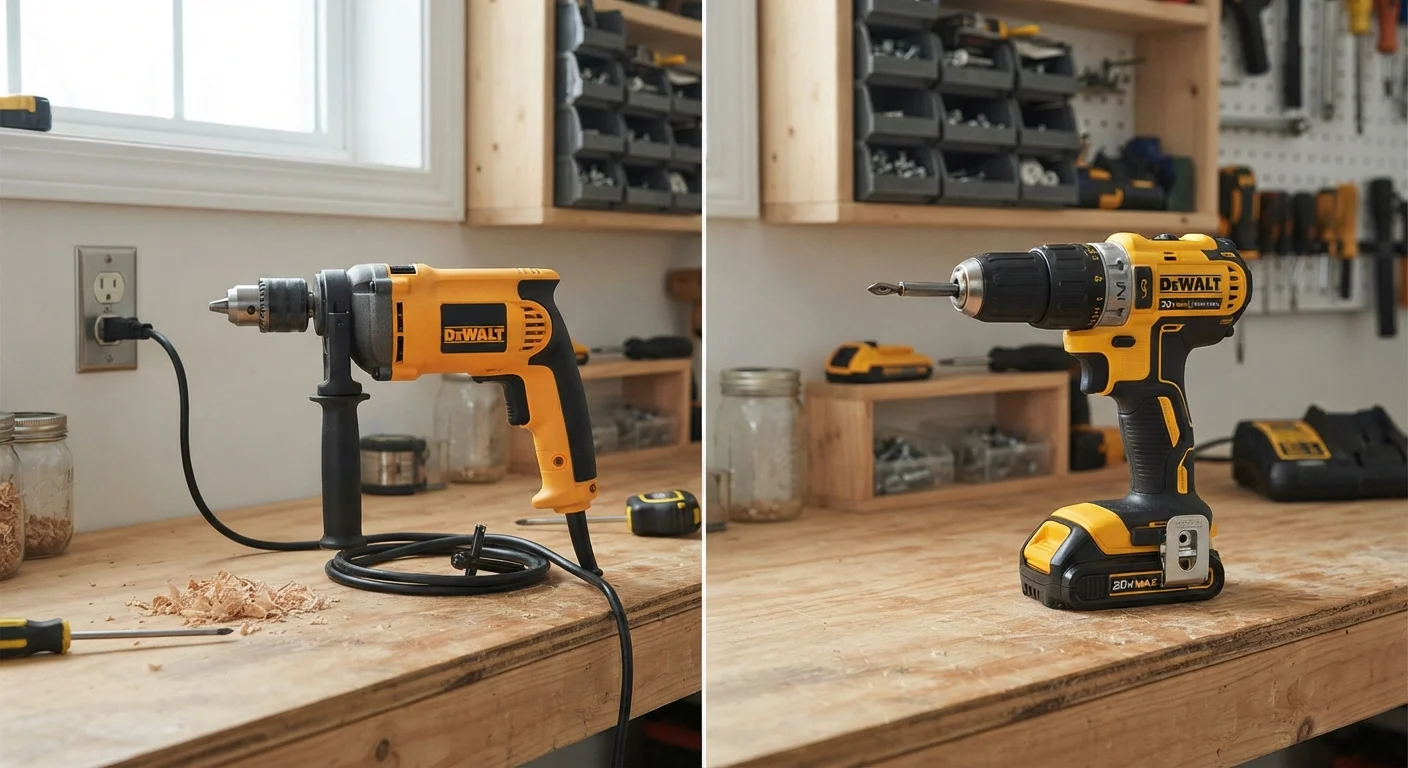
Why Power Source Matters More Than People Expect
When most people shop for a vacuum, drill, or handheld blower, the corded-versus-cordless decision often gets made on feel — cordless looks sleek and modern, corded feels dated. But power source affects performance in ways that go well beyond aesthetics, and those differences compound over time.
The core issue is energy delivery. Corded appliances draw directly from your home's electrical grid, which provides a consistent, essentially unlimited power supply for as long as the tool is running. Cordless appliances run from a rechargeable battery pack — typically lithium-ion — whose available energy decreases as the charge depletes and whose total capacity shrinks gradually over the battery's lifespan.
For occasional, light tasks, that gap is nearly invisible. For sustained or demanding work, it becomes the defining factor in whether a tool does the job well. See also how to think about power tools and appliances for the home for a broader decision framework.
| Corded | Cordless | |
|---|---|---|
| Power consistency | Constant throughout use | Decreases as battery depletes |
| Mobility | Limited by cord and outlet access | Full freedom of movement |
| Upfront cost | Lower for equivalent performance | Higher due to battery system |
| Long-term maintenance | Minimal — no battery to replace | Battery replacement needed over time |
| Best task duration | Extended or continuous use | Short to moderate sessions |
| Hazard considerations | Trailing cord is a trip risk | No cord; safer in some settings |
Where Corded Appliances Hold a Real Edge
Consistent power output is the primary advantage of corded tools, and it matters most in two scenarios: tasks that run longer than 20–30 minutes, and tasks that require maximum torque or suction throughout.
A corded shop vacuum, for example, will deliver the same suction at minute one and minute sixty. A corded drill won't slow down as a screw drives deeper into hardwood. That reliability is difficult to replicate with batteries, even high-capacity ones.
Corded appliances also tend to carry a lower upfront cost for equivalent performance. The battery and charging system that accompanies a cordless tool represents meaningful additional expense — cost that isn't always obvious in side-by-side comparisons at retail.
Match the Tool to the Task Duration
Before purchasing, estimate how long you typically run an appliance in a single session. If sessions regularly exceed 30 minutes under load — sanding, vacuuming a large home, drilling many holes — that's a strong signal to favor corded. If sessions are short and scattered throughout the day, battery runtime is rarely a limiting factor.
There's also the maintenance angle: corded tools have no battery to replace or degrade. That simplicity benefits homeowners who use tools infrequently and don't want to manage charging schedules or monitor battery health over years of ownership.
Where Cordless Appliances Genuinely Win
Mobility is the honest advantage of cordless — not just convenience as a marketing concept, but practical access to spaces where a cord is a real obstacle. Cleaning a car interior, trimming shrubs away from an outlet, or moving between rooms without hunting for extension cords are all situations where battery power makes the task meaningfully easier.
Cordless tools also eliminate the hazard of a trailing cord, which matters in workshops and on ladders. For quick, repeated tasks — a hand vacuum used several times daily, a screwdriver for assembling furniture — the grab-and-go workflow has genuine value.
If you're evaluating a vacuum specifically, canister vs. upright designs also affect maneuverability in ways that interact with the corded question.
Battery platform compatibility adds another consideration. Many manufacturers offer interchangeable batteries across their tool lines. If you already own batteries from a given platform, adding a compatible cordless tool is less expensive than it would be otherwise — the battery investment is already made.
Battery Platform Lock-In Has Real Costs
Cordless tool batteries are not universally interchangeable — they're specific to each manufacturer's voltage and connector standard. Committing to one platform means future tool additions should ideally stay within that ecosystem, or you'll pay for duplicate battery sets. Before buying into a cordless system, consider whether the platform is well-supported and carries a product line that covers your future tool needs.
The Long-Term Cost Picture
Cordless tools carry a hidden cost trajectory that deserves attention before purchasing. Lithium-ion batteries degrade with charge cycles — most batteries retain roughly 70–80% of their original capacity after several hundred full charge cycles, though this varies by battery chemistry, storage conditions, and usage patterns. Eventually, replacement becomes necessary.
Replacement battery packs are often expensive — sometimes approaching a third to half the original tool price. That cost doesn't appear on the price tag but should factor into your total-cost evaluation.
For appliances used daily or near-daily, this matters more. For tools used a handful of times per year, battery degradation is slower and less financially significant. The long-term cost framework for everyday products applies directly here: upfront price and total ownership cost often diverge.
It's also worth noting that if a tool sits unused for months, lithium-ion batteries should be stored partially charged to extend their useful life — a small but real maintenance responsibility that corded tools don't require.
~500
Typical full charge cycles before notable capacity loss
Most lithium-ion battery manufacturers cite 300–500 full charge cycles before capacity falls to around 80%, though actual performance varies by usage and storage conditions.
20–40%
Power output drop as battery depletes
Independent tool-testing analyses have observed meaningful torque and suction reductions in cordless appliances as battery charge falls below 50%, particularly under high load.
How to Match Power Source to Your Actual Use Case
The most practical approach is to evaluate each appliance category individually rather than committing uniformly to one format. Some tools are better suited to corded operation almost regardless of preference; others are genuinely improved by cordless design.
Consider frequency first: tools used briefly and often benefit most from cordless convenience. Tools used for extended sessions, or that demand full power continuously, benefit most from corded reliability. Consider location second: tasks in fixed locations near outlets argue for corded; tasks across the yard, in a vehicle, or on a ladder argue for cordless.
Budget-conscious homeowners evaluating infrequently used tools may also want to weigh whether ownership makes sense at all — renting vs. buying infrequently used household items is worth reading before committing to either format for specialty equipment.
Finally, if you're building out a home tool set gradually, corded options for high-demand tools (circular saw, vacuum, jigsaw) alongside cordless for convenience tools (drill-driver, handheld blower, screwdriver) is a practical mixed approach that many experienced homeowners land on naturally.