The Tools You Use Every Day Without Thinking
Most kitchen upgrades get directed toward cookware or appliances — the visible, photogenic stuff. Meanwhile, the tools you actually reach for dozens of times a week go unexamined. These are the items that quietly shape whether cooking feels efficient or frustrating, whether your knife stays sharp, whether cleanup is a five-minute task or a twenty-minute one.
The good news: most of these overlooked essentials are inexpensive. What they require is awareness, not a big budget. If you're evaluating where to focus household spending, our guide on where spending more actually pays off is a useful starting point. Below are the kitchen items most worth a second look.
Cutting Board Material
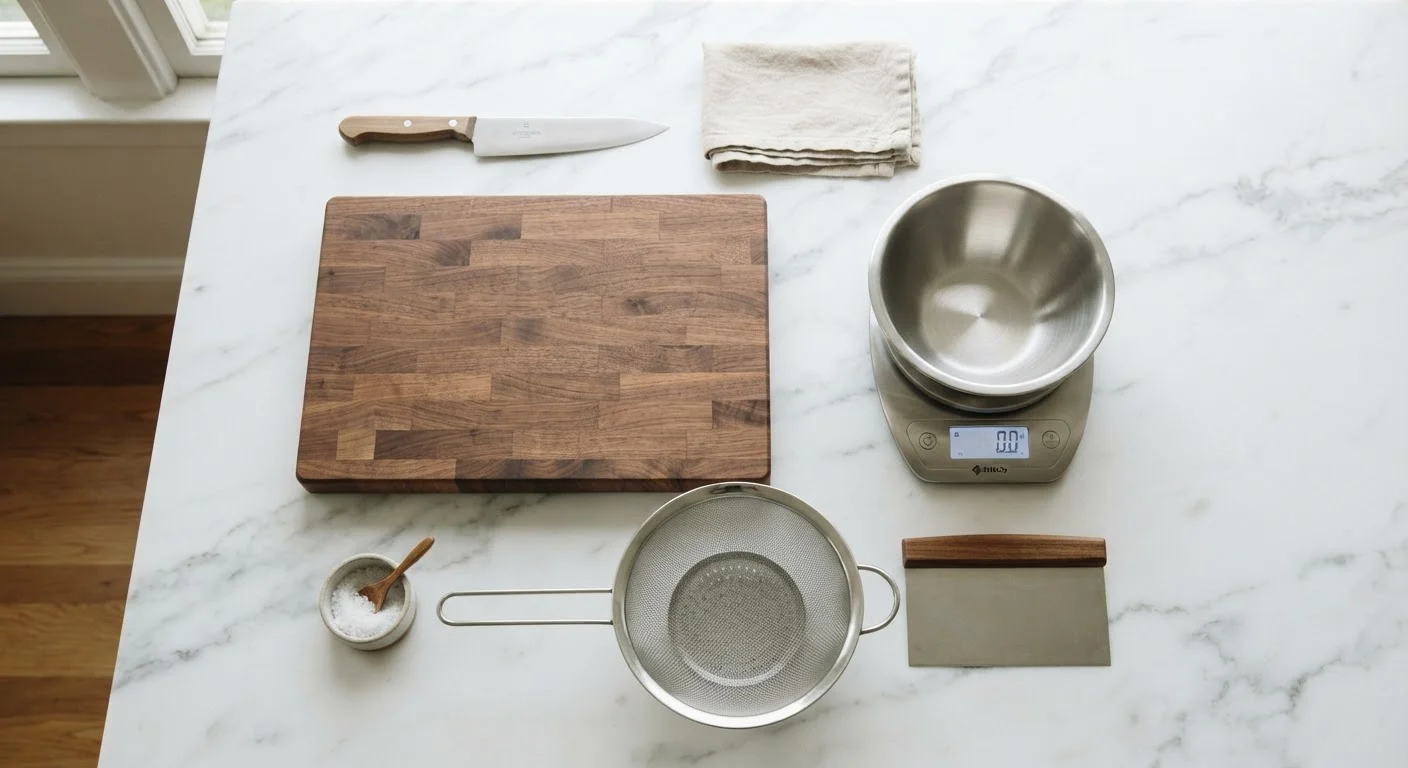
Most households own a cutting board, but the material matters more than people realize. Plastic boards are easy to sanitize in a dishwasher but develop deep grooves over time that can harbor bacteria if not replaced regularly. Wood and bamboo boards are gentler on knife edges, but they require hand washing and occasional oiling to resist warping and cracking. End-grain wood boards are particularly forgiving on blades because knives slip between wood fibers rather than cutting across them.
The key is matching the board to your habits. If you're diligent about hand-washing, a well-maintained wood board can last years. If your household relies on the dishwasher, a thick plastic board that you replace periodically is a practical choice. Keeping separate boards for raw proteins and produce — regardless of material — is a straightforward food safety step worth building into your routine. You can also explore how cookware safety concerns similarly depend on material and maintenance habits.
End-grain wood boards protect knife edges by letting blades slip between fibers rather than across them.
A Colander Worth Using
A colander seems like a simple object, but a poor one creates real friction. Cheap versions with large, uneven holes can let small pasta shapes slip through. Lightweight models without a stable base tip over when you pour heavy pots. Colanders that sit too shallow in the sink catch splashback from draining hot water in ways that are genuinely hazardous.
When evaluating a colander, look for a wide, stable base or feet that keep it elevated above the sink floor, consistent small-to-medium perforations, and enough bowl depth to handle a full pound of pasta without overflow. Stainless steel holds up well over time and doesn't retain odors the way some plastics do. This is a purchase where slightly more attention upfront saves repeated annoyance across years of use.
A colander without a stable base is a minor kitchen hazard waiting to happen during a pasta night.
A Kitchen Scale
Volume measurements — cups and tablespoons — introduce variability that most home cooks don't account for. A cup of flour can range significantly in weight depending on how it's scooped, which is why baked goods often turn out differently between attempts even with the same recipe. A kitchen scale removes that variable entirely.
Beyond baking, a scale is useful for portioning proteins, tracking quantities when cooking for one versus four, and following recipes from sources that use weight measurements (common in European and professional contexts). Digital scales with a tare function — which resets to zero after each ingredient so you can measure directly into one bowl — are the most practical format. They take up almost no space and represent one of the highest utility-to-cost ratios in a kitchen drawer.
A digital kitchen scale removes the variability that makes baking results inconsistent batch after batch.
A Bench Scraper
A bench scraper — a flat rectangular blade with a handle along one edge — is one of the most underestimated tools in a home kitchen. Professional bakers use them constantly, but home cooks rarely think to own one. Its uses are broad: transferring chopped vegetables from a board to a pan without the awkward knife-scooping maneuver, cleaning dough residue off a countertop, portioning pastry or dough cleanly, and scraping down a cutting board between tasks.
Most bench scrapers are inexpensive, made from stainless steel with a comfortable rolled handle. They require almost no maintenance. If you routinely find yourself improvising with the flat side of a knife to move ingredients, a bench scraper will immediately feel like something you should have had for years.
Professional bakers rely on bench scrapers constantly — yet most home kitchens don't own one.
A Splatter Screen
High-heat cooking — searing proteins, frying, rendering fat — generates splatter that lands on stovetops, nearby surfaces, and occasionally on the cook. A splatter screen sits over the pan to contain most of that mess while still allowing steam to escape, unlike a lid, which traps moisture and can alter cooking results.
Splatter screens are typically mesh stretched across a round frame with a handle. The key quality factor is mesh fineness: a tighter weave catches more grease without blocking airflow. Look for a screen that matches your largest pan's diameter, since an undersized screen defeats its purpose. Stainless mesh screens can go in the dishwasher, which matters given how greasy they get. Cleanup time and surface protection both improve noticeably with regular use — which is the kind of practical payoff that defines a genuinely useful kitchen essential, as explored in our piece on what makes a household product truly essential.
A splatter screen lets steam escape while containing grease — a result a lid simply can't replicate.
Small Investments, Real Daily Impact
What's striking about this list is how little these items cost relative to the friction they eliminate. A bench scraper under ten dollars does work that a fancy knife set can't. A colander with poor drainage adds minutes of annoyance to every pasta night. These aren't glamorous purchases, but they're the kind that make cooking feel smoother across hundreds of meals.
Start With What You Use Most
Before purchasing any of these items, spend a week noticing where your current kitchen setup creates friction. Which tasks feel awkward? Where do you improvise? Upgrading the tools tied to your most frequent cooking tasks will deliver the most immediate benefit. Focused improvements to a few high-use areas outperform a broad overhaul of everything at once.
If you're thinking more broadly about what earns a permanent place in your kitchen, what makes a household product truly essential offers a practical framework for evaluating any item before it takes up drawer space. And if you're cooking more at home to manage grocery spending, pantry staples that quietly drain your grocery budget is worth a read alongside this one.