Why Payment Method Matters Beyond Convenience
Most people choose how to pay based on habit or what's in their wallet — but the method itself can quietly shape how much they spend and how they feel about it. Behavioral economists have documented what's sometimes called the "pain of paying": the mild discomfort that registers when money leaves your possession. That pain is sharpest with cash and dullest with credit cards, which creates meaningfully different spending patterns across the three main options.
This isn't about which method is morally better. It's about understanding how each one interacts with your psychology and finances, so you can make a more deliberate choice. For a broader look at how environment shapes purchasing decisions, see how retailers design stores to influence what you spend.
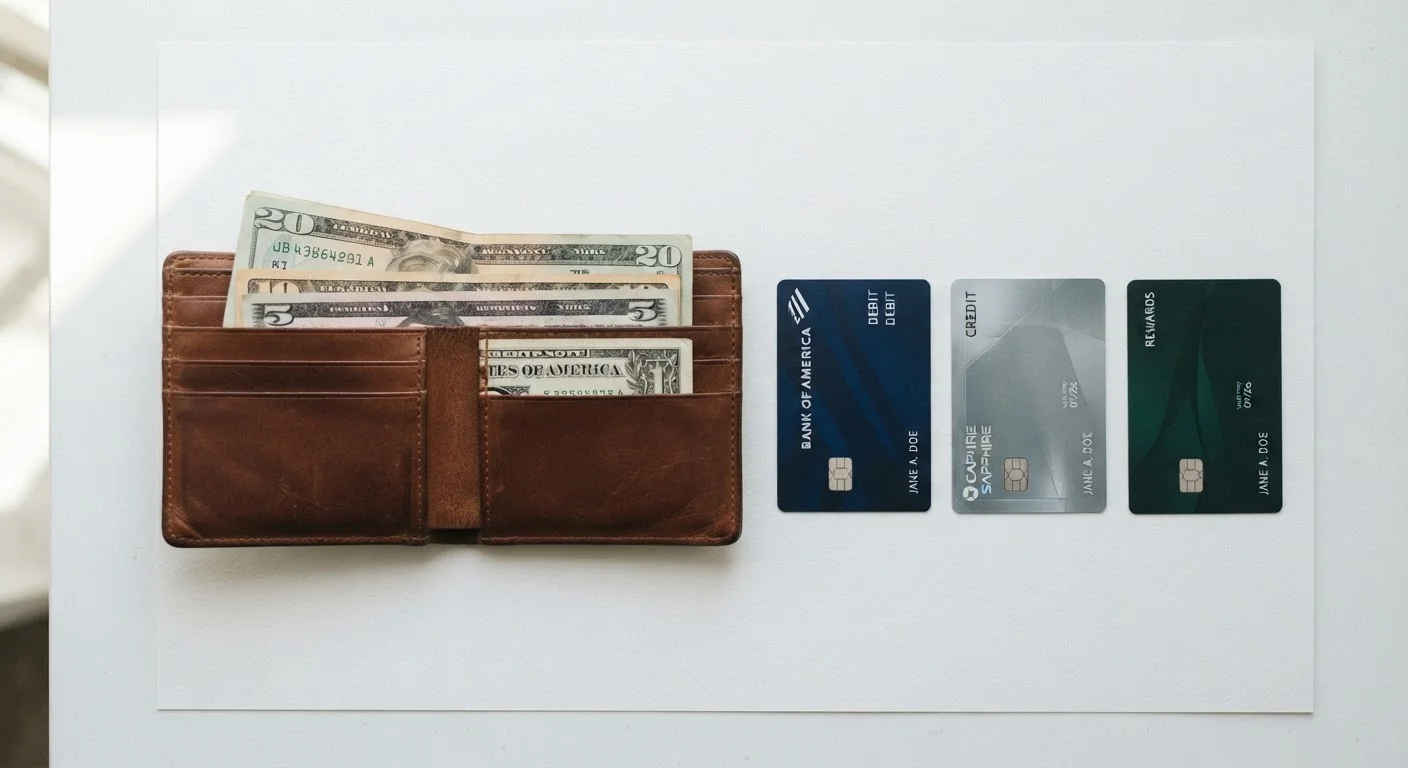
How Cash, Debit, and Credit Compare
Each payment method has a different relationship to your money, your protections, and your behavior at the point of purchase. The table below outlines the key dimensions worth comparing.
| Cash | Debit | Credit | |
|---|---|---|---|
| Funds source | Physical money on hand | Existing checking balance | Borrowed line of credit |
| Overspending risk | Low — hard stop at what you carry | Low-moderate — limited to account balance | Higher — credit limit may far exceed budget |
| Fraud protection | None — lost cash is gone | Moderate — federal Reg E rules apply | Strong — Fair Credit Billing Act applies |
| Spending awareness | High — physical handoff is tangible | Moderate — tap or swipe feels abstract | Lower — payment is deferred |
| Rewards potential | None | Rarely — some accounts offer minor perks | Often — cashback, points, or miles |
| Interest / cost risk | None | Overdraft fees if account runs low | High if balance carried month to month |
| Practical for online use | No | Yes | Yes — most widely accepted |
A few of these distinctions deserve closer attention before drawing conclusions.
The Case for Cash: Friction as a Feature
Research in consumer psychology — including widely cited work by Drazen Prelec and Duncan Simester — suggests that paying with cash is more "painful" than swiping a card, which tends to reduce the total amount spent. Handing over physical bills makes the transaction feel more concrete, and running out of cash creates a hard stop that cards don't.
The practical limitation is obvious: cash offers no fraud protection, no purchase records beyond what you keep yourself, and no rewards. It's also impractical for online purchases. But for categories where overspending is a recurring problem — dining out, entertainment, discretionary shopping — some people find that a cash envelope or weekly cash budget introduces useful friction. This connects directly to the patterns explored in how household spending habits form and how to reshape them.
Using Cash Strategically Doesn't Mean Going All-In
You don't have to abandon cards entirely to benefit from cash's psychological effect. Some people find it useful to withdraw a set weekly amount for discretionary spending categories — coffee, meals out, impulse purchases — and use cards only for planned, recurring expenses. This hybrid approach captures the spending-awareness benefit of cash without giving up digital protections for larger purchases.
Debit Cards: Real-Money Accountability With Some Risk
Debit cards draw directly from your checking account, so they share cash's core constraint: you can only spend what you have. That accountability is genuinely useful for people managing a tight budget or avoiding debt. Unlike cash, debit cards leave a transaction record, which helps with tracking and budgeting — a relevant tool for anyone working through the basics covered in budgeting basics.
The downside is consumer protection. Federal Regulation E covers debit card fraud, but the process differs from credit card disputes — and if you report a lost or stolen card late, your liability exposure is higher. Debit cards also typically lack the purchase protections (extended warranty, travel insurance, purchase protection) that many credit cards include. For everyday, in-person spending where you're disciplined about balances, debit works well. For large or online purchases, the protections gap is worth considering.
Credit Cards: Flexibility and Rewards, With Real Trade-Offs
Credit cards offer the strongest consumer protections of the three — the Fair Credit Billing Act gives you the right to dispute unauthorized charges, and many issuers offer zero-liability policies for fraud. They also often include rewards programs, which can return value on spending you'd do anyway. For a breakdown of how those reward structures work, see cashback, rewards points, and statement credits explained.
The behavioral risk is well-documented: credit cards reduce the psychological friction of spending, which makes it easier to buy more than you intended. And if you carry a balance, interest charges can eliminate any rewards benefit many times over. The question of whether to carry a balance deserves careful consideration — carrying a balance vs. paying in full every month walks through what interest accumulation actually costs over time. Credit works best as a tool for people who pay their balance in full each billing cycle.
Rewards Can Obscure Real Costs
Rewards programs are designed to make credit cards feel like they're paying you to spend — and for disciplined users who pay in full, they can. But studies suggest that the prospect of earning rewards can increase overall spending, which may offset any cashback or points earned. If you find yourself spending more just to earn rewards, the net financial effect is likely negative. Treat rewards as a secondary benefit, not a reason to spend.