Why the Sticker Price Alone Doesn't Tell You Much
A $3.49 jar and a $5.99 jar of the same pasta sauce sit side by side. One is 16 oz; the other is 28 oz. Which one costs less? The sticker price gives you no answer. That's exactly the problem unit price solves.
Retailers package the same type of product in a dizzying range of sizes — partly driven by supply-chain economics, partly by shelf strategy. Shoppers are left trying to do mental math under fluorescent lights with a cart full of items. Unit price eliminates that friction by reducing every option to the same denominator: cost per ounce, per count, per sheet, per pound.
Understanding the difference between price and value is the foundation of smarter shopping — and unit price is the most direct tool for getting there at the shelf level.
~30
U.S. states with some unit pricing requirements
According to consumer advocacy research, roughly 30 states have some form of unit pricing regulation for retail food or drug products, though coverage and enforcement vary considerably.
< 30 sec
Time to calculate unit price manually
Dividing a product's total price by its quantity takes under 30 seconds with a phone calculator, yet most shoppers skip the step entirely.
Up to 40%
Potential cost difference within the same product category
Consumer research has found unit price variation of up to 40% between different package sizes of the same product on the same shelf.
How to Read a Unit Price Label
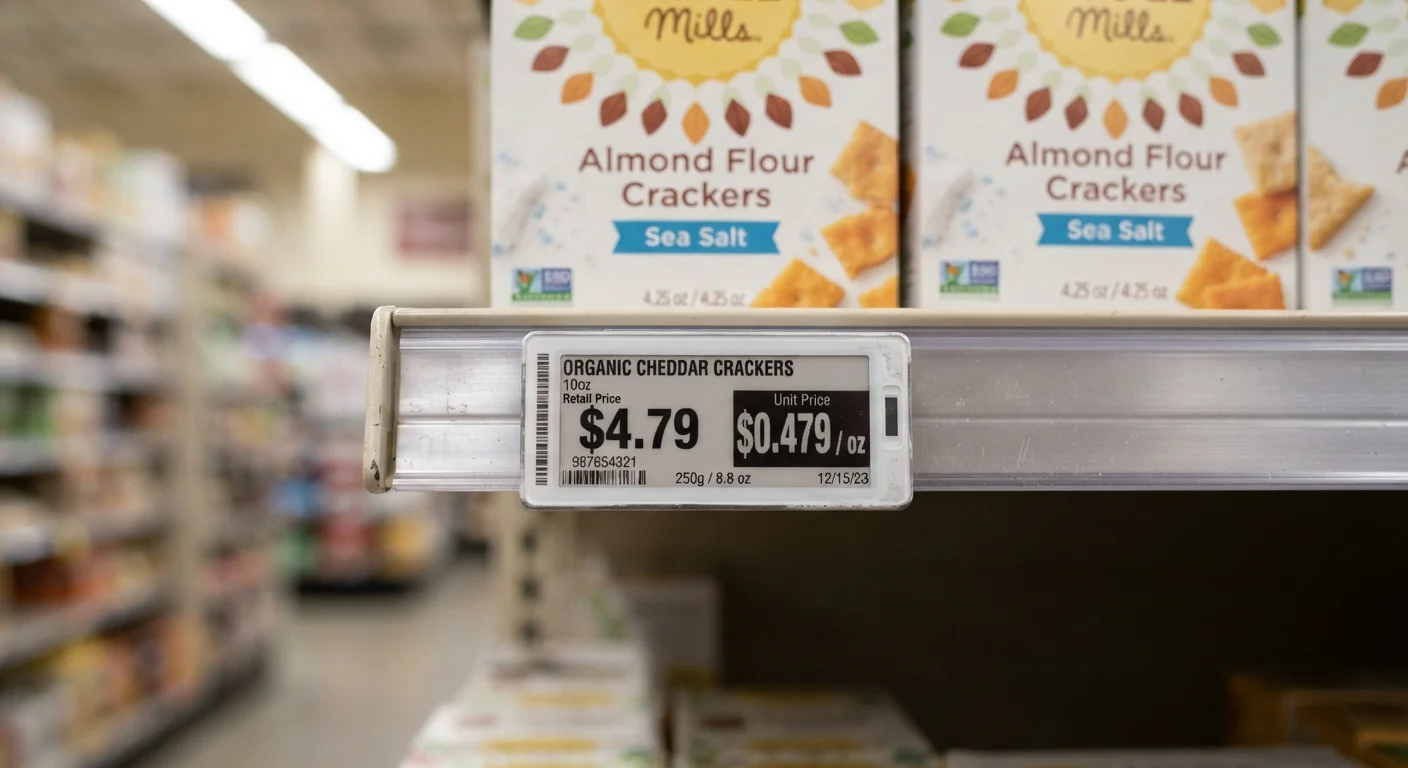
Shelf tags in most grocery and mass-retail stores carry two numbers: the item price and the unit price. The unit price is typically smaller, often in the upper-left or lower portion of the tag, and will read something like:
- $0.22/oz — for a dry or liquid product sold by weight or volume
- $0.04/sheet — for paper towels or toilet paper
- $0.19/count — for items like trash bags, vitamins, or batteries
The measure used varies by product category, which matters when comparing. Two competing brands of olive oil should both be priced per fluid ounce — if one is per ounce and one is per 100 mL, you'll need to convert before comparing. The math isn't complicated, but it's worth double-checking the unit before assuming two tags are directly comparable.
Unit price math rewards even a few seconds of attention — and it almost always clarifies which option is the better per-measure cost.
Can't Find the Unit Price? Do the Math Fast
Open your phone's calculator, enter the total price, divide by the number of ounces (or sheets, or count), and you have the unit price in seconds. Make it a quick habit on any item where two sizes or brands are competing for your cart.
Common Misconceptions About Unit Price
Bigger is always cheaper per unit. Often true, but not always. Retailers occasionally price jumbo sizes at a higher unit cost than mid-size options, banking on the assumption that shoppers won't check. Bulk sections and club-store quantities can go either way depending on the item and the week.
Sale prices mean a lower unit price than competitors. A marked-down item might still have a higher unit price than the store-brand alternative sitting next to it. Sale price mechanics can create the impression of a deal without one actually existing on a per-unit basis.
Unit price accounts for quality. It doesn't. A lower price per ounce of coffee tells you nothing about the roast or origin. Unit price is a cost-efficiency measure, not a quality signal. Those are separate evaluations.
When Unit Price Should — and Shouldn't — Drive Your Decision
Unit price is most useful when comparing genuinely interchangeable products: the same brand in different sizes, or similar generic versus name-brand items in the same category. It's the right tool for staples — canned goods, laundry detergent, paper products, bulk grains.
It's less useful when products differ in quality, concentration, or intended use. A concentrated cleaning product with a higher unit price may actually go further than a diluted version with a lower one. A higher price-per-ounce lotion might be formulated more richly than its shelf neighbor.
Storage and consumption rate also matter. A lower unit price on a perishable you can't finish before it expires is only a savings on paper. Consider how retail pricing works across package sizes before assuming the math alone closes the decision.
Used correctly, unit price is one of the fastest, most reliable ways to avoid paying more for less — which is what it was designed to do.