The Three Main Pathways to Health Coverage
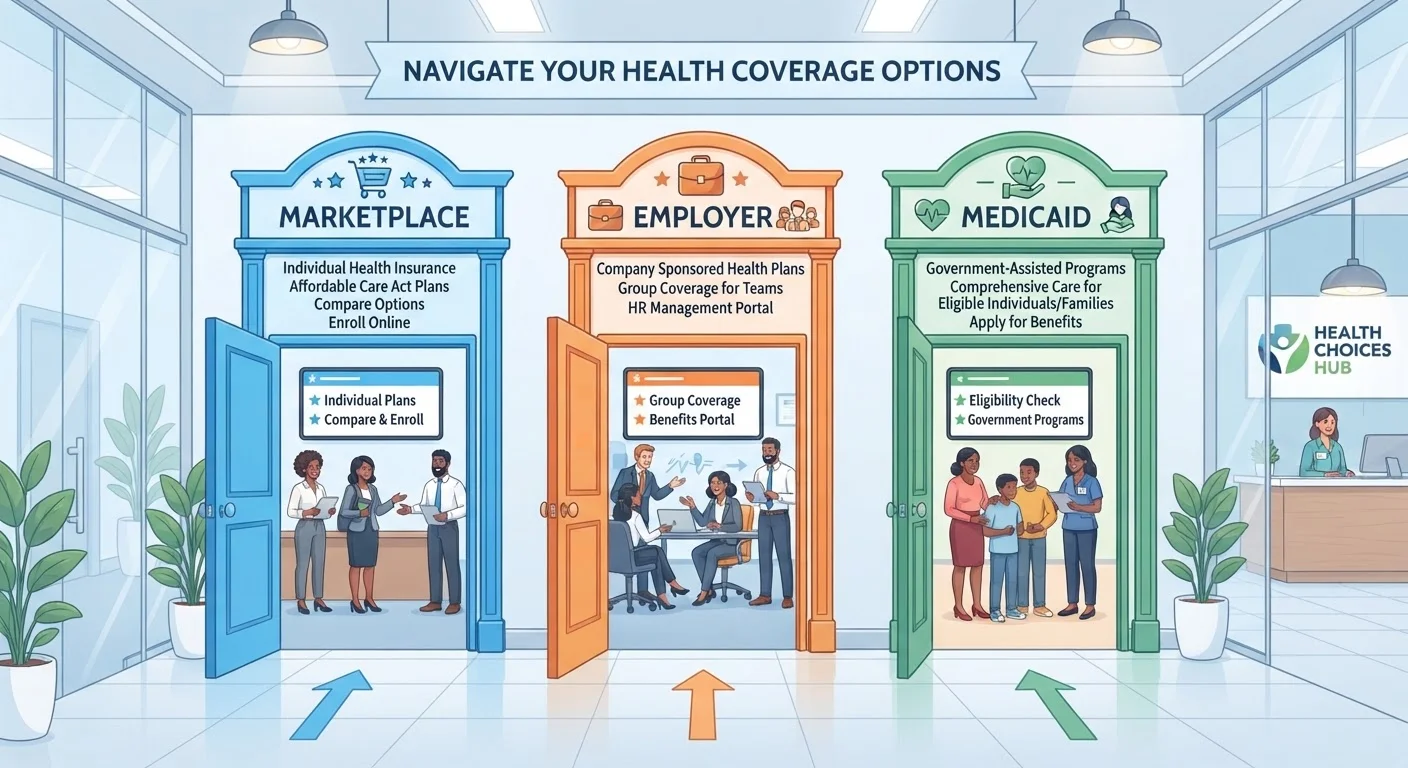
Most Americans get health insurance through one of three channels: a plan offered by an employer, a plan purchased through the Health Insurance Marketplace (sometimes called the Exchange), or Medicaid — the public program jointly run by the federal government and individual states. Each pathway has its own eligibility rules, enrollment windows, and cost structures.
If you're new to navigating these options, our plain-language health insurance guide explains the core concepts — like premiums, deductibles, and networks — before you dive into choosing a pathway.
Understanding which door is open to you is essential, because the rules that govern one pathway generally don't apply to another.
| Employer-Sponsored | Marketplace Plan | Medicaid | |
|---|---|---|---|
| Who qualifies | Employees of offering companies | Those without qualifying employer coverage | Low-income individuals and families |
| Cost to enrollee | Shared premium with employer | Full premium, minus any subsidy | Free or very low cost |
| Enrollment timing | New hire window + annual open enrollment | Annual open enrollment + qualifying events | Open year-round |
| Income-based financial help | Not applicable | Premium tax credits and cost-sharing reductions | Program is income-based by design |
| Regulated by | Federal (ERISA) and state law | ACA / state exchange rules | Federal and state jointly |
| Coverage portability | Tied to employment | Portable, not tied to employer | Tied to state residency and income |
Employer-Sponsored Coverage: The Workplace Baseline
Employer-sponsored insurance (ESI) covers more Americans than any other single source. When a company offers health benefits, it typically pays a portion of the monthly premium, with employees covering the rest through payroll deductions. The Affordable Care Act (ACA) requires employers with 50 or more full-time equivalent employees to offer minimum essential coverage — though smaller businesses may offer plans voluntarily.
Enrollment usually happens when you're first hired (during a new-hire window, typically 30 to 60 days) and during the employer's annual open enrollment period. Outside these windows, you can only enroll if you experience a qualifying life event — such as marriage, a new dependent, or losing other coverage.
Check Your Employer Offer Before Enrolling Elsewhere
Before shopping on the Marketplace, ask your HR department for a Summary of Benefits and Coverage and an affordability calculation. If your employer's plan meets ACA minimum value and affordability standards, you likely won't qualify for Marketplace subsidies. Getting clarity on this first can save you time and prevent a coverage mismatch.
One important rule: if your employer offers coverage that meets ACA affordability and minimum value standards, you generally won't qualify for premium tax credits on the Marketplace. A licensed benefits coordinator or insurance agent can help you evaluate whether your employer's offer qualifies.
Marketplace Plans: Coverage for Everyone Else
The Health Insurance Marketplace — accessible at HealthCare.gov in most states, or through a state-run exchange — was created by the ACA to give individuals and families without qualifying employer coverage a structured place to shop for regulated plans. All Marketplace plans must cover a set of essential health benefits and cannot deny coverage based on pre-existing conditions.
Depending on your household income relative to the federal poverty level, you may qualify for a premium tax credit that reduces your monthly cost, or a cost-sharing reduction that lowers your out-of-pocket expenses on certain plan tiers. These subsidies are applied at enrollment and are not automatic — you must apply through the Marketplace to receive them.
Marketplace open enrollment typically runs from November 1 through January 15 in most states, though some state-run exchanges set different dates. Missing the window means waiting until the next open enrollment unless you have a qualifying life event. For more on what happens if you miss it, see our guide on what missing open enrollment actually means.
~16M
Americans enrolled via ACA Marketplace
Federal and state Marketplace enrollment data has shown record-level sign-ups in recent plan years, reflecting expanded subsidy availability.
~90M
Americans covered by Medicaid and CHIP
According to CMS data, Medicaid and the Children's Health Insurance Program together cover roughly 90 million enrollees across the United States.
Medicaid: Income-Based Public Coverage
Medicaid provides free or very low-cost health coverage to eligible low-income individuals and families, including children, pregnant women, adults, and people with disabilities. Unlike the Marketplace, Medicaid enrollment is open year-round — if you're eligible, you can apply any time and coverage can begin quickly.
Eligibility rules differ by state. Under the ACA, states had the option to expand Medicaid to cover adults with incomes up to 138% of the federal poverty level. As of this writing, the majority of states have adopted this expansion, but a number have not — meaning eligibility thresholds vary considerably depending on where you live. Your state's Medicaid agency website is the authoritative source for current income limits and application procedures.
It's worth noting that Marketplace subsidies and Medicaid don't overlap: if your income qualifies you for Medicaid, you're generally not eligible for Marketplace premium tax credits. The Marketplace application process will screen for Medicaid eligibility automatically and route you accordingly.
If you're still building your foundational understanding of how health plans work, our first-time enrollee guide walks through key terminology step by step. And when you're ready to compare plans during an enrollment period, our open enrollment walkthrough can help you work through the process without getting overwhelmed.
This article is for general informational purposes only and does not constitute personalized insurance, financial, or legal advice. Coverage terms, eligibility rules, and subsidy amounts vary by state and individual circumstance. Consult a licensed insurance agent, navigator, or your state's Medicaid agency for guidance specific to your situation.