
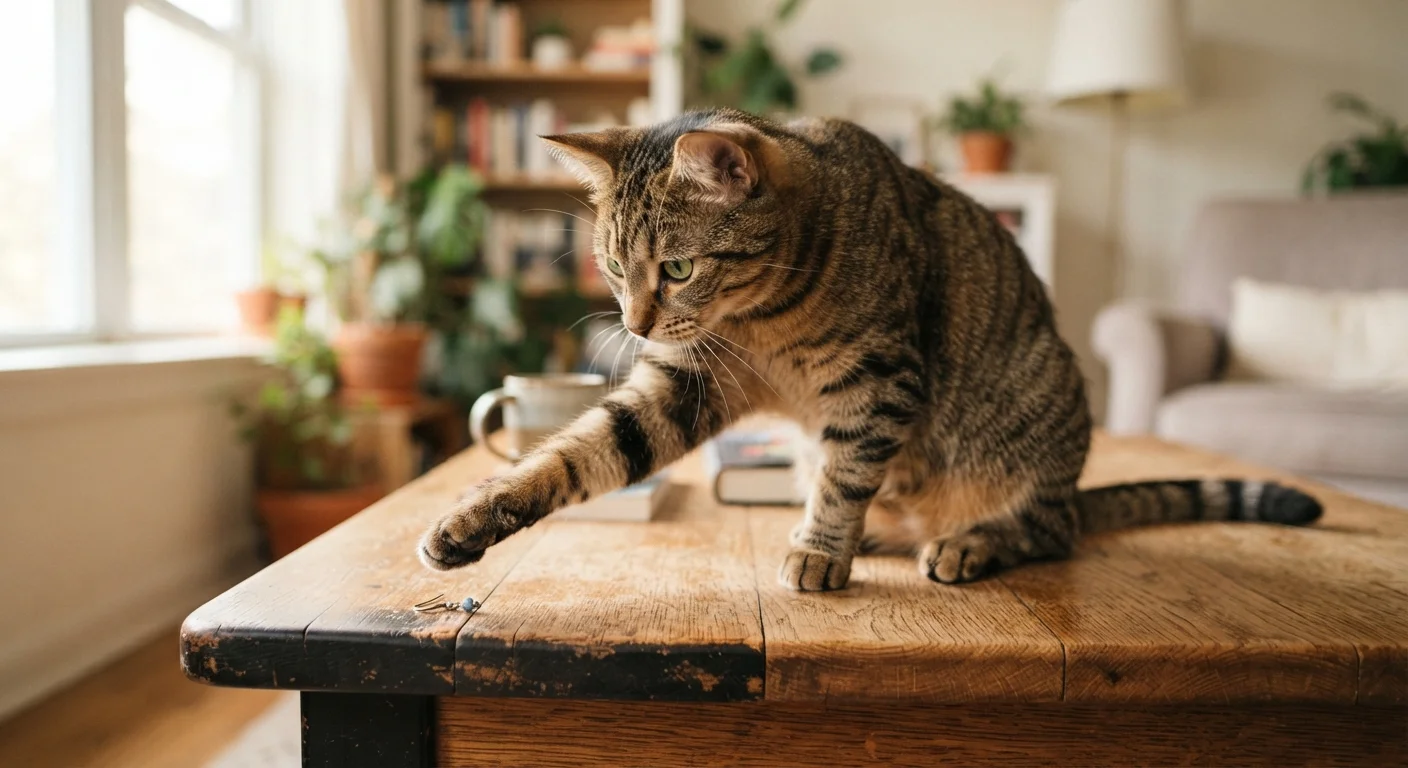
The Hunting Brain Behind the Habit
Watch a cat bat at a pen on a desk and you are watching millions of years of predatory programming play out on your kitchen table. Cats are obligate carnivores whose survival once depended on accurately assessing small, moving prey. Tapping an object with a paw — and watching what happens — is the same cognitive routine their ancestors used to confirm whether something was alive, dead, or worth pursuing.
The paw is a cat's primary sensory and assessment tool. It is packed with nerve endings sensitive to texture, resistance, and movement. When a cat nudges your phone charger off the edge, it is essentially running a quick field test: Does this thing move? Does it react? Is it prey? The fact that it crashes to the floor and stays still is, technically, useful data.
“Cats are not being destructive when they knock things over — they are being cats. The behavior reflects exactly the kind of sensory investigation their biology has prepared them for.”
— Dr. Karen Becker, Integrative veterinarian and animal behavior educator
This is why the behavior tends to appear even in well-fed, thoroughly indoor cats. The instinct does not require hunger to activate — it is simply part of how the feline brain engages with its environment. For a deeper look at the behavioral science involved, see what drives cats to push objects off surfaces.
Attention, Boredom, and What Your Cat Is Really Asking For
Predatory instinct explains a lot, but it does not always explain why your cat chooses 6 a.m. to send your water glass airborne. Timing and context often point to a second driver: attention-seeking.
Cats are skilled observers of cause and effect. If knocking something over reliably produces a loud reaction from you, your cat has learned that the behavior works. Even a negative response — rushing over and saying "no" — is still a response, and to an under-stimulated cat, any interaction counts as a reward.
Redirect, Don't React
When your cat begins nosing objects toward the edge, redirect attention to an appropriate toy rather than responding to the behavior itself. Consistent redirection over time is far more effective than scolding, and it gives your cat a legitimate outlet for the same impulse.
Boredom amplifies both motivations. A cat without adequate outlets for its predatory drive will find them. Object displacement is one of the more harmless ways that impulse surfaces. Environmental stressors and under-stimulation can quietly escalate quirky habits into more persistent behavior patterns over time.
Structured daily play and feeding schedules can significantly reduce the frequency of attention-motivated knocking. Two focused 10–15 minute interactive play sessions per day give your cat a sanctioned channel for the same impulses.
~90%
Of cat behaviors rooted in predatory sequences
Feline behaviorists estimate the vast majority of domestic cat play and investigative behaviors directly mirror wild predatory motor patterns.
2x daily
Recommended interactive play sessions per cat
Veterinary behavior guidelines generally suggest two 10–15 minute interactive play sessions per day to meet a cat's mental and physical stimulation needs.
What the Behavior Actually Tells You About Your Cat
Far from being a sign of bad temperament, object displacement is a signal of an active, engaged mind. Cats that interact boldly with their environment — investigating, testing, manipulating objects — tend to be confident and cognitively healthy.
That said, a sudden increase in this or other disruptive behaviors can occasionally reflect underlying stress or a change in the cat's environment. If object knocking appears alongside other shifts in behavior — changes in litter box use, altered appetite, or increased hiding — it is worth consulting a veterinarian. Litter box avoidance and object displacement can both be behavioral flags worth taking seriously when they cluster together.
Understanding this behavior is also part of reading feline communication more broadly. Cats express curiosity, social needs, and even affection in ways that do not always look intuitive to humans. How cats show affection follows similarly indirect patterns — subtle signals that require a bit of translation. Recognizing object displacement for what it is, rather than framing it as spite, is a good first step toward that broader understanding.
When to Mention It to Your Vet
Occasional object knocking is normal feline behavior and requires no intervention. If the behavior escalates sharply or appears alongside changes in eating, elimination, or social patterns, mention it at your next veterinary visit. Behavioral shifts can sometimes reflect underlying health or stress issues that benefit from professional evaluation.