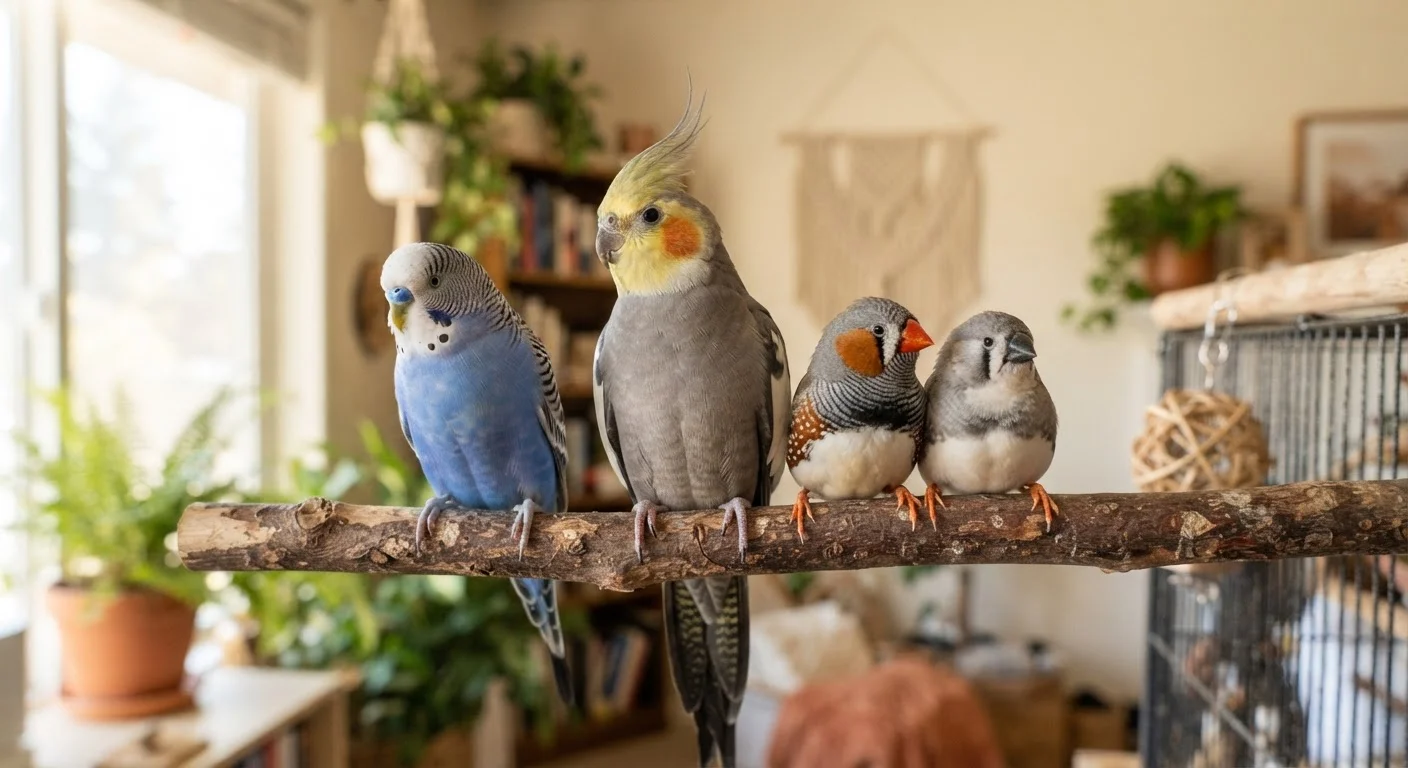
What Makes These Three Species Stand Apart
Budgies (parakeets), cockatiels, and finches are routinely grouped together as "beginner birds," but their temperaments, care requirements, and social needs differ in ways that matter considerably when choosing one for your home. Understanding those differences upfront prevents mismatches between owner expectations and a bird's actual needs.
For a broader look at what bird ownership involves day-to-day, see our comprehensive bird care guide. This comparison focuses specifically on how the three species compare side-by-side across the factors most households care about: social needs, noise, space, and hands-on interaction.
| Budgie | Cockatiel | Finch | |
|---|---|---|---|
| Typical size | 6–8 inches | 12 inches (incl. tail) | 3.5–4.5 inches |
| Noise level | Moderate | Moderate to high | Low to moderate |
| Hands-on handling | Enjoys handling | Seeks daily handling | Prefers to avoid handling |
| Kept alone or in pairs | Pair or solo with interaction | Can be solo with attention | Must be kept in pairs or groups |
| Talking ability | Yes, with training | Whistles; some words possible | No |
| Typical lifespan | 7–15 years | 15–20 years | 5–8 years |
| Beginner-friendliness | Very high | High | High (hands-off style) |
Budgies: Sociable, Talkative, and Adaptable
Budgerigars — commonly called budgies or parakeets — are among the most widely kept pet birds in the United States for good reason. They're small (typically 6–8 inches long), relatively quiet compared to larger parrots, and capable of learning a surprisingly large vocabulary when handled consistently from a young age.
Budgies are flock animals and do best with companionship — either a second budgie or substantial daily human interaction. A solitary budgie left alone for most of the day can develop stress behaviors like feather plucking. Their cage should be wide enough for horizontal flight (a minimum of 18–20 inches wide is a common recommendation), and they benefit from daily out-of-cage time in a safe room.
Make Daily Out-of-Cage Time a Habit
Budgies and cockatiels both benefit from supervised free-flight time outside their cage each day — even 30 to 60 minutes in a bird-safe room makes a meaningful difference in their mental wellbeing. Before allowing free flight, check for open windows, ceiling fans, non-stick cookware on the stove, and other common household hazards. Establishing a consistent routine helps birds feel secure and reduces stress-related behaviors.
Diet is a common area where budgie owners make mistakes. A seed-only diet, though convenient, is nutritionally incomplete. Fresh vegetables, leafy greens, and a quality pellet component are important additions. See common small pet nutrition myths for more on feeding habits to reconsider.
Cockatiels: Affectionate Birds That Need Your Time
Cockatiels are larger than budgies (roughly 12 inches including the tail) and generally regarded as one of the most affectionate small parrot species. They often bond strongly with their primary caregiver and enjoy being near people, riding on shoulders, or being gently hand-fed treats.
However, that affection comes with a requirement for daily interaction. Cockatiels that are under-stimulated can become loud, hormonal, or anxious. Their signature sound — a melodic whistle — is pleasant to most ears, but a distressed or attention-seeking cockatiel can reach volumes that stand out in an apartment. Comparing cockatiels and parakeets in more depth can help if you're deciding between those two species specifically.
Cockatiels are also prone to fatty liver disease on seed-heavy diets, so a varied diet with pellets and vegetables is important. Mental enrichment — foraging toys, rotation of perch types, and out-of-cage exploration — supports their wellbeing meaningfully. See enrichment strategies for small pets for practical ideas.
Finches: Low-Contact, High-Activity Birds for Observers
Finches — zebra finches and society finches being the most common household varieties — are fundamentally different from budgies and cockatiels in one key way: they don't seek human contact and generally don't enjoy being held. Their appeal lies in watching them interact with each other, sing, and move energetically through a well-appointed cage.
Because finches are flock animals, they should almost always be kept in pairs at minimum. A single finch is a stressed finch. Their vocalizations are soft chirps and songs that most people find pleasant rather than disruptive — making them one of the more apartment-friendly small birds.
Never Keep a Single Finch Alone
Unlike budgies or cockatiels that can bond with humans as their social companion, finches are not wired for human interaction and cannot substitute a bird companion for a person. Keeping one finch alone — even in a large, stimulating cage — typically leads to chronic stress and health decline. Always house finches in at least a bonded pair, and introduce new birds carefully to minimize territorial conflict.
Their cage should be large enough to allow active flight between perches; a long, horizontal cage works better for finches than a tall, narrow one. Care is relatively hands-off, but it isn't minimal — clean water, fresh food, and routine veterinary check-ups are still essential to their health.