The Resolution Ladder: HD, Full HD, 4K, and 8K
Every TV resolution label describes how many pixels — individual light-emitting dots — fill the screen from corner to corner. Think of pixels like tiles in a mosaic: more tiles let the picture show finer detail without looking blocky.
Here's how the common labels stack up:
- HD (720p): 1,280 × 720 pixels. Once the entry-level standard, now mostly found on smaller or budget screens.
- Full HD (1080p): 1,920 × 1,080 pixels. The long-standing mainstream standard for streaming, cable, and Blu-ray content.
- 4K UHD: 3,840 × 2,160 pixels — four times the pixel count of 1080p. Now the dominant resolution tier for mid-size and large televisions.
- 8K UHD: 7,680 × 4,320 pixels — four times 4K. Available in select large-screen models, though native 8K content remains scarce.
Going up each step quadruples the total pixel count, which is why each jump sounds dramatic on a spec sheet. Whether that translates to a visible difference in your living room is a separate question — and the answer depends on more than the number itself.
4×
More pixels in 4K vs. Full HD
4K UHD (3840×2160) contains approximately four times the pixel count of 1080p Full HD, which is the basis of its sharpness advantage on larger screens.
~33M
Pixels in an 8K screen
An 8K UHD display (7680×4320) contains roughly 33 million pixels — 16 times the count of Full HD and four times that of 4K.
15–25 Mbps
Typical internet speed needed for 4K streaming
Most major streaming platforms recommend download speeds in this range for consistent 4K playback, though specific requirements vary by service.
Why Viewing Distance and Screen Size Change Everything
Human eyes have a finite ability to resolve detail. Beyond a certain distance, adding more pixels produces no visible improvement because the individual dots are already smaller than what your eye can distinguish.
This means the value of 4K over 1080p is closely tied to how large your screen is and how far back you sit. A 40-inch 4K TV viewed from ten feet away delivers little perceptible advantage over the same screen at 1080p. A 65-inch screen at the same distance, however, is where 4K sharpness becomes genuinely apparent.
A useful rough rule: the benefit of 4K over 1080p becomes clearly visible when your screen's diagonal size in inches is at least equal to your seating distance in feet — for example, a 65-inch TV at roughly six to eight feet. For 8K to show any advantage, the screen would need to be exceptionally large (85 inches or more) and the viewer seated unusually close.
Match Screen Size to Your Seating Distance
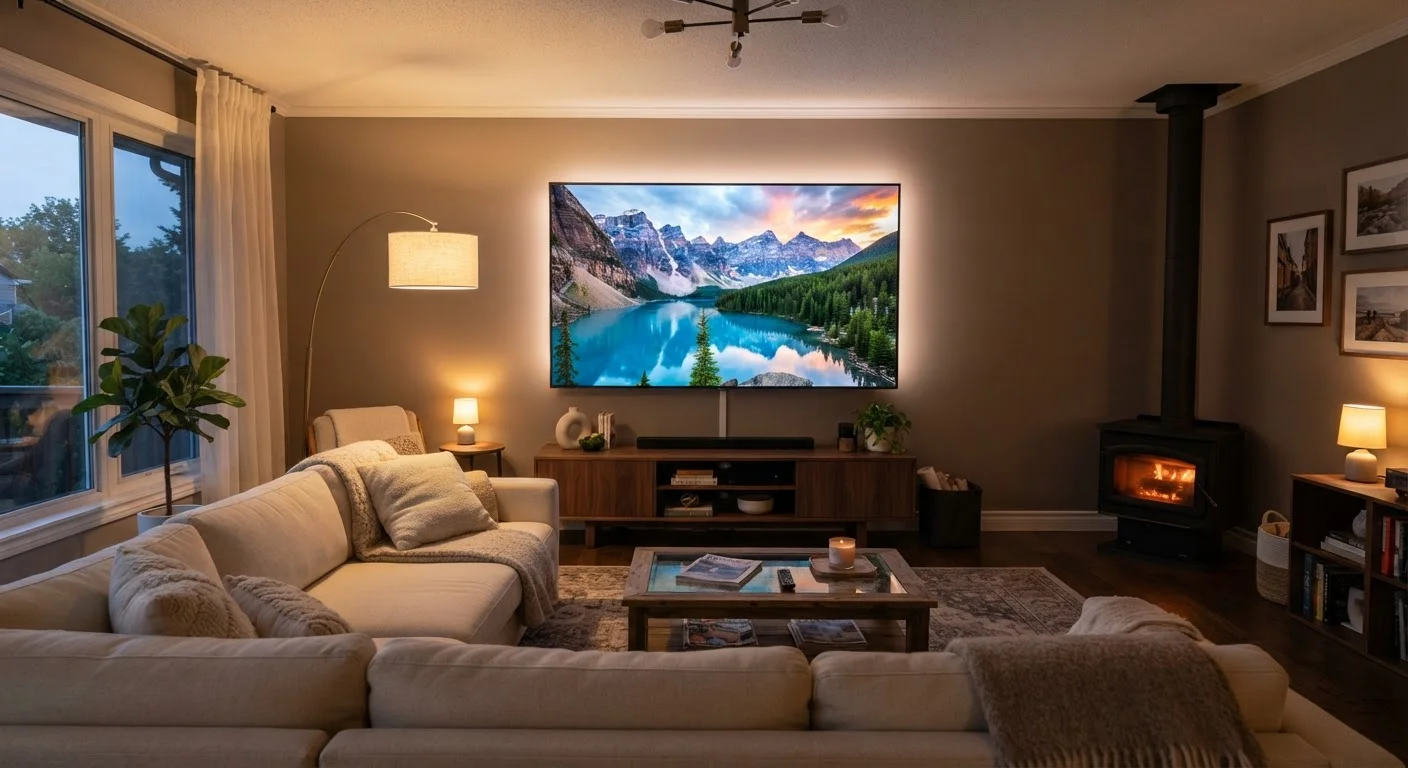
Before focusing on resolution tier, measure how far your seating is from the TV wall. A 65-inch or larger screen at 7–9 feet is the range where 4K sharpness delivers a meaningful, everyday visible benefit. At smaller sizes or greater distances, the resolution difference shrinks noticeably.
For more on how display specifications interact beyond resolution, see our plain-language display terms guide.
Content Availability: What You're Actually Watching
Resolution on a TV is only as useful as the content being played at that resolution. A 4K television displaying a 1080p stream is upscaling — using software to stretch the original image — which can look good but isn't the same as native 4K.
As of the mid-2020s, the content landscape looks roughly like this:
- 4K native content is available through major streaming platforms and on physical 4K Blu-ray discs. Many platforms require a higher-tier subscription to unlock 4K streams.
- 1080p (Full HD) remains the most widely produced resolution for broadcast television, standard streaming tiers, and older libraries.
- 8K native content is extremely limited. A handful of demonstrations and select productions exist, but no major streaming platform offers a library of 8K titles.
This content gap is the most practical reason 8K televisions don't offer clear everyday benefits yet. Upscaling technology on 8K sets has improved, but it cannot fully replicate the detail of genuine 8K source material.
Keep in mind that your internet connection also affects the resolution you actually receive when streaming. See why your streaming video looks blurry or buffers if playback quality has been inconsistent.
Resolution Is One Piece of Picture Quality
It's easy to focus on resolution because it's expressed as a clean, comparable number. But picture quality is the product of several interacting factors, and resolution is rarely the limiting one once you're past 1080p at a typical viewing distance.
Two other specifications often have a more noticeable effect on what you see:
- HDR (High Dynamic Range): Expands the range between the darkest blacks and brightest highlights in the image. HDR content on a capable display can look more lifelike than non-HDR 4K content.
- Panel technology: The type of screen — whether LED, OLED, or QLED — shapes contrast, color accuracy, and black levels. Our guide to OLED, QLED, and LED differences explains how each technology affects the picture you see.
“Resolution is a floor, not a ceiling. Once you've cleared the threshold where pixels become invisible at your viewing distance, the variables that define a great picture shift — contrast, color volume, and motion handling take over.”
— Tech & Electronics Editorial Team, Consumer electronics editorial researchers
Resolution matters most when choosing a screen large enough that lower pixel counts would visibly soften the image. For a screen 50 inches or larger viewed within ten feet, 4K is a reasonable minimum. Beyond that, the quality of the panel and the source content tend to shape the experience more than the resolution label alone.