Why Refurbished Grades Exist — and Why They're Confusing
The refurbished phone market has grown significantly as consumers look to reduce electronic waste and manage their budgets. Sellers introduced grading systems to communicate device condition at a glance. The problem: there is no industry-wide standard governing what Grade A, B, or C actually means. Each marketplace, carrier, or reseller writes its own definitions.
This means two phones wearing the same "Grade B" label could have very different cosmetic conditions or histories. One seller's Grade B might be a nearly pristine device with a faint screen mark; another's could have a noticeable crack on the housing. Reading the fine print — not just the grade — is essential. For broader guidance on evaluating product quality from listings alone, see quality signals worth knowing when buying online.
"Renewed" and "Refurbished" Are Not Always the Same
Some major online marketplaces use the term "renewed" rather than "refurbished" and apply their own program-specific standards to qualifying listings. Always check which program or standard applies and what that program guarantees — the umbrella label alone does not tell you everything about the device's condition or the backing behind it.
What the Typical Grades Actually Describe
While definitions vary, most sellers follow a loose common framework:
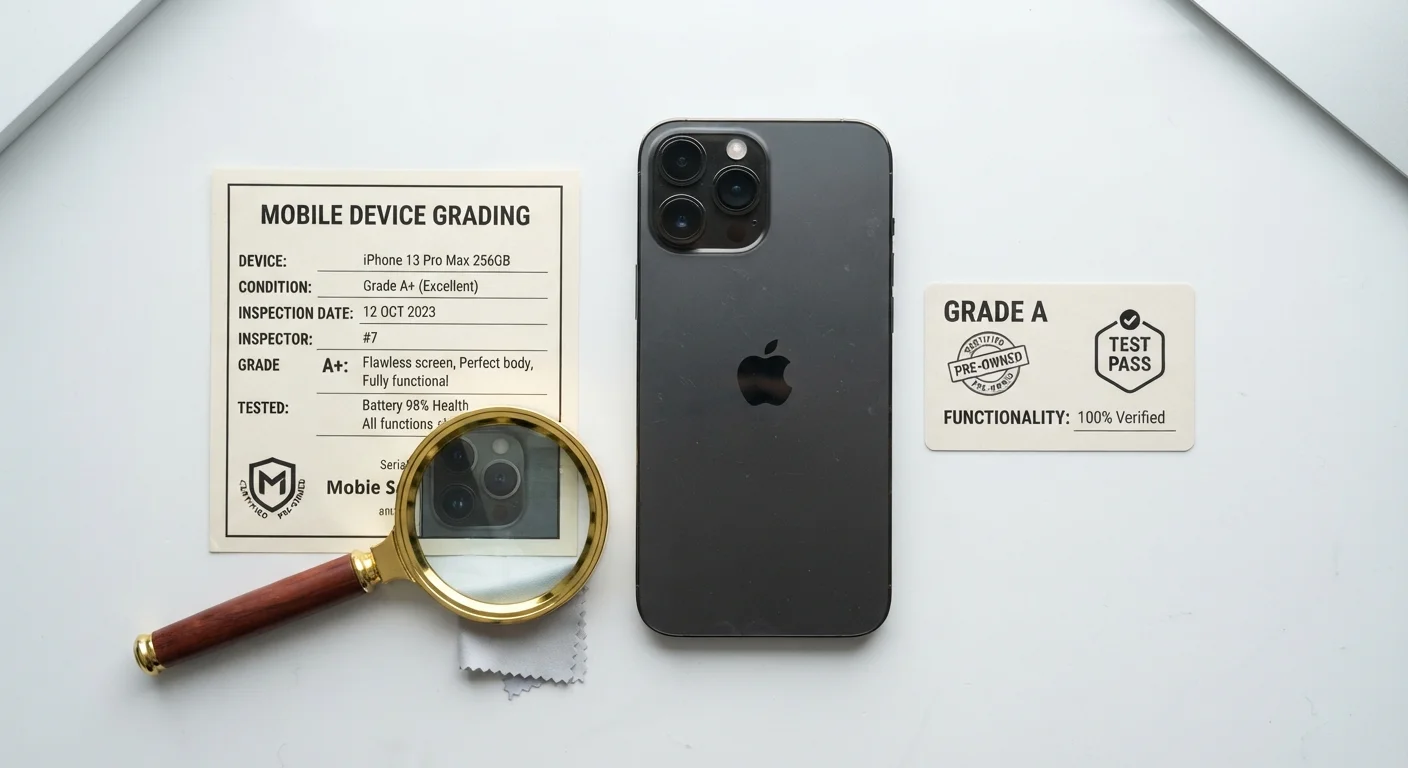
- Grade A (or "Like New" / "Excellent"): Little to no visible wear. Screen and body are typically free of scratches or cracks. All features — cameras, buttons, charging port — function normally. Battery health is often reported at 80% or above of original capacity.
- Grade B (or "Good"): Light cosmetic wear such as minor scratches on the frame or back, possibly faint marks on the screen. Fully functional. Battery health may be slightly lower. This is a common middle-ground choice.
- Grade C (or "Fair" / "Acceptable"): Noticeable scratches, scuffs, or potentially a small crack on the body (rarely the screen, though some sellers include it here). Function is intact, but cosmetic wear is clearly visible.
Some sellers add sub-grades (A+, A-, etc.) or use plain-language labels instead of letters. Whatever terminology is used, demand specifics rather than relying on the label alone.
~15%
Global smartphone market share held by refurbished devices
Industry analysts have estimated refurbished phones account for a growing share of global handset sales, reflecting increased consumer and environmental interest in extending device lifespans.
80%
Battery health threshold commonly cited as acceptable
Many refurbishment standards and consumer guides reference 80% of original battery capacity as a practical minimum for a device to perform adequately in daily use.
Battery Health: The Spec That Often Gets Buried
A phone's exterior condition is easy to photograph — battery health is harder to communicate and often understated in listings. Lithium-ion batteries degrade with each charge cycle, and a used phone with 70% battery health will noticeably underperform a new one in daily use.
Reputable sellers will disclose battery health as a percentage. On iPhones, this figure is accessible in Settings and is a standard disclosure for quality resellers. Android devices vary by manufacturer, but third-party apps can surface similar data. If a listing does not mention battery health at all, treat that as a gap worth clarifying before purchase.
Ask for Battery Health in Writing
Before purchasing, contact the seller and ask for the battery health percentage if it is not already listed. A reputable refurbisher will have this data readily available. If the seller cannot or will not provide it, that is useful information in itself.
Display performance is another spec that interacts with how a phone feels to use — if you want to understand how screen quality is described in listings, our explainer on screen resolution, refresh rate, and brightness breaks down what those numbers mean in practice.
Manufacturer-Refurbished vs. Third-Party: A Meaningful Distinction
Where the phone was refurbished matters as much as the grade assigned to it. Manufacturer-refurbished (also called "certified refurbished") devices are restored by the original brand or an authorized partner. They are typically tested against the maker's own specifications, may include replacement of worn parts with genuine components, and often come with a limited warranty comparable to what a new device might carry.
Third-party refurbishers range from highly professional operations with rigorous quality control to informal resellers doing minimal work. The grade label on a third-party listing carries more uncertainty. Look for resellers who are transparent about their testing process, parts sourcing, and return windows. The same inspection mindset applies as with buying secondhand appliances — a clear inspection checklist protects you when you can't handle the item first.
What to Verify Before You Commit
Before finalizing a refurbished phone purchase, work through this checklist:
- Request or read the seller's grade definitions — don't assume the label matches your expectations.
- Check battery health — look for explicit disclosure; anything below 80% warrants caution for everyday use.
- Confirm the IMEI is clean — a blacklisted device cannot be activated on most US carriers. Free IMEI checkers are widely available online.
- Verify carrier lock status — confirm the phone is compatible with your carrier's network bands.
- Review the return window and warranty — a minimum 30-day return window and some form of warranty are reasonable expectations from a credible seller.
- Look for condition photos — generic stock images are a warning sign; legitimate sellers show the actual unit.
Refurbished phones can represent genuine value, but the grade label is a starting point for research, not a guarantee of quality. The detail in a seller's listing — not the letter grade at the top — is where the real information lives.