
What Health Insurance Actually Does
Health insurance is a contract between you and an insurer. You pay a regular premium — a fixed monthly fee — and in return the insurer agrees to share the cost of covered medical services according to the plan's terms. The insurer doesn't pay for everything; instead, the two parties split costs according to a pre-defined structure.
This cost-sharing model exists because healthcare expenses are unpredictable. A single hospitalization can run into the tens of thousands of dollars. Insurance spreads that financial risk across a large pool of people, making catastrophic costs survivable for individuals.
If you're newer to the terminology, our plain-English guide for first-time enrollees is a useful companion to this article. For a quick-reference glossary you can return to anytime, see The Health Insurance Glossary Every American Should Bookmark.
This article is general health insurance information and education — not personalized insurance, financial, or legal advice. Coverage terms vary by plan and state. Always read your actual policy documents and consult a licensed insurance professional for guidance specific to your situation.
The Core Cost-Sharing Terms You Must Know
Four numbers define how much you'll pay before and after insurance kicks in:
- Premium: What you pay every month to keep the policy active, regardless of whether you use any care.
- Deductible: The amount you pay out-of-pocket each plan year before the insurer starts sharing costs (for most services).
- Copay / Coinsurance: A copay is a flat fee per service (e.g., $30 for a primary care visit). Coinsurance is a percentage split — for example, you pay 20% and the insurer pays 80% after you meet your deductible.
- Out-of-Pocket Maximum: The most you'll pay in a plan year. Once you hit this cap, the insurer covers 100% of covered in-network services for the remainder of the year.
$1,763
Average individual deductible for employer plans
According to KFF's 2023 Employer Health Benefits Survey, the average annual deductible for single coverage in employer-sponsored plans was approximately $1,763.
$9,450
ACA out-of-pocket maximum for individual plans
For 2024, the ACA set the maximum out-of-pocket limit at $9,450 for individual coverage in Marketplace and most employer plans.
~160M
Americans with employer-sponsored coverage
The Kaiser Family Foundation estimates roughly 160 million Americans receive health insurance through an employer, making it the dominant coverage source.
These four numbers interact. A plan with a low premium often carries a higher deductible. A high-premium plan may have a lower deductible. Neither is universally better — the right balance depends on how often you use care and your financial cushion.
Use Your Out-of-Pocket Max as a Safety Net Benchmark
Before choosing a plan, ask yourself: could I cover the full out-of-pocket maximum in an emergency? If not, a lower-deductible plan with higher premiums may actually cost you less in a high-use year. Think of the out-of-pocket max as the ceiling of your worst-case annual medical expense.
Plan Types: HMO, PPO, EPO, and HDHP
The plan type controls how you access care, not just what's covered:
- HMO (Health Maintenance Organization)
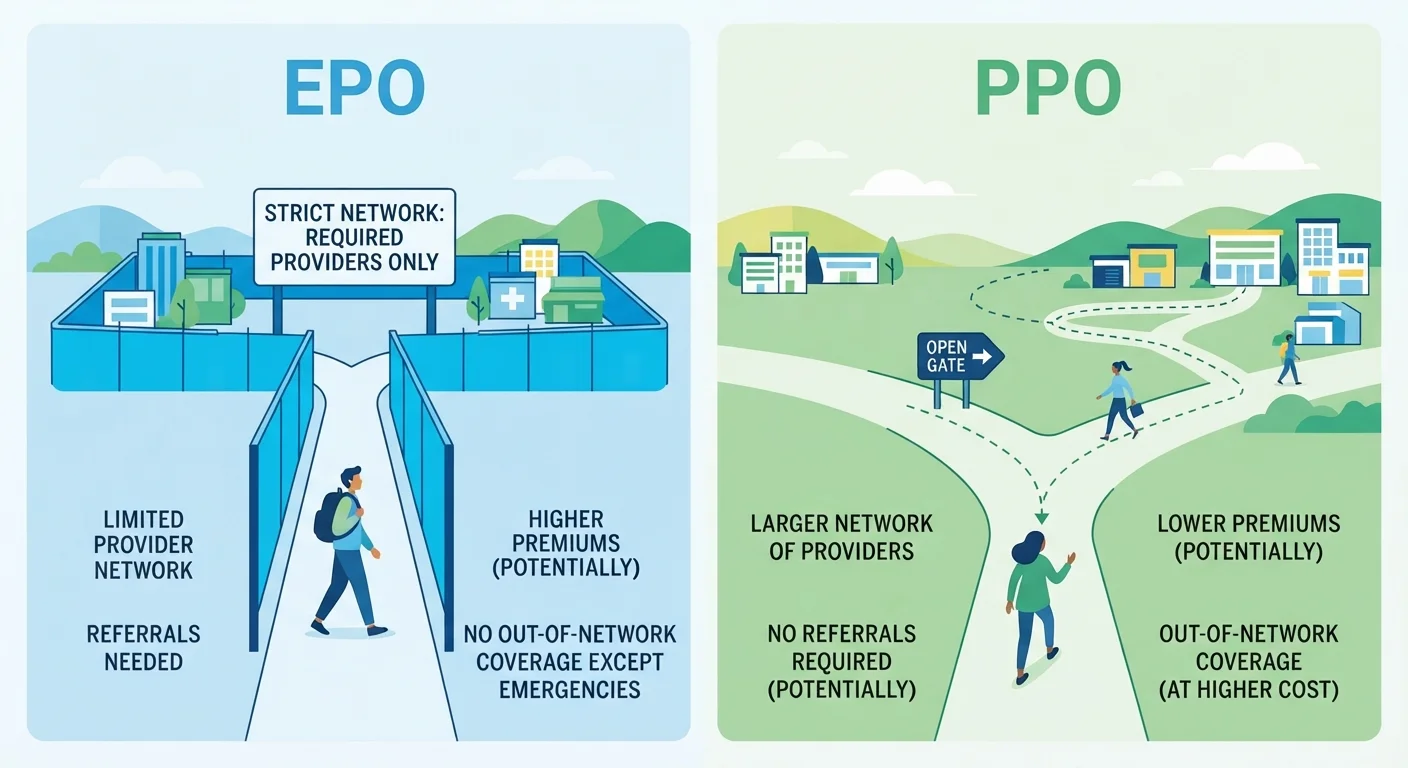
- Care is coordinated through a primary care physician (PCP) who must issue referrals to see specialists. Generally lower premiums and tighter networks.
- PPO (Preferred Provider Organization)
- You can see any doctor — in-network or out — without a referral. More flexibility, typically higher premiums.
- EPO (Exclusive Provider Organization)
- Like a PPO for paperwork (no referrals needed), but like an HMO for network rules: out-of-network care is not covered except in emergencies.
- HDHP (High-Deductible Health Plan)
- Defined by the IRS each year with a higher minimum deductible and lower premiums. Eligibility to open a Health Savings Account (HSA) is tied to HDHP enrollment — a tax-advantaged way to save for medical costs.
When comparing HDHPs, calculate the worst-case scenario: premium × 12 + out-of-pocket maximum. Then do the same for a lower-deductible plan. The HDHP is only a clear win if the premium savings outpace the higher potential cost-sharing.
Most people focus on the monthly premium difference without accounting for what a bad health year could actually cost them under each plan structure.
If your employer offers an HDHP, contribute at least enough to your HSA each year to cover your deductible. That money rolls over indefinitely and can be invested — it's one of the few triple-tax-advantaged accounts available to working Americans.
HSA funds are contributed pre-tax, grow tax-free, and are withdrawn tax-free for qualified medical expenses — a distinct advantage over FSAs, which expire annually.
Networks, Referrals, and Prior Authorization
A network is the group of doctors, hospitals, labs, and pharmacies that have contracted with your insurer at negotiated rates. Using in-network providers means the insurer's contracted discount applies and your cost-sharing counts toward your deductible and out-of-pocket maximum.
Using an out-of-network provider — when your plan even allows it — means higher cost-sharing, and some plans pay nothing at all for out-of-network care outside emergencies.
Prior authorization (sometimes called pre-authorization or pre-approval) is a requirement that your doctor get the insurer's sign-off before delivering certain services, procedures, or medications. It is among the most misunderstood parts of health coverage. Without it, the insurer may deny the claim — even if the service was medically necessary.
Prior Authorization Gaps Can Be Costly
Even when your doctor recommends a procedure, insurers can deny the claim if prior authorization wasn't obtained in advance. Don't assume your doctor's office handled this — call your insurer directly to confirm authorization is on file before any scheduled procedure or specialist visit.
Always verify that a provider — including any specialist or facility referred to you — is in-network before your appointment, not after. The insurer's online directory is a starting point, but calling the provider's billing office to confirm is more reliable.
How Claims and Explanations of Benefits Work
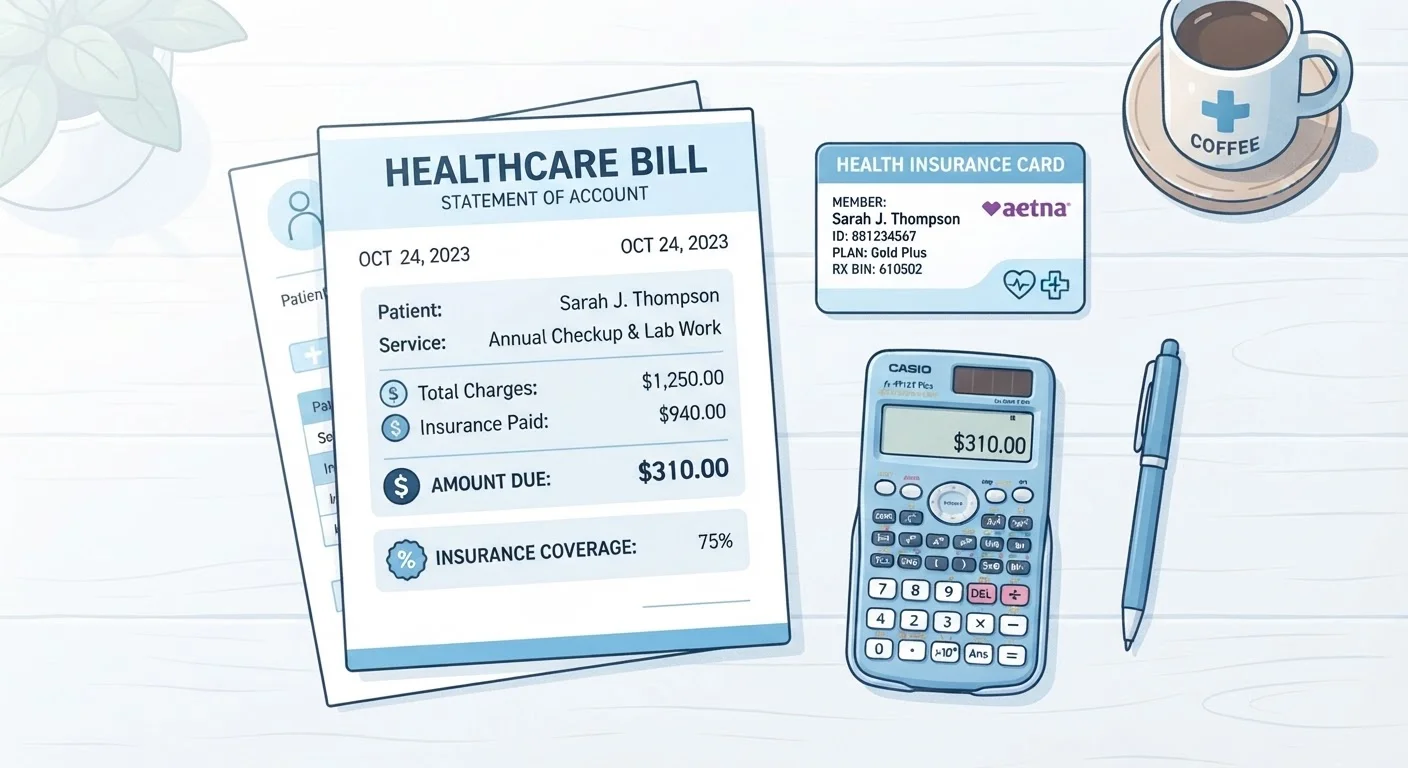
When you receive covered care, your provider submits a claim to the insurer. The insurer reviews it, applies your plan's rules, and sends back an Explanation of Benefits (EOB) — a summary of what was billed, what the insurer will pay, and what you owe.
An EOB is not a bill. Your actual bill comes from the provider and reflects the amount the EOB says is your responsibility. Comparing the two documents is the only way to catch billing errors, which are common.
EOB Errors Are More Common Than You Think
Studies of medical billing consistently find high rates of errors in provider invoices and insurance processing. An incorrect diagnosis code or duplicate charge can result in you being billed for an amount your insurer already covered. Matching your EOB to your provider bill every time is a practical habit that can save real money.
Review every EOB against the subsequent provider bill. If the amounts don't match, contact the provider's billing department first, then your insurer if needed.
Subsidies, Enrollment Windows, and Coverage Pathways
Americans access coverage through several distinct channels — employer-sponsored plans, the ACA Marketplace (Healthcare.gov or state exchanges), Medicaid, Medicare, and others. Each has its own eligibility rules and enrollment mechanics. See our full breakdown of each enrollment pathway to understand which applies to you.
If you buy through the ACA Marketplace, premium tax credits (also called subsidies) can reduce your monthly premium based on household income and family size. Separately, cost-sharing reductions (CSR) lower your deductible and out-of-pocket maximum on Silver-tier plans for qualifying income levels. Eligibility is calculated annually when you file taxes.
Enrollment is time-limited. The annual Open Enrollment Period is the main window to sign up or switch plans. Outside that window, a qualifying life event — job loss, marriage, birth of a child — triggers a Special Enrollment Period. Missing both means waiting until the next open enrollment unless you qualify for Medicaid or CHIP, which have year-round enrollment. For a guided walk through plan selection, see our open enrollment step-by-step walkthrough.
Your Rights: Appeals and Denials
A claim denial is not necessarily the final word. Federal law — specifically the Affordable Care Act — gives you the right to appeal insurance decisions. There are two stages:
- Internal Appeal: You request that the insurer review its own decision. The insurer must respond within defined timeframes (typically 30–60 days for non-urgent claims, 72 hours for urgent care).
- External Review: If the internal appeal fails, you can request an independent review by a third-party organization not affiliated with the insurer. For most plans, this right is guaranteed under federal law, and the reviewer's decision is binding on the insurer.
Common grounds for a successful appeal include demonstrating medical necessity, showing that prior authorization was properly obtained (or wasn't required), or correcting a coding error in the original claim.
Act Quickly: Appeal Deadlines Are Short
Most plans require you to file an internal appeal within 180 days of receiving a denial notice, but some windows are shorter. Missing the deadline can forfeit your right to challenge the decision entirely. If you receive a denial, review the notice immediately for the specific deadline and required documentation.
Keep records of every interaction: claim numbers, denial letters, dates, and names of representatives you spoke with. Documentation is the foundation of any successful appeal.
HealthCare.gov Plan Compare Tool
The official federal tool for comparing ACA Marketplace plans side-by-side, including premiums, deductibles, and estimated costs based on your usage.
CMS Summary of Benefits and Coverage Template
The federal standardized template all insurers must provide. Use it to make apples-to-apples comparisons across different plans.
Open Enrollment Step-by-Step Walkthrough
Our guide to selecting a plan during open enrollment walks through every evaluation step before you lock in your decision.
Health Insurance Glossary
A bookmarkable reference covering 30+ terms — from EOBs and formularies to prior authorization and coordination of benefits.