What Envelope Budgeting Actually Is
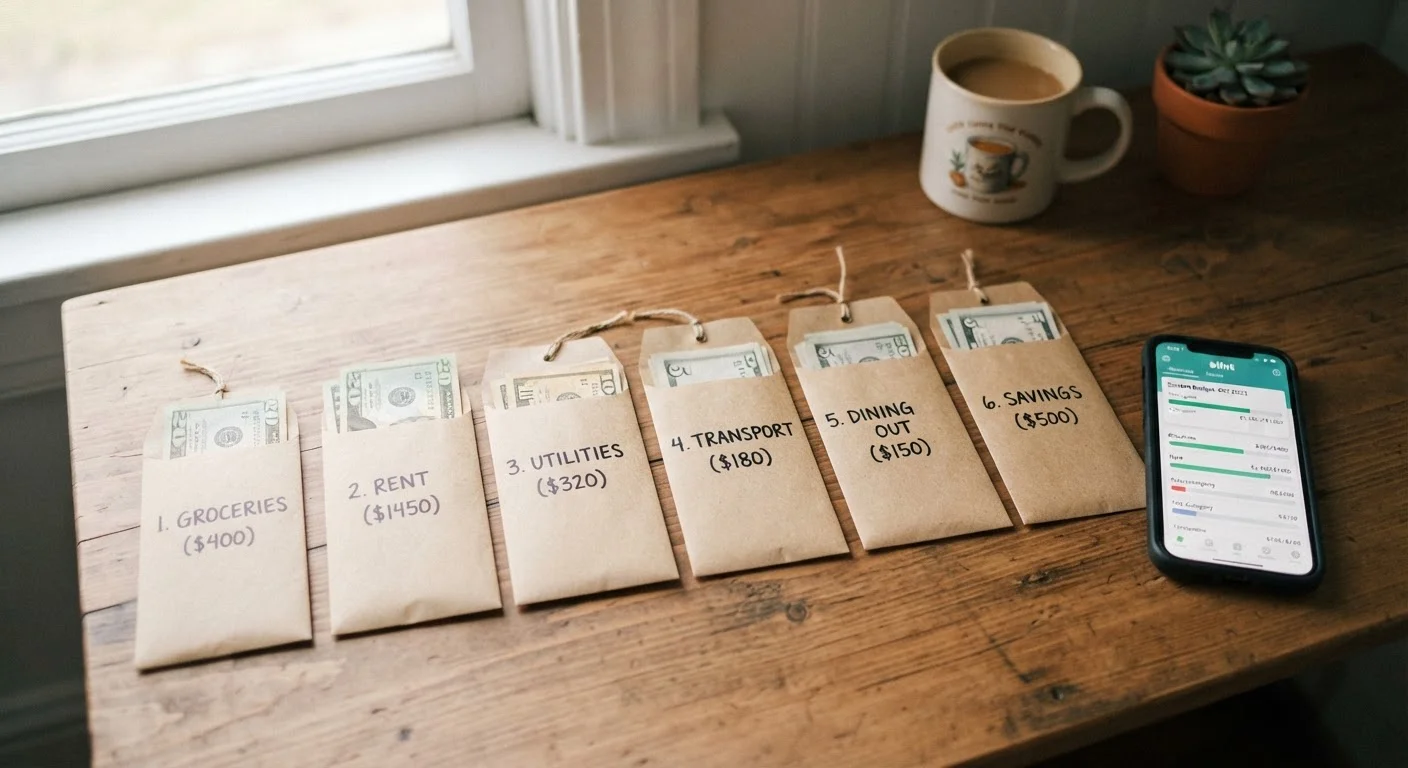
Envelope budgeting is a cash-allocation method in which you divide your take-home pay into labeled envelopes — groceries, dining out, gas, entertainment — at the start of each pay period. Once an envelope is empty, spending in that category stops until the next cycle. No borrowing from other envelopes, no overdraft buffer, no silent credit card safety net.
The idea is straightforward: spending limits become physical rather than abstract. Rather than mentally tracking a running tally, you see exactly how much remains by glancing inside an envelope. For a deeper look at foundational budgeting concepts before diving in, see our guide to personal budgeting from the ground up.
The method predates personal finance apps by decades, but its core logic — pre-committing money to specific purposes — remains sound. Many digital tools, including dedicated budgeting apps, now replicate the envelope structure without requiring physical cash, making it more accessible in a world where card transactions dominate.
The Advantages: Why It Still Works
Makes spending limits tangible and concrete
Physical or virtual envelopes transform an abstract budget number into a visible, finite resource, making it harder to rationalize overspending.
Reduces impulsive discretionary spending
Research in behavioral economics suggests that spending cash activates a stronger psychological cost response than swiping a card, which tends to slow unnecessary purchases.
Simple enough for anyone to start immediately
No spreadsheet skills, financial literacy courses, or software are required — the system can be set up with envelopes and cash in under an hour.
Builds a proactive spending mindset
Allocating money before spending it shifts decision-making from reactive (checking what's left) to intentional, which is a foundational habit for long-term financial health.
Naturally prevents overspending in problem categories
Because each category is self-contained, runaway spending in one area cannot silently erode funds meant for another purpose.
The psychological mechanism at the heart of envelope budgeting is well-documented in behavioral economics: people spend differently when they use cash versus cards. Handling physical money activates a stronger sense of loss, which tends to slow discretionary spending. Even in digital form, pre-allocating funds into labeled buckets creates a mental boundary that a general checking account balance simply does not.
This method also excels at simplicity. There are no complex formulas, no income percentages to calculate, and no software subscriptions required. Anyone who can sort cash into labeled containers can operate it. That accessibility makes it a strong entry point for people who find other budgeting systems overwhelming.
If you are weighing envelope budgeting against other popular approaches, our comparison of zero-based budgeting vs. the envelope method breaks down the key differences.
The Disadvantages: Where It Falls Short
Poorly suited to a cashless, card-driven economy
Most Americans now pay utilities, subscriptions, and even groceries by card or autopay, making strict cash-envelope management increasingly impractical without workarounds.
Physical cash carries security and convenience risks
Keeping budgeted cash at home or on your person exposes it to loss or theft, with no recourse comparable to bank fraud protection.
Requires significant manual upkeep each pay cycle
Withdrawing cash, sorting it into envelopes, and tracking spending across categories takes more time and discipline than a linked digital budgeting app.
Difficult to manage with irregular or variable income
Freelancers, gig workers, and anyone with fluctuating pay may find it hard to pre-assign funds accurately when total income is unknown at the start of the period.
Does not earn interest or rewards on allocated funds
Cash sitting in envelopes earns nothing, whereas the same funds in a high-yield savings account or on a cash-back card could generate modest returns.
The most significant friction point is the decline of cash usage in everyday American life. Many recurring bills — utilities, streaming subscriptions, insurance premiums — cannot be paid from a physical envelope at all. This forces a hybrid workaround that can undermine the method's simplicity.
Security is another concern. Carrying large amounts of cash or storing it at home introduces risks that a bank account does not. Lost or stolen cash is generally unrecoverable, whereas fraudulent card charges can typically be disputed.
For a side-by-side look at how manual, spreadsheet, and app-based approaches compare on effort and practicality, see our article on pen-and-paper budgeting vs. spreadsheets vs. apps.
Adapting the Method for a Digital Era
The core discipline of envelope budgeting — spending only what has been pre-assigned to a category — can be replicated digitally without touching a dollar bill. Several budgeting apps use virtual envelopes or "buckets" that draw from a linked account. When a category's virtual balance hits zero, the app flags it, producing the same stopping signal as an empty physical envelope.
Digital Envelope Apps: A Middle Ground
Several budgeting apps replicate the envelope method using virtual category buckets linked to your bank account. You set a spending ceiling for each category at the start of the month; the app tracks card transactions against those limits in real time. This preserves the pre-commitment discipline of classic envelope budgeting while accommodating digital payments. As with any financial app, review its data privacy and security practices before connecting bank credentials.
A practical hybrid approach: use cash envelopes for high-temptation, variable categories like dining, entertainment, and personal care, while handling fixed digital bills — rent, utilities, subscriptions — directly from your checking account in a tracked line item. This captures the behavioral benefit of cash where it matters most without forcing an impractical cash-only lifestyle.
For households managing shared expenses or home-specific spending, our practical introduction to envelope budgeting for home expenses offers targeted guidance. Building envelope habits also supports broader saving and debt-reduction goals — explore actionable strategies in our saving and debt hub.
This article is for general informational and educational purposes only and does not constitute personalized financial advice. Consult a qualified financial professional for guidance specific to your situation.