
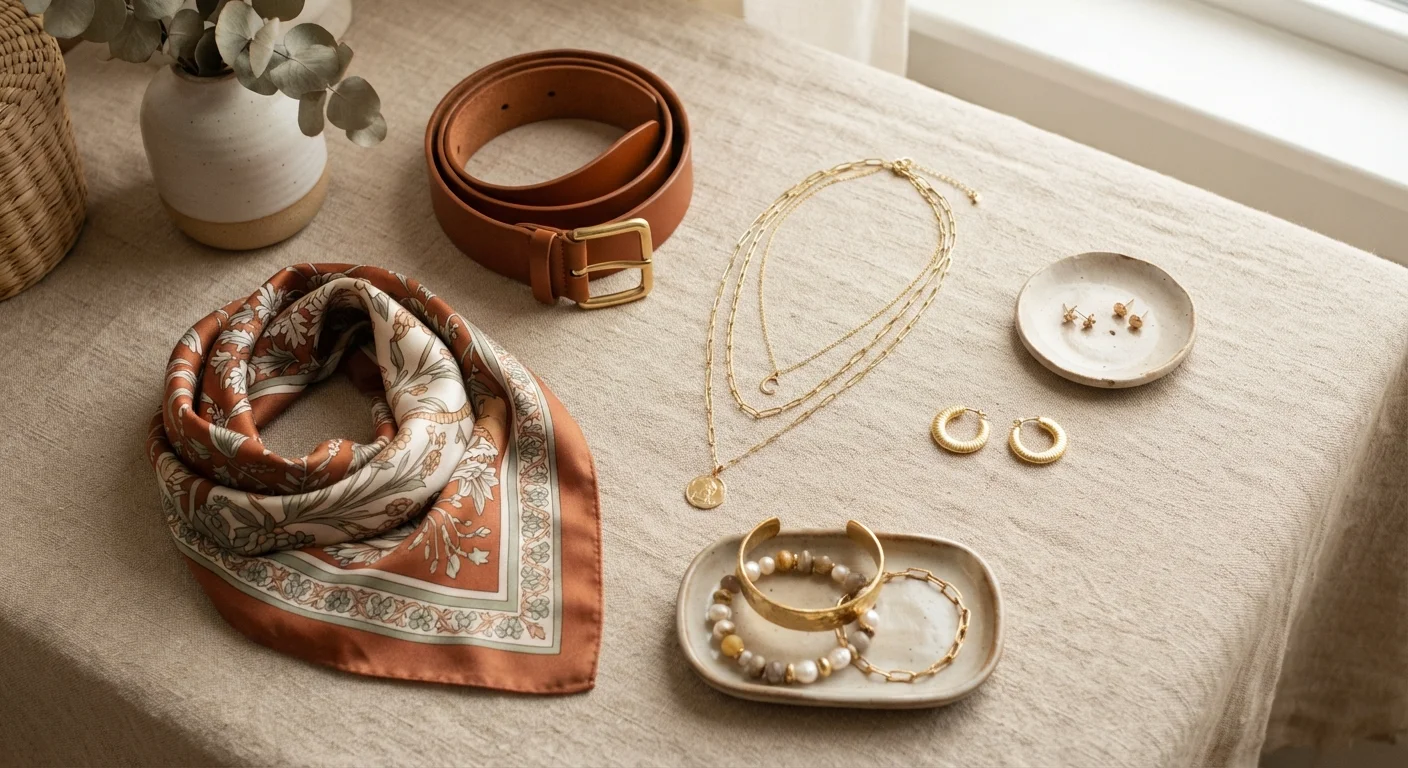
What Accessories Actually Do to an Outfit
Most people treat accessories as the last thing they add before walking out the door — the finishing flourish. But styling professionals think about them differently: as tools that actively shape how an outfit reads.
Accessories perform three primary functions. First, they direct the eye — a bold necklace draws attention upward; a wide belt pulls focus to the waist; a printed bag introduces energy at the hip line. Second, they adjust proportion — a long pendant lengthens the torso visually; chunky earrings balance a voluminous silhouette. Third, they set tone — the same jeans-and-white-top combination reads entirely differently with a delicate gold chain versus a bandana tied at the neck versus a structured leather bag.
Understanding these functions transforms accessories from an afterthought into an intentional part of how you put a look together. For a broader view of how individual pieces interact, see our guide to outfit cohesion.
1
Anchor piece per outfit for clean visual focus
Styling educators broadly recommend building around a single dominant accessory to prevent competing focal points and maintain a cohesive look.
3×
Outfit variations from one base look using accessories
Capsule wardrobe frameworks frequently illustrate that changing accessories alone — bag, belt, jewelry — can produce multiple distinct looks from a single clothing combination.
How to Identify Your Outfit's Anchor Point
Before reaching for accessories, ask yourself one question: Where do I want the eye to go? That answer determines which type of accessory leads the look.
If you want attention near your face — for a meeting, a celebration, or simply because you love your neckline — earrings or a necklace become your anchor. If the waist is the focal point, a belt does the work. If the outfit needs energy but you'd rather not add visual weight near your face or body, an interesting bag or shoe introduces personality at the periphery.
One Anchor, Two Supporters
A reliable rule of thumb: choose one accessory to carry the visual weight of your look, then add no more than two quieter pieces that share a finish, tone, or texture with it. This keeps things cohesive without tipping into excess. If you're ever unsure, removing one accessory almost always improves the result.
Once you've chosen your anchor, everything else should support it rather than compete. Pairing bold earrings with a statement necklace and a printed scarf creates visual noise — each piece fights for attention and none wins. Instead, let one accessory lead and keep the others simple in scale or finish.
This principle also applies when you're repeating outfits. A single accessory swap — swapping a casual tote for a structured bag, or a plain belt for a woven one — can shift the tone enough to make the same base outfit feel intentionally different. Outfit repeating is a legitimate strategy, and accessories are its most efficient lever.
Practical Ways to Build Anchoring Into Your Routine
You don't need a wardrobe overhaul to use accessories more intentionally. A few consistent habits make a significant difference.
- Start with your base, then identify the gap. If your outfit feels flat, it usually needs either contrast (a different texture or color) or a focal point. Accessories address both.
- Repeat one element across accessories. Wearing warm gold tones in your earrings, belt buckle, and watch creates quiet cohesion without looking matchy. Repetition signals intention.
- Consider scale deliberately. Delicate pieces suit tailored or close-fitting clothing well; chunkier accessories balance oversized or flowy silhouettes. Proportion between your clothing and your accessories matters as much as the pieces themselves.
- Use texture as a tool. A matte leather bag grounds a flowy floral dress. A silk scarf softens structured suiting. Texture contrast adds dimension without relying on color.
For a comprehensive look at building a confident everyday style — including fit, color, and occasion dressing — the complete everyday style guide is a useful companion resource.