Why Starting Over Is Actually an Advantage
A wardrobe built from scratch — whether after a move, a major life change, a shift in body size, or simply a decision that nothing you own represents who you are anymore — has something most cluttered closets don't: clarity. You're not untangling years of impulse buys, gifts you kept out of guilt, or clothes that were someone else's idea of your style.
That blank-slate feeling can be overwhelming at first, but it's genuinely useful. Starting over means you get to build a wardrobe around your actual life, not the life you had five years ago. For a broader look at how fit, color, and occasion dressing all connect, the complete everyday style guide is a strong companion resource for this process.
Reframe the Starting Point
Instead of thinking 'I have nothing to wear,' try 'I get to choose exactly what I want.' This shift in framing makes the process feel empowering rather than stressful. Many people who've rebuilt intentionally report feeling more confident in their daily outfits than they ever did with a full but chaotic closet.
Assess Your Life Before You Shop
The most common mistake when rebuilding a wardrobe is heading straight to the store. Before you buy a single item, spend 15 minutes mapping the situations you actually dress for in a typical week.
- Work or professional settings — in-person, remote, or hybrid? What's the real dress code, not the stated one?
- Casual and weekend life — errands, socializing, outdoor activities, lounging?
- Special occasions — how often, and how formal?
Next, factor in your climate. A wardrobe built for a Minnesota winter looks completely different from one built for coastal Georgia. Note the seasons you'll face in the next 12 months and weight your initial purchases accordingly.
This inventory isn't just a shopping list — it's a filter that prevents you from buying clothes for a life you don't actually live. If your days are 90% casual and 10% professional, buying mostly dress clothes is a recipe for a closet full of things you never reach for. And if you eventually find yourself overwhelmed by choices even with a pared-down selection, the guide to getting dressed when decision fatigue takes over offers practical strategies for that moment.
Capsule wardrobe
A small, intentionally chosen collection of clothing pieces that coordinate easily with each other, designed to maximize outfit options with minimal items.
Cost per wear
The total price of a garment divided by the number of times you wear it — a useful way to evaluate whether a higher-priced item is actually a better value over time.
Core pieces
Versatile, frequently worn items that serve as the foundation of a wardrobe and pair well with many other pieces across different occasions.
Wardrobe gap
A missing category or item in your wardrobe that forces you to either go without or make a last-minute purchase — identified through regular audits or daily use.
Phased buying
A strategy of purchasing wardrobe pieces gradually over time, prioritizing the most urgent needs first rather than trying to rebuild everything at once.
The Core Pieces That Work the Hardest
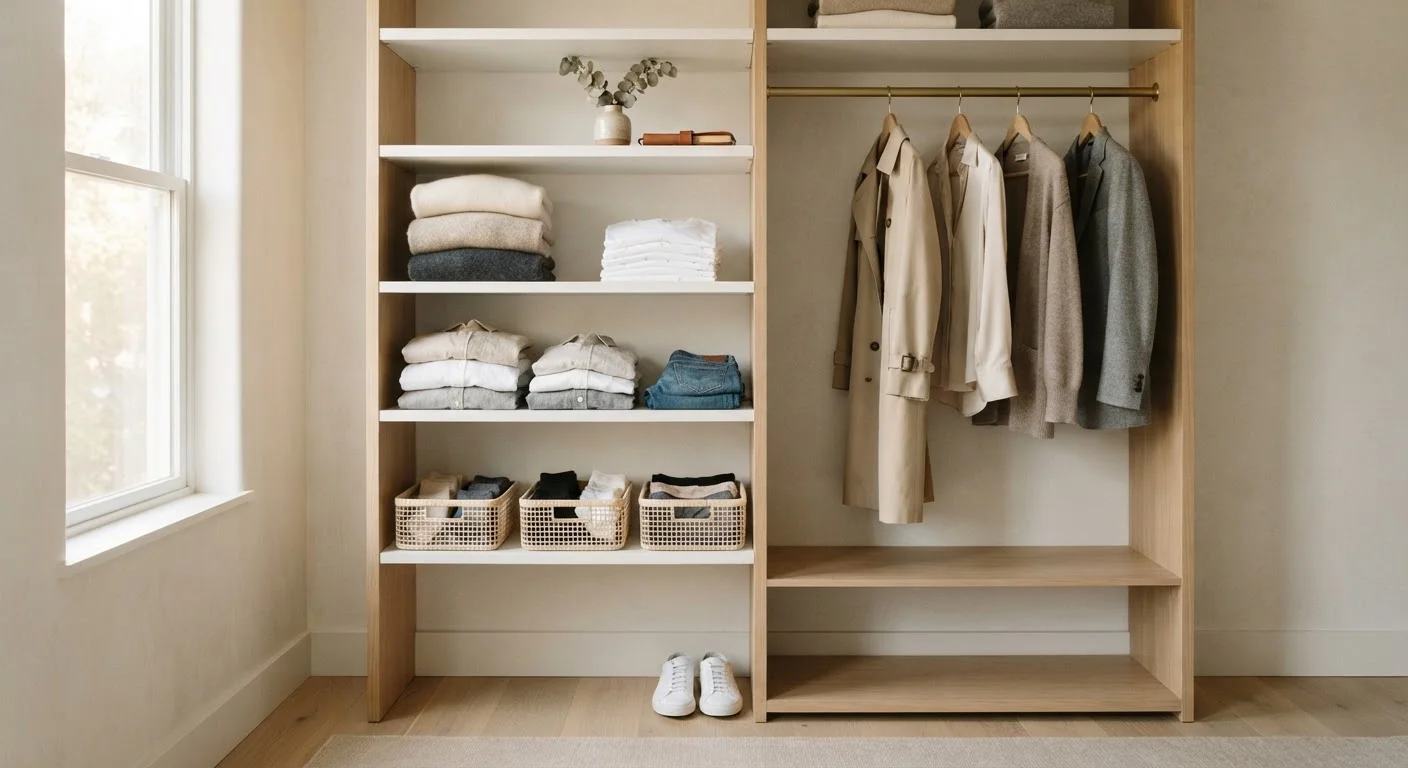
Rather than prescribing a list of specific items, think in terms of categories that earn their keep through versatility. For most everyday American lives, a functional from-scratch wardrobe covers these zones:
- Bottoms that anchor outfits
- One or two pairs of well-fitting trousers or jeans in neutral colors serve as the foundation for dozens of combinations. Fit matters more than style here — something that fits properly always looks intentional.
- Layering tops
- A few solid-color tops in tones that work with your anchor bottoms give you outfit variety without visual chaos. Neutral doesn't have to mean boring — it means flexible.
- An outer layer for your climate
- One coat, jacket, or cardigan suited to your actual weather covers a huge number of occasions and can pull casual pieces into a more polished look instantly.
- Comfortable, appropriate footwear
- Two to three pairs — one more casual, one more polished, one suited to your specific lifestyle needs — handle most scenarios without overloading your space or budget.
- Something occasion-appropriate
- Even one versatile piece that works for slightly more dressed-up moments (a dinner, a professional meeting, a family event) prevents last-minute stress purchases.
Once your core is in place, the outfit repeater's guide shows exactly how to remix a small set of pieces so every wear feels considered.
Building on a Budget Without Sacrificing Quality
Rebuilding a wardrobe all at once is expensive, and it's rarely necessary. A phased approach — buying for your highest-priority use cases first, then filling gaps over the following months — keeps costs manageable and gives you time to learn what you actually need versus what you thought you needed.
A few general principles hold up well across price points:
- Cost per wear matters more than sticker price. A $70 pair of trousers worn 150 times costs less per wear than a $20 pair worn 10 times before falling apart.
- Secondhand is a legitimate strategy, not a compromise. Thrift stores, consignment shops, and clothing swaps can significantly expand what's available at a given budget.
- Buy for where you are now. If your body has changed, or may change, avoid buying aspirationally. Clothes that fit your current self serve you; clothes that don't fit sit unused regardless of how much you paid.
For the financial side of rebuilding thoughtfully, the budgeting basics hub offers practical frameworks for earmarking money toward specific goals without derailing other priorities.
Avoid the All-at-Once Trap
Trying to rebuild a complete wardrobe in a single shopping trip — especially under pressure after a move or major change — often leads to overspending and regret. Without daily use as your guide, it's easy to misjudge what you actually need. Give yourself permission to be intentionally incomplete at the start.
How to Keep the Momentum Going
A from-scratch wardrobe is never truly finished — that's actually the good news. Once your core is in place, the ongoing work is light: a quick review every season to notice what you're reaching for, what's being ignored, and what genuine gaps have appeared through daily use.
The wardrobe audit checklist is designed for exactly this — a structured way to assess what's earning its place and what can go. And when seasons change, transitioning your wardrobe between seasons without buying everything new keeps the momentum sustainable.
Building a wardrobe from scratch is ultimately an act of self-knowledge. The more honestly you dress for the life you have, the less time and money you spend managing clothes that don't serve you.
This article is for general informational and educational purposes only. Financial suggestions are general guidance, not personalized financial advice. Consult a licensed financial professional for guidance specific to your situation.