Why Pattern Mixing Has Rules (Even If They're Loose)
Here's the thing about patterns that look effortlessly combined: there's almost always a reason they work, even if the person wearing them couldn't fully explain it. Pattern mixing isn't random — it operates on a handful of visual principles that designers and stylists use intuitively and that anyone can learn deliberately.
The fear most people feel around mixing prints usually comes from treating patterns as unpredictable. But prints have clear properties: scale (how large or small the repeat is), color (what tones appear in the pattern), and structure (geometric, organic, linear). Once you see those properties, you can work with them intentionally instead of hoping for the best.
Understanding why outfits fall apart is the first step — pattern mixing is a natural extension of that same logic.
Use a Mirror Test Before You Leave
When you're unsure about a pattern combination, step back and view the full outfit in a mirror from a few feet away. If the look reads as a coherent whole at a glance, the mix is working. If one element jumps out aggressively and pulls your eye away from the rest, that's your cue to swap or simplify.
The Scale Rule: Your Most Useful Tool
Scale variation is the single most reliable technique for mixing patterns that read as intentional. The idea is simple: pair a large, bold print with a smaller, more intricate one. The size difference gives each pattern its own visual territory and prevents them from fighting for dominance.
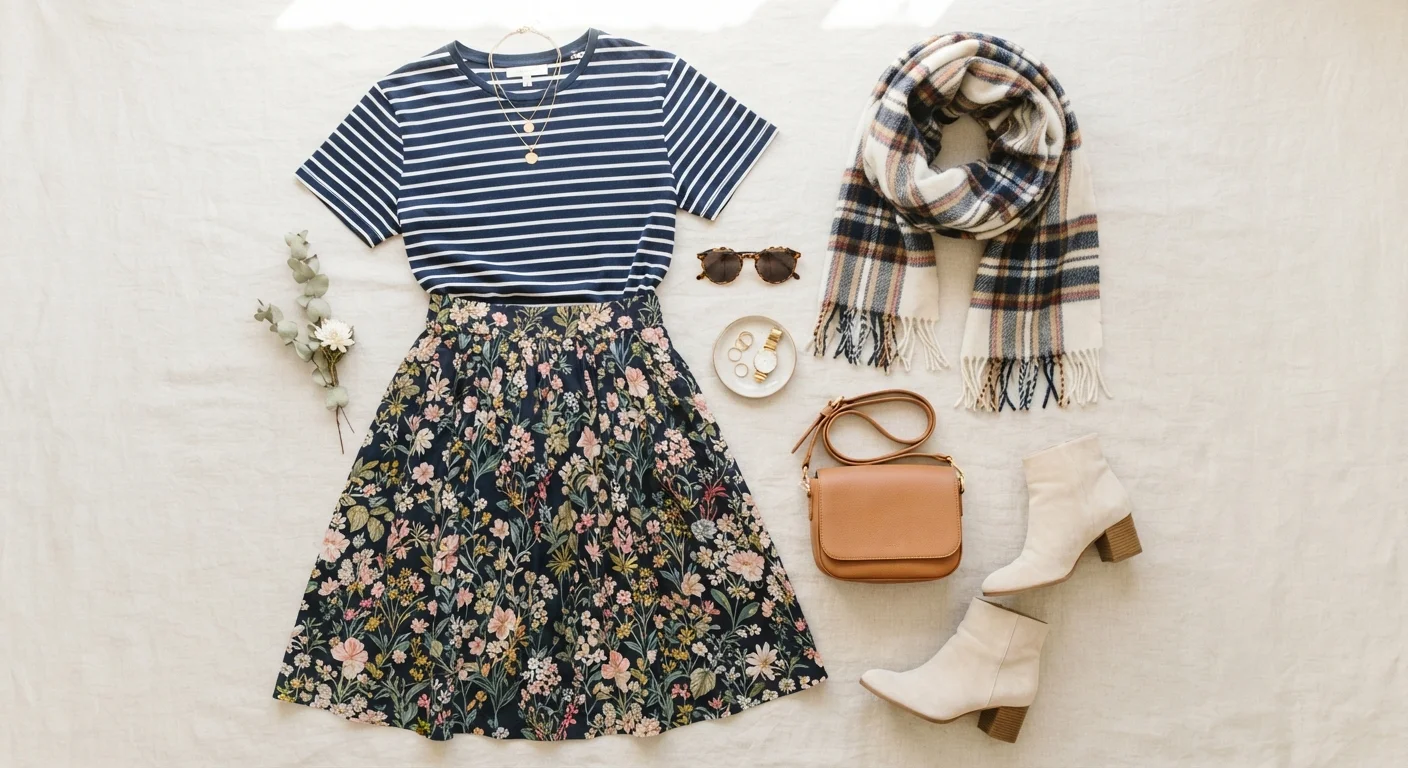
Think of a wide-stripe shirt alongside a small floral skirt, or a large plaid blazer over a fine, dense houndstooth blouse. The contrast in scale tells the eye where to focus. When two patterns are too similar in size, they can create a visual vibration — that slightly dizzying, unsettled feeling that makes an outfit look unintentional.
A helpful rule of thumb: if two patterns could pass for different colorways of the same print, they're too close in scale. You want clear contrast — not sameness, not chaos.
2–3
Ideal number of patterns per outfit
Style educators and professional stylists widely suggest two to three patterns as the effective range before visual complexity outpaces cohesion.
1 rule
Minimum shared element needed
Stylists consistently note that at least one shared element — color, scale relationship, or structural contrast — is what separates intentional mixing from accidental clashing.
Color as the Unifying Thread
After scale, color is your most powerful cohesion tool. When two patterns share at least one color — even a minor accent — they read as a set. This shared thread is what separates a deliberate combination from an accidental collision.
You don't need the colors to match exactly. A deep burgundy in a floral can pick up the rust tones in a plaid without being identical. The connection just needs to exist. Color coordination doesn't have to be complicated — the same accessible thinking applies directly to mixing prints.
If you're working with patterns that don't share obvious colors, a solid neutral acts as a bridge. A white shirt between a floral skirt and a plaid jacket, or a tan belt breaking up a head-to-toe print situation, gives the eye a moment to reset and makes the overall combination feel composed rather than crowded.
Texture and Structure: The Underrated Dimension
Beyond color and scale, patterns also carry a structural personality. Geometric prints (stripes, checks, grids) feel organized and graphic. Organic prints (florals, watercolor blots, abstract shapes) feel free-form and fluid. Mixing one of each creates natural tension that reads as sophisticated rather than confused.
This is why a classic navy stripe and a loose floral feels so reliably good: one pattern is disciplined, the other is relaxed. They don't compete — they balance. The same logic applies to combining a tight houndstooth with a loose, painterly print, or a rigid plaid with a soft paisley.
Texture in the fabric itself also plays a role. A matte cotton floral and a slightly lustrous jacquard stripe have enough textural difference that the eye accepts their coexistence more easily. You're giving the outfit multiple dimensions instead of a single flat surface.
Building Confidence Without Starting from Scratch
You don't need to buy new pieces to start practicing pattern mixing. Look at what you already own. If you have a striped top, pair it with something printed in complementary tones. If you have a plaid scarf, try it with a small floral or abstract print. The wardrobe you have is already full of potential combinations — most just haven't been tried.
Outfit repeating is a legitimate strategy, and pattern mixing is one of the tools that makes repeated pieces feel new. A floral skirt you've worn ten times reads completely differently under a wide-stripe blazer than it does under a solid cardigan.
Start with two patterns, get comfortable, and only add a third when the first combination feels easy. Pattern mixing is a skill that compounds — the more combinations you try, the faster your eye learns what works.
Pattern Mixing Is Forgiving With Practice
Not every combination will land on the first try, and that's completely normal. Even experienced stylists experiment and edit. The more combinations you attempt — even privately at home — the faster your eye calibrates to what creates balance and what creates noise. Treat it as exploration, not a test.